Results by title
3 books match the query '1815 - 1860'

Blacks on the Border
The Black Refugees in British North America, 1815–1860Harvey Whitfield
University Press of New England, 2006
Following the American Revolution, free black communities and enslaved African Americans increasingly struggled to reconcile their African heritage with their American home. This struggle resulted in tens of thousands of African Americans seeking new homes in areas as diverse as Haiti and Nova Scotia. Black refugees arrived in Nova Scotia after the War of 1812 with little in common but their desire for freedom. By 1860, they had formed families, communities, and traditions. Harvey Amani Whitfield’s study reconstructs the lives and history of a sizeable but neglected group of African Americans by placing their history within the framework of free black communities in New England and Nova Scotia during the nineteenth century. It examines which aspects of American and African American culture black expatriates used or discarded in an area that forced them to negotiate the overlapping worlds of Great Britain, the United States, Afro–New England, and the African American Diaspora, while considering how former American slaves understood freedom long before the Civil War.
[more]

Friends of the Unrighteous Mammon
Northern Christians and Market Capitalism, 1815-1860Stewart Davenport
University of Chicago Press, 2008
What did Protestants in America think about capitalism when capitalism was first something to be thought about? The Bible told antebellum Christians that they could not serve both God and mammon, but in the midst of the market revolution most of them simultaneously held on to their faith while working furiously to make a place for themselves in a changing economic landscape. In Friends of the Unrighteous Mammom, Stewart Davenport explores this paradoxical partnership of transcendent religious values and earthly, pragmatic objectives, ultimately concluding that religious and ethical commitments, rather than political or social forces, shaped responses to market capitalism in the northern states in the antebellum period.
Drawing on diverse primary sources, Davenport identifies three distinct Christian responses to market capitalism: assurance from clerical economists who believed in the righteousness of economic development; opposition from contrarians who resisted the changes around them; and adaptation by the pastoral moralists who modified their faith to meet the ethical challenges of the changing economy. Delving into the minds of antebellum Christians as they considered themselves, their God, and their developing American economy, Friends of the Unrighteous Mammon is an ambitious intellectual history of an important development in American religious and economic life.
Drawing on diverse primary sources, Davenport identifies three distinct Christian responses to market capitalism: assurance from clerical economists who believed in the righteousness of economic development; opposition from contrarians who resisted the changes around them; and adaptation by the pastoral moralists who modified their faith to meet the ethical challenges of the changing economy. Delving into the minds of antebellum Christians as they considered themselves, their God, and their developing American economy, Friends of the Unrighteous Mammon is an ambitious intellectual history of an important development in American religious and economic life.
[more]
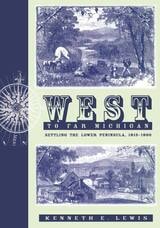
West to Far Michigan
Settling the Lower Peninsula, 1815-1860Kenneth E. Lewis
Michigan State University Press, 2001
West to Far Michigan is a study of the lower peninsula's occupation by agriculturalists, whose presence forever transformed the land and helped to create the modern state of Michigan. This is not simply a history of Michigan, but rather a work that focuses on why the state developed as it did. Although Michigan is seen today as an industrial state whose history is couched in terms of the fur trade and the international rivalry for the Great Lakes, agricultural settlement shaped its expansion. Using a model of agricultural colonization derived from comparative studies, Lewis examines the settlement process in Michigan between 1815 and 1860. This period marked the opening of Michigan to immigrants, saw the rise of commercial agriculture, and witnessed Michigan's integration into the larger national economy.
Employing numerous primary sources, West to Far Michigan traces changes and patterns of settlement crucial to documenting the large-scale development of southern Michigan as a region. Diaries, letters, memoirs, gazetteers, and legal documents serve to transform the more abstract elements of economic and social change into more human terms. Through the experiences of the early Agriculturists process, we can gain insight into how their triumphs played out in communities within the region to produce small-scale elements that comprise the fabric of the larger cultural landscape.
Employing numerous primary sources, West to Far Michigan traces changes and patterns of settlement crucial to documenting the large-scale development of southern Michigan as a region. Diaries, letters, memoirs, gazetteers, and legal documents serve to transform the more abstract elements of economic and social change into more human terms. Through the experiences of the early Agriculturists process, we can gain insight into how their triumphs played out in communities within the region to produce small-scale elements that comprise the fabric of the larger cultural landscape.
[more]