Results by title
2 books match the query '1838-1916'
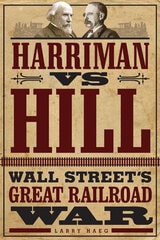
Harriman vs. Hill
Wall Street’s Great Railroad WarLarry Haeg
University of Minnesota Press, 2013
In 1901, the Northern Pacific was an unlikely prize: a twice-bankrupt construction of the federal government, it was a two-bit railroad (literally—five years back, its stock traded for twenty-five cents a share). But it was also a key to connecting eastern markets through Chicago to the rising West. Two titans of American railroads set their sights on it: James J. Hill, head of the Great Northern and largest individual shareholder of the Northern Pacific, and Edward Harriman, head of the Union Pacific and the Southern Pacific. The subsequent contest was unprecedented in the history of American enterprise, pitting not only Hill against Harriman but also Big Oil against Big Steel and J. P. Morgan against the Rockefellers, with a supporting cast of enough wealthy investors to fill the ballroom of the Waldorf Astoria.
The story, told here in full for the first time, transports us to the New York Stock Exchange during the unfolding of the earliest modern-day stock market panic. Harriman vs. Hill re-creates the drama of four tumultuous days in May 1901, when the common stock of the Northern Pacific rocketed from one hundred ten dollars a share to one thousand in a mere seventeen hours of trading—the result of an inadvertent “corner” caused by the opposing forces. Panic followed and then, in short order, a calamity for the “shorts,” a compromise, the near-collapse of Wall Street brokerages and banks, the most precipitous decline ever in American stock values, and the fastest recovery. Larry Haeg brings to life the ensuing stalemate and truce, which led to the forming of a holding company, briefly the biggest railroad combine in American history, and the U.S. Supreme Court ruling against the deal, launching the reputation of Justice Oliver Wendell Holmes as the “great dissenter” and President Theodore Roosevelt as the “trust buster.”
The forces of competition and combination, unfettered growth, government regulation, and corporate ambition—all the elements of American business at its best and worst—come into play in the account of this epic battle, whose effects echo through our economy to this day.
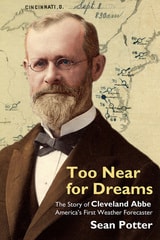
Too Near for Dreams
The Story of Cleveland Abbe, America's First Weather ForecasterSean Potter
American Meteorological Society, 2020
As director of the Cincinnati Observatory and, later, a civilian in the newly established forecast and storm warning division of the U.S. Army Signal Service, Cleveland Abbe was the first person to issue official, regularly scheduled weather forecasts, or “probabilities,” in the United States. Abbe began his work in forecasting in 1869, earning the nickname “Old Probabilities” and gaining recognition for the reliability of his reports. He would go on to become a leader of the US Weather Bureau—which we know today as the National Weather Service. In establishing a system for creating daily weather forecasts and more, this humble pioneer helped lay the foundation for modern meteorology in the United States.
Set against the backdrop of nineteenth and early twentieth-century international events and scientific advancements, this biography of Abbe explores both his personal life and his scientific career. It illuminates his time spent in Russia in the mid-1860s—as the Civil War was waged and a president was assassinated back home—in part through letters with his mother. Decades of diaries and correspondence from the Cleveland Abbe Papers at the Library of Congress, as well as first-person accounts, illuminate this biography of a mild-mannered family man whose thirst for knowledge drove him to become a giant in an emerging scientific field.