Results by title
33 books match the query 'Battle'

Battle Of Kosovo
John Matthias
Ohio University Press, 1987
The Battle of Kosovo cycle of heroic ballads is generally considered the finest work of Serbian folk poetry. Commemorating the Serbian Empire’s defeat at the hands of the Turks in the late fourteenth century, these poems and fragments have been known for centuries in Eastern Europe. With the appearance of the collections of Serbian folk poems by Vuk Stefanovic Karasdzic, the brilliance of the poetry in the Kosovo and related cycles of ballads was affirmed by poets and critics as deeply influential as Goethe, Jacob Brimm, Adam Mickiewicz, and Alexander Pushkin. Although translations into English have been attempted before, few of them, as Charles Simic notes in his preface, have been persuasive until now. Simic compares the movement of the verse in these translations to the “variable foot” effect of William Carlos Williams’s later poetry, and argues that John Matthias “grasps the poetic strategies of the anonymous Serbian poet as well as Pound did those of Chinese poetry.”
First published in 1987, the translation of the Battle of Kosovo is now reprinted both because of its intrinsic merits and because the recent crisis in Kosovo itself compels the entire world to understand the nature of the ancient conflicts and passions that fuel it. Although Matthias and Simic have elected to retain their original preface and introduction, Christopher Merrill, a scholar of the region and author of Only the Nails Remain, has contributed a brief afterword explaining the importance of this poetry in the context of NATO’s first military action ever against a sovereign nation.

Battle in the Mind Fields
John A. Goldsmith and Bernard Laks
University of Chicago Press, 2019
Taking note of this phenomenon, John Goldsmith and Bernard Laks embark on a uniquely interdisciplinary history of the genesis of linguistics, from nineteenth-century currents of thought in the mind sciences through to the origins of structuralism and the ruptures, both political and intellectual, in the years leading up to World War II. Seeking to explain where contemporary ideas in linguistics come from and how they have been justified, Battle in the Mind Fields investigates the porous interplay of concepts between psychology, philosophy, mathematical logic, and linguistics. Goldsmith and Laks trace theories of thought, self-consciousness, and language from the machine age obsession with mind and matter to the development of analytic philosophy, behaviorism, Gestalt psychology, positivism, and structural linguistics, emphasizing throughout the synthesis and continuity that has brought about progress in our understanding of the human mind. Arguing that it is impossible to understand the history of any of these fields in isolation, Goldsmith and Laks suggest that the ruptures between them arose chiefly from social and institutional circumstances rather than a fundamental disparity of ideas.
Battle of Beecher Island and the Indian War of 1867-1869
Second EditionJohn Monnett
University Press of Colorado, 2021
Monnett’s compelling study, a finalist for the Western Writers of America’s Spur Award in 1993, was the first to examine the Beecher Island battle and its relationship to the overall conflict between American Indians and Euroamericans on the central plains of Colorado and Kansas during the late 1860s. Focusing on the struggle of the Cheyenne Dog Men warrior society to defend the lands between the Republican River valley and the Smoky Hill River valley from Euroamerican encroachment, Monnett presents original reminiscences of American Indian and Euroamerican participants.
Since its original release several developments and an important original source document have come to light and offer new information. The second edition presents and examines these new discoveries and developments that moderate the original interpretive causes and more modern effects of this historical episode. Scholars and general readers alike interested in this important episode in the post–Civil War conflicts on the Great Plains and western history will find this new edition of The Battle of Beecher Island and the Indian War of 1867–1869 illuminating, surprising, and perhaps even controversial.
Battle of Valle Giulia
Oral History and the Art of DialogueAlessandro Portelli
University of Wisconsin Press, 1997
In The Battle of Valle Giulia—the title comes from an Italian student protest of the 1960s—Portelli reflects on how to connect personal memories with history, how to fittingly collect and represent the complexity of memory. Crossing cultures, classes, and generations, he records the private and singular experiences of Italian steelworkers and Kentucky coal miners, veterans and refugees of World War II, soldiers who fought in Vietnam, Italian resistance fighters and Nazis, and members of student movements from Berkeley to Rome. By listening to those whom others presume are "without historical memory"—such as youthful protesters, or the rural Tuscan women who saw every father, son, and brother killed by Nazi soldiers—Portelli clarifies the process by which narratives come into being as oral history, and he illustrates the differences and distances between story-telling and history-telling.
Portelli's articulate discussion of dialogue, representation, narrative and genre link historical analysis with literary and linguistic theory and with the concerns of contemporary anthropology.

Battle of the Big Bang
The New Tales of Our Cosmic OriginsNiayesh Afshordi and Phil Halper
University of Chicago Press, 2025
“Excellent.”—Steven Poole, The Wall Street Journal • “Terrific.”—Liz Else, New Scientist (Best Popular Science Books of 2025 So Far) • “A brilliant overview of the state of modern cosmology.”—Alex O'Connor, alexoconnor.com • “This will expand readers’ minds.”—Publishers Weekly • One of Smithsonian's Ten Best Science Books of 2025
“An intellectual feast.”—Carlo Rovelli • “A must-read.”—Sabine Hossenfelder • “Wonderfully broad and open-minded.”—Roger Penrose • “Remarkable.”—Brian Keating
A thrilling exploration of competing cosmological origin stories, comparing new scientific ideas that upend our very notions of space, time, and reality.
By most popular accounts, the universe started with a bang some 13.8 billion years ago. But what happened before the Big Bang? And how do we know it happened at all? Here prominent cosmologist Niayesh Afshordi and science communicator Phil Halper offer a tour of the peculiar possibilities: bouncing and cyclic universes, time loops, creations from nothing, multiverses, black hole births, string theories, and holograms. Along the way, they offer both a call for new physics and a riveting story of scientific debate.
Incorporating insights from Afshordi’s cutting-edge research and Halper’s original interviews with scientists like Stephen Hawking, Roger Penrose, and Alan Guth, Battle of the Big Bang compares these models for the origin of our origins, showing each theory’s strengths and weaknesses and explaining new attempts to test these notions. Battle of the Big Bang is a tale of rivalries and intrigue, of clashes of ideas that have raged from Greek antiquity to the present day over whether the universe is eternal or had a beginning, whether it is unique or one of many. But most of all, Afshordi and Halper show that this search is filled with wonder, discovery, and community—all essential for remembering a forgotten cosmic past.
Battle on the Bay
The Civil War Struggle for GalvestonBy Edward T. Cotham, Jr.
University of Texas Press, 1998
The Civil War history of Galveston is one of the last untold stories from America's bloodiest war, despite the fact that Galveston was a focal point of hostilities throughout the conflict. As other Southern ports fell to the Union, Galveston emerged as one of the Confederacy's only lifelines to the outside world. When the war ended in 1865, Galveston was the only major port still in Confederate hands.
In this beautifully written narrative history, Ed Cotham draws upon years of archival and on-site research, as well as rare historical photographs, drawings, and maps, to chronicle the Civil War years in Galveston. His story encompasses all the military engagements that took place in the city and on Galveston Bay, including the dramatic Battle of Galveston, in which Confederate forces retook the city on New Year's Day, 1863.
Cotham sets the events in Galveston within the overall conduct of the war, revealing how the city's loss was a great strategic impediment to the North. Through his pages pass major figures of the era, as well as ordinary soldiers, sailors, and citizens of Galveston, whose courage in the face of privation and danger adds an inspiring dimension to the story.
Battle
The Nature and Consequences of Civil War CombatEdited by Kent Gramm
University of Alabama Press, 2008
A critical, multidisciplinary examination of Civil War combat that interrogates the technological, medical, psychological, and cultural forces shaping battlefield experience and its enduring national legacy.
“In our youth, our hearts were touched with fire,” wrote Oliver Wendell Holmes of his generation’s Civil War days. Through the ages, war stories have gleamed with romantic glory, and American memories of the cataclysmic Civil War inspire pageantry and poetry even today.
The essays in Battle form a corrective to such celebratory histories by examining the lethal realities of Civil War combat—Enlightenment science applied to the creation of weapons that maimed and killed, which far outpaced advances in diet, sanitation, and medical treatment. The book reveals that behind the drums and trumpets, sashes and swords, the armies of the Union and Confederacy alike were haunted by fear, pain, and death.
The collection includes an introduction and afterword by editor Kent Gramm, who also contributes an essay titled “Numbers” that reveals the war in statistics. Paul Fussell contributes a powerful essay titled “The Culture of War.” D. Scott Hartwig examines the face of battle at Gettysburg. Bruce A. Evans discusses medical technology in “Wounds, Death, and Medical Care in the Civil War.” Eric T. Dean challenges the meanings and consequences of combat in “The Awful Shock and Rage of Battle.” The collection is rounded out by Alan T. Nolan’s masterful review of the national consequences of battle and the resultant myth of the Confederacy’s Lost Cause.
Decision at Brandywine
The Battle on Birmingham HillRobert Dunkerly
Westholme Publishing, 2025
The Battle of Brandywine, fought on September 11, 1777, along its namesake creek in the bucolic Pennsylvania countryside, was one of the largest engagements of the Revolutionary War. To those who participated in this massive battle, spread out over ten square miles and lasting from late afternoon until dark, it was unforgettable. Soon after the action, Major Joseph Bloomfield of the 3rd New Jersey recorded that it was “the grandest scene I ever saw, a sight beyond description.” Brandywine was the first major battle for the recently reorganized Continental Army. Units had fought in small engagements, but not until Brandywine did the army fight as a whole against the British. As the two armies clashed, a ferocious and desperate action developed on a hill at the heart of the battlefield, and it was here where the battle’s outcome was determined.
Despite its size and significance—Brandywine was the third bloodiest engagement of the war, with 1,300 American and 581 British casualties—the battle has been the subject of very few studies. In Decision at Brandywine: The Battle on Birmingham Hill, historian Robert M. Dunkerly analyzes the fighting near the Birmingham Meeting House where the battle turned. By dissecting the struggle on Birmingham Hill in detail, he offers a case study in weapons, tactics, and terrain analysis critical to a holistic understanding of the entire battle and what it would mean for the future of the Continental Army. In the process he not only explains how the Continental Army’s lack of uniformed training and inexperience in large open-field battles played a major role in their defeat, but also provides important information about Revolutionary War combat in general.
Facing Washington's Crossing
The Hessians and the Battle of TrentonSteven Bier
Westholme Publishing, 2025
They crossed the ocean to fight in someone else's war. They came for glory, honor, and plunder. Instead, they became America's most famous captives.
In Steven Bier's groundbreaking book, Facing Washington's Crossing: The Hessians at the Battle of Trenton, old stereotypes are shattered and new information emerges. Using newly translated documents, rare hard-to-find material, and obscure nearly-forgotten sources, Facing Washington's Crossing rewrites our understanding of the Battle of Trenton.
Bier maintains a gripping narrative, following the military exploits of a Hessian Brigade through six brutal battles. From their crushing victories in New York to the shocking reversal in the snow-covered village of Trenton, witness how professional European soldiers faced an enemy unlike any they had encountered.Bier offers a fresh perspective by narrating the story through Hessian eyes, presenting fascinating details: shipboard cockfights, St. Elmo's fires, how the militaristic Hessians were influenced by the peaceful philosopher Voltaire, when the Royal Navy accidentally landed the Hessians on a deserted island, and how Emanuel Leutze's iconic painting of Washington crossing the Delaware was created in a tavern.The author traces the Hessian Prince's decision to hire out his army, the army’s harrowing voyage across the Atlantic, and the numerous clashes leading up to Trenton. Washington’s Crossing and the subsequent battle itself are fully recounted, providing a much-needed understanding of the Hessian experience.For 250 years, the story has been told mostly from one side. Now the essential counterpoint is finally revealed.
Impact Zone
The Battle of the DMZ in Vietnam, 1967–1968Jim Brown
University of Alabama Press, 2004
In the heart of the DMZ, one Marine faced the war—and the truth behind it.
Impact Zone documents Marine First Lieutenant James S. Brown's intense battle experiences, including those at Khe Sanh and Con Thien, throughout his thirteen months of service on the DMZ during 1967-68. This high-action account also reflects Brown's growing belief that the Vietnam War was mis-fought due to the unproductive political leadership of President Johnson and his administration. Brown's naiveté developed into hardening skepticism and cynicism as he faced the harsh realities of war, though he still managed to retain a sense of honor, pride, and patriotism for his country.
Impact Zone is a distinctive book on the Vietnam War because it is told from the perspective of an artilleryman, and the increasingly dangerous events gain momentum as they progress from one adventure to the next. Impact Zone is not only an important historical document of the Vietnam conflict, but also a moving record of the personal and emotional costs of war.
Loss and Redemption at St. Vith
The 7th Armored Division in the Battle of the BulgeGregory Fontenot, Colonel, US Army, Retired
University of Missouri Press, 2020
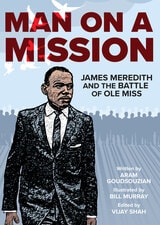
Man on a Mission
James Meredith and the Battle of Ole MissAram Goudsouzian
University of Arkansas Press, 2022
In 1962, James Meredith famously desegregated the University of Mississippi (a.k.a. Ole Miss). As the first Black American admitted to the school, he demonstrated great courage amidst the subsequent political clashes and tragic violence. After President Kennedy summoned federal troops to help maintain order, the South—and America at large—would never be the same.
Man on a Mission depicts Meredith’s relentless pursuit of justice, beginning with his childhood in rural Mississippi and culminating with the confrontation at Ole Miss. A blend of historical research and creative inspiration, this graphic history tells Meredith’s dramatic story in his own singular voice.
From the dawn of the modern civil rights movement, Meredith has offered a unique perspective on democracy, racial equality, and the meaning of America. Man on a Mission presents his captivating saga for a new generation in the era of Black Lives Matter.
Mashairi ya Vita vya Kuduhu
War Poetry in Kiswahili Exchanged at the Time of the Battle of KuduhuAnn Biersteker
Michigan State University Press, 1995
Mashairi Ya Vita Vya Kuduhu is a presentation and discussion of both manuscript and published versions of poems written by Lamu poets around the time of the Battle of Kuduhu. The poetic dialogue studied in this volume has played a significant role in the history of Swahili poetry, and its primary concern is to inform continued work in this area. The poems contained in this work were transmitted and preserved by speakers of Kiswahili and later collected and preserved by scholars. Chapter One contains the edited poems; Chapter Two consists of the translations. Subsequent chapters include accounts of the Battle of Kuduhu, editing and translating practices, and annotated poems and source versions. This work is presented as an example of the importance of research, fieldwork, and the consideration of available versions and alternative styles of presentation in the study of Swahili poetry.
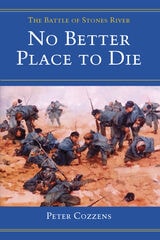
No Better Place to Die
THE BATTLE OF STONES RIVERPeter Cozzens
University of Illinois Press, 1990
It was here that both the Union and Confederate armies lost over one-quarter of their forces in battle casualties. The Confederacy's defeat at Stones River unleashed a wave of dissension that crippled the army's high command and ultimately closed Tennessee to the South for two years. The loss deterred the British and French from coming to the aid of the South in the Civil War, with tragic effects for the Southern cause.
In the 126 years since the guns fell silent at Stones River, few books have examined the bloody clash and its impact on the war's subsequent outcome. No Better Place to Die recounts the events and strategies that brought the two armies to the banks of this central Tennessee river on December 31, 1862. Cozzens re-creates the battle itself, following the movements and performance of individual regiments. A series of maps clarifies the combat activity.
Cozzens frequently lets the men who fought the battle speak for themselves, through letters, diaries, memoirs, and battlefield communications. Here we learn about such critical moments as General Philip Sheridan's gallant defense along the Wilkinson Pike, one of the war's most tenacious stands against overwhelming odds, and the bravery in battle exemplified by Brekenridge's attack on the Union left, a doomed assault with the poignancy of Pickett's charge.
Over twenty thousand Union and Confederate soldiers were killed, wounded, or captured in the bloody New Year's battle of Stone's River. The impact of their struggle extended far beyond the thousands of shattered human lives, ultimately imperiling the fortunes of the Confederacy. No Better Place to Die pays tribute to the heroes, the scoundrels, the mistakes, the bravery, and the grief at Stone's River.
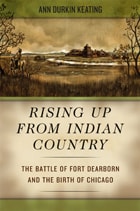
Rising Up from Indian Country
The Battle of Fort Dearborn and the Birth of ChicagoAnn Durkin Keating
University of Chicago Press, 2012
In August 1812, under threat from the Potawatomi, Captain Nathan Heald began the evacuation of ninety-four people from the isolated outpost of Fort Dearborn to Fort Wayne. The group included several dozen soldiers, as well as nine women and eighteen children. After traveling only a mile and a half, they were attacked by five hundred Potawatomi warriors. In under an hour, fifty-two members of Heald’s party were killed, and the rest were taken prisoner; the Potawatomi then burned Fort Dearborn before returning to their villages.
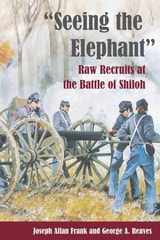
Seeing the Elephant
RAW RECRUITS AT THE BATTLE OF SHILOHJoseph Allan Frank and George A. Reaves
University of Illinois Press, 1989
Drawing on the letters, diaries, and other reminiscences of these raw recruits on both sides of the conflict, “Seeing the Elephant” gives a vivid and valuable primary account of the terrible struggle.
From the wide range of voices included in this volume emerges a nuanced picture of the psychology and motivations of the novice soldiers and the ways in which their attitudes toward the war were affected by their experiences at Shiloh.
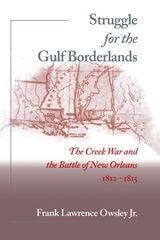
Struggle for the Gulf Borderlands
The Creek War and the Battle of New Orleans, 1812-1815Frank L. Owsley
University of Alabama Press, 2000
Using American, British, and Spanish documents, many previously unknown, Frank Owsley’s study establishes the Creek War and the struggle to control the Gulf borderlands as integral parts of the War of 1812. The war between the United States and a large part of the Creek nation is usually studied as local or regional history. These documentary sources, however, show the larger picture. They show Spain to have been a major influence in the Creek War and indicate the extent to which the British were aiding the Indians and using them to redirect American troops. On the other hand, Andrew Jackson, in charge of the American forces on the Gulf Coast, emerged from the conflict as a first-rate military commander. His victories on the Gulf gave the West a leader and aided in shifting political power from the eastern seaboard to the South and West.
Owsley concludes that the victories in the Gulf region were of sufficient magnitude to justify the claim that the War of 1812 was not a draw but a decisive American victory and that had there been a general of Jackson's caliber on the northern frontier, the United States might have had a clear-cut victory there.
As a result of the war, the United States held its claim on Louisiana, annexed the Mobile district, forced Spain out of Florida, and broke the power of the southern Indians, thus opening vast lands for settlement from the new nation on the eastern seaboard.
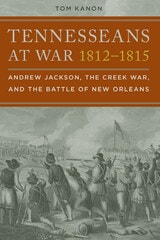
Tennesseans at War, 1812–1815
Andrew Jackson, the Creek War, and the Battle of New OrleansTom Kanon
University of Alabama Press, 2014
Although frequently discussed as separate military conflicts, the War of 1812 against Great Britain and the Creek War against Native Americans in the territory that would become Alabama were part of the same forceful projection of growing American power. Success in both wars won for America security against attack from abroad and vast tracks of new land in “the Old Southwest.” In Tennesseans at War, 1812–1815, Tom Kanon explains the role Tennesseans played in these changes and how they remade the south.
Because it was a landlocked frontier state, Tennessee’s economy and security depended heavily upon the river systems that traversed the region; some, like the Tennessee River, flowed south out of the state and into Native American lands. Tennesseans of the period perceived that gaining mastery of these waterways formed an urgent part of their economic survival and stability.
The culmination of fifteen years’ research, Kanon’s work draws on state archives, primary sources, and eyewitness accounts, bringing the information in these materials together for first time. Not only does he narrate the military campaigns at the heart of the young nation’s expansion, but he also deftly recalls the economic and social pressures and opportunities that encouraged large numbers of Tennesseans to leave home and fight. He expertly weaves these themes into a cohesive narrative that culminates in the vivid military victories of the War of 1812, the Creek War, and the legendary Battle of New Orleans—the victory that catapulted Tennessee’s citizen-soldier Andrew Jackson to the presidency.
Expounding on the social roles and conditions of women, slaves, minorities, and Native Americans in Tennessee, Kanon also brings into focus the key idea of the “home front” in the minds of Tennesseans doing battle in Alabama and beyond. Kanon shows how the goal of creating, strengthening, and maintaining an ordered society permeated the choices and actions of the American elites on the frontiers of the young nation.
Much more than a history of Tennesseans or the battles they fought in Alabama, Tennesseans at War, 1812–1815, is the gripping story of a pivotal turning point in the history of the young American republic.
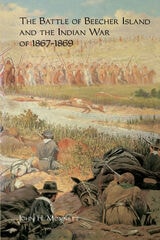
The Battle of Beecher Island and the Indian War of 1867-1869
John H. Monnett
University Press of Colorado, 1994
Monnett's compelling study is the first to examine the Beecher Island Battle and its relationship to the overall conflict between American Indians and Euroamericans on the central plains of Colorado and Kansas during the late 1860s. Focusing on the struggle of the Cheyenne Dog Soldiers warrior society to defend the lands between the Republican River valley and the Smoky Hill River valley from Euroamerican encroachment, Monnett presents original reminiscences of American Indian and Euroamerican participants. Unlike many military studies of the Indian Wars, The Battle of Beecher Island also includes in-depth examinations of the viewpoints of homesteaders and the views of western railroad interests of the late nineteenth century.
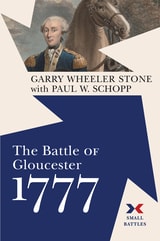
The Battle of Gloucester, 1777
Garry Wheeler Stone
Westholme Publishing, 2022
In The Battle of Gloucester, 1777, archaeological historian Garry Wheeler Stone, with the assistance of historian Paul W. Schopp, recreates this minor but important clash during the Philadelphia campaign. Relying on both primary source documents and the latest archaeological interpretations, the authors have determined the course of this fascinating “battle,” as Benjamin Franklin later proclaimed it to be. As a result of this action, when Washington requested that Lafayette be given a division, Congress agreed. On December 4, 1777, the marquis, promoted to major-general, took command of the brigades of Generals Woodford and Scott to begin what would be a glorious career in American service.
Small Battles: Military History as Local History
Mark Edward Lender and James Kirby Martin, Series Editors
Small Battles offers a fresh and important new perspective on the story of America’s early conflicts. It was the small battles, not the clash of major armies, that truly defined the fighting during the colonial wars, the American Revolution, the War of 1812, and the hostilities on the frontiers. This is dramatic military history as seen through the prism of local history—history with a depth of detail, a feeling for place, people, and the impact of battle and its consequences that the story of major battles often cannot convey. The Small Battles series focuses on America’s military conflicts at their most intimate and revealing level.

The Battle of Harlem Heights, 1776
David Price
Westholme Publishing, 2022
The action began when a contingent of rangers led by Col. Thomas Knowlton of Connecticut encountered British light infantry while conducting a reconnaissance mission on Washington’s orders. What began as a skirmish transformed into a full-fledged battle as both sides reinforced, and a heavy engagement continued for several hours until, with ammunition running low, the British withdrew. Washington decided not to pursue and risk confrontation with a larger force, thereby keeping his army intact. In The Battle of Harlem Heights, 1776, David Price conveys the significance of the Continental Army’s first victory and highlights the role of one of its key participants, the largely forgotten Knowlton—the “father of American military intelligence”—who gave his life during the action while urging his rangers forward. No matter how many times U.S. Army troops have recorded a battlefield success over the past two and a half centuries—whether on American soil, in a European wood, across a Middle Eastern desert, or on a Pacific island—one thing about that history remains indisputable. They did it first at Harlem Heights.
Small Battles: Military History as Local History
Mark Edward Lender and James Kirby Martin, Series Editors
Small Battles offers a fresh and important new perspective on the story of America’s early conflicts. It was the small battles, not the clash of major armies, that truly defined the fighting during the colonial wars, the American Revolution, the War of 1812, and the hostilities on the frontiers. This is dramatic military history as seen through the prism of local history—history with a depth of detail, a feeling for place, people, and the impact of battle and its consequences that the story of major battles often cannot convey. The Small Battles series focuses on America’s military conflicts at their most intimate and revealing level.
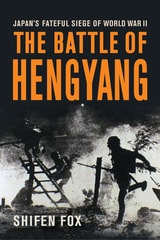
The Battle of Hengyang
Japan's Fateful Siege of World War IIShifen Fox
Westholme Publishing, 2026
The first English language history of China's Most Important Battle in World War II
In April 1944, Imperial Japan launched Operation Ichigo to secure a transport route linking Japanese forces in northern China and Southeast Asia, while eliminating American airfields in the region. The Japanese army quickly overran Chinese resistance and pushed fast toward the city of Hengyang, a key railway junction in south-central China. The Battle of Hengyang began on June 23, 1944. With just 17,000 troops and besieged in an area of less than ten square miles, the Chinese 10th Army held off a Japanese force totaling more than 110,000 men, supported by aircraft, tanks, chemical weapons, and artillery, for forty-seven days. The fighting was among the most savage of the entire Second World War. Hengyang finally fell on August 8, but the Chinese defenders and undaunted American pilots had stopped Ichigo’s momentum. The Japanese military’s failure to quickly conquer such a small city led to the fall of Japanese Prime Minister Tojo’s cabinet in July 1944, ultimately weakening Japan’s resolve to prosecute the war. News accounts compared the battle to the German defeat at Stalingrad in its ferocity and to the Battle of Suiyang, the most famous siege in ancient Chinese history.
In the aftermath of World War II, the battle was erased from Chinese history books since Communist propaganda insisted that only they, not the Nationalists, had successfully resisted the Japanese. But the survivors, both soldiers and civilians, kept the battle alive in their memories, and during the early part of the twenty-first century, the truth of Hengyang was finally presented to the Chinese people. The Battle of Hengyang: Japan’s Fateful Siege of World War II by Shifen Fox is the first English language history of one of the most important battles of the Second World War. The author returned to China where she interviewed survivors and children of survivors, read private letters, and had access to normally closed archives; in addition, she read memoirs written by Japanese survivors and referenced Japanese historical records. Learning late in life that her father perished in the battle, she also explains how the role of her father and this heroic defense was censored by China, but more than eighty years later has now been restored to its place in Chinese and world history.
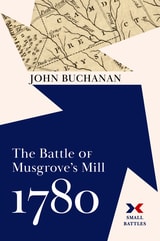
The Battle of Musgrove's Mill, 1780
John Buchanan
Westholme Publishing, 2022
The Battle of Musgrove’s Mill, 1780, by award-winning historian John Buchanan, begins by describing the situation in South Carolina following the British invasion of 1780 before introducing the three colonels: Isaac Shelby, James Williams, and Elijah Clarke. These men led Rebel militia from North Carolina, South Carolina, and Georgia in an effort to disrupt British operations and their Loyalist support. The colonels and other leaders led mounted Rebel militia in a sweeping and bloody guerilla war that played an essential role in opening a path to the eventual British surrender at Yorktown and Britain’s loss of America.
Small Battles: Military History as Local History
Mark Edward Lender and James Kirby Martin, Series Editors
Small Battles offers a fresh and important new perspective on the story of America’s early conflicts. It was the small battles, not the clash of major armies, that truly defined the fighting during the colonial wars, the American Revolution, the War of 1812, and the hostilities on the frontiers. This is dramatic military history as seen through the prism of local history—history with a depth of detail, a feeling for place, people, and the impact of battle and its consequences that the story of major battles often cannot convey. The Small Battles series focuses on America’s military conflicts at their most intimate and revealing level.

The Battle of Upper Sandusky, 1782
Eric Sterner
Westholme Publishing, 2023
In May 1782, Colonel William Crawford led over 450 volunteers across Ohio to attack British-allied Native Americans who had been raiding the frontiers of Pennsylvania and Virginia for years. An experienced yet reluctant commander, Crawford and his men clashed with a similarly sized force of British Rangers and Wyandot, Delaware, and Shawnee Indians on the Sandusky River in early June. After three days, the Americans were routed in one of the worst defeats American arms suffered on the frontier during the American Revolution. During the retreat, Native American warriors captured dozens of men, including Colonel Crawford. Many were horrifically tortured to death in revenge for the Gnadenhutten massacre earlier that spring, when American volunteers bludgeoned nearly one hundred unarmed and unresisting Delaware Indians to death.
The Battle of Upper Sandusky, 1782 places military operations at the forefront of events in the waning months of the American Revolution on the frontier. Importantly, it gives long-deserved credit to Native American leaders, particularly Dunquat of the Wyandot and Hopocan of the Delaware, for their roles and commands on the battlefield. For over two centuries, their victory was attributed to the presence of British Rangers and a few officers, but Dunquat and Hopocan made the critical decisions before and after the battle while Native American warriors constituted the bulk of their army.
The book also reconsiders the effectiveness of American operations. Crawford was an unenthusiastic commander who had to be talked into leading the campaign to help prevent a repeat of the Gnadenhutten massacre. Despite his long service on the frontier and experience in the Continental Army, Crawford failed to unite his ad hoc command, suffered from constant indecision, and could not put his own stamp on the campaign. The unprofessional nature of his army also contributed to its defeat as it lacked organization, experience, leadership, training, and standardization.
The presence of Simon Girty, demonized by Americans on the frontier as a turncoat, and the gruesomeness of Crawford’s execution focused stories about the campaign on those two individuals, rather than the military operations themselves or the Indians who won the victory. Myths were accepted as fact. Afterward, interest in the campaign and the combatants faded. The Battle of Upper Sandusky, 1782 gives Crawford’s campaign its proper place as one of the largest battles between frontier forces and Native Americans during the Revolutionary War.

The Battle of the Sexes in French Cinema, 1930–1956
Noël Burch and Geneviève Sellier
Duke University Press, 2013
Citing more than 300 films and providing many in-depth interpretations, Burch and Sellier argue that films made in France between 1930 and 1956 created a national imaginary that equated masculinity with French identity. They track the changing representations of masculinity, explaining how the strong patriarch who saved fallen or troubled women from themselves in prewar films gave way to the impotent, unworthy, or incapable father figure of the Occupation. After the Liberation, the patriarch reemerged as protector and provider alongside assertive women who figured as threats not only to themselves but to society as a whole.
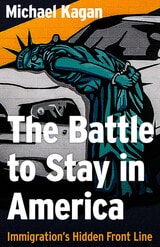
The Battle to Stay in America
Immigration's Hidden Front LineMichael Kagan
University of Nevada Press, 2025
The Battle to Stay in America is the story of a community coming to grips with the federal government’s crackdown on immigrants, and learning how to defend itself. Informative and personal, this is a story about mothers and fathers, lawyers and activists, local police and federal agencies, and a struggle for the identity of a nation. This is the quintessential story of the war on immigrants, as fought and felt on the front lines in the heart of America.

The Defender
The Battle to Protect the Rights of the Accused in PhiladelphiaEdward W. Madeira Jr. and Michael D. Schaffer
Temple University Press, 2020
Long before the Supreme Court ruled that impoverished defendants in criminal cases have a right to free counsel, Philadelphia’s public defenders were working to ensure fair trials for all. In 1934, when penniless defendants were routinely railroaded through the courts without ever seeing a lawyer, Philadelphia attorney Francis Fisher Kane helped create the Voluntary Defender Association, supported by charity and free from political interference, to represent poor people accused of crime.
When the Supreme Court’s 1963 decision Gideonv. Wainwright mandated free counsel for indigent defendants, the Defender (as it is now known) became more essential than ever, representing at least 70 percent of those caught in the machinery of justice in the city. Its groundbreaking work in juvenile advocacy, homicide representation, death-row habeas corpus petitions, parole issues, and alternative sentencing has earned a national reputation.
In The Defender, Edward Madeira, past president of the Defender’s Board of Directors, and former Philadelphia Inquirer journalist Michael Schaffer chart the 80-plus-year history of the organization as it grew from two lawyers in 1934 to a staff of nearly 500 in 2015.
This is a compelling story about securing justice for those who need it most.

The People's Agents and the Battle to Protect the American Public
Special Interests, Government, and Threats to Health, Safety, and the EnvironmentRena Steinzor and Sidney Shapiro
University of Chicago Press, 2010
Reasonable people disagree about the reach of the federal government, but there is near-universal consensus that it should protect us from such dangers as bacteria-infested food, harmful drugs, toxic pollution, crumbling bridges, and unsafe toys. And yet, the agencies that shoulder these responsibilities are in shambles; if they continue to decline, lives will be lost and natural resources will be squandered. In this timely book, Rena Steinzor and Sidney Shapiro take a hard look at the tangled web of problems that have led to this dire state of affairs.
It turns out that the agencies are not primarily to blame and that regulatory failure actually stems from a host of overlooked causes. Steinzor and Shapiro discover that unrelenting funding cuts, a breakdown of the legislative process, an increase in the number of political appointees, a concurrent loss of experienced personnel, chaotic White House oversight, and ceaseless political attacks on the bureaucracy all have contributed to the broken system. But while the news is troubling, the authors also propose a host of reforms, including a new model for measuring the success of the agencies and a revitalization of the civil service. The People’s Agents and the Battle to Protect the American Public is an urgent and compelling appeal to renew America’s best traditions of public service.
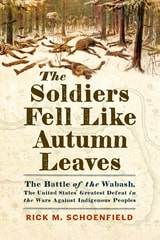
The Soldiers Fell Like Autumn Leaves
The Battle of the Wabash, the United States' Greatest Defeat in the Wars Against Indigenous PeoplesRick M. Schoenfield
Westholme Publishing, 2026
The Soldiers Fell Like Autumn Leaves: The Battle of the Wabash, the United States’ Greatest Defeat in the Wars Against Indigenous Peoples by Rick M. Schoenfield places this important war into its cultural, racial, economic, and political context. For the first time, the ecological impact is explored, for at stake in the clash between Woodland Native Americans and white, agrarian settlement, was the fate of a vast forest eco-system. The issue echoes today in the debate over climate change, deforestation, and indigenous control of forest habitats. Based on primary sources, some of which are consulted here for the first time, including a newly discovered muster roll and the recent archaeological study of the battlefield, the author provides the most accurate description of the battle while capturing the drama of what occurred. He also critically examines the information gathering,planning, and tacticsof both the Maumee Confederation and the United States, from the conception of the campaign through the battlefield decisions. By skillfully weaving together the disparate but related parts of the larger history of this battle,The Soldiers Fell Like Autumn Leaves allows the reader to better understand the motivations and long-term consequences of the war against Native peoples in the Americas.
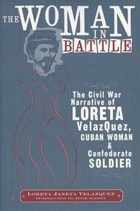
The Woman in Battle
The Civil War Narrative of Loreta Janeta Velazquez, Cuban Woman and Confederate SoldierLoreta Janeta Velazquez
University of Wisconsin Press, 2003
Originally published in 1876 as The Woman in Battle, this Civil War narrative offers Velazquez’s seemingly impossible autobiographical account, as well as a new critical introduction and glossary by Jesse Alemán. Scholars are divided between those who read the book as a generally honest autobiography and those who read it as mostly fiction. According to Alemán’s critical introduction, the book also reads as pulp fiction, spy memoir, seduction narrative, travel literature, and historical account, while it mirrors the literary conventions of other first-person female accounts of cross-dressing published in the United States during wartime, dating back to the Revolutionary War. Whatever the facts are, this is an authentic Civil War narrative, Alemán concludes, that recounts how war disrupts normal gender roles, redefines national borders, and challenges the definition of identity.
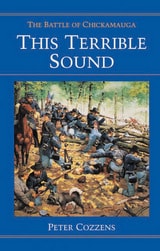
This Terrible Sound
The Battle of ChickamaugaPeter Cozzens
University of Illinois Press, 1992
In this study of the campaign, the first to appear in over thirty years and the most comprehensive account ever written on Chickamauga, Peter Cozzens presents a vivid narrative about an engagement that was crucial to the outcome of the war in the West. Drawing upon a wealth of previously untapped sources, Cozzens offers startling new interpretations that challenge the conventional wisdom on key moments of the battle, such as Rosecrans's fateful order to General Wood and Thomas's historic defense of Horseshoe Ridge.
Chickamauga was a battle of missed opportunities, stupendous tactical blunders, and savage fighting by the men in ranks. Cozzens writes movingly of both the heroism and suffering of the common soldiers and of the strengths and tragic flaws of their commanders. Enhanced by the detailed battle maps and original sketches by the noted artist Keith Rocco, this book will appeal to all Civil War enthusiasts and students of military history.
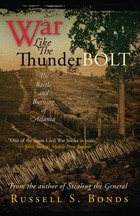
War Like the Thunderbolt
The Battle and Burning of AtlantaRussell S. Bonds
Westholme Publishing, 2009
A masterpiece of prose and research, the definitive history of the struggle for Atlanta during the Civil War, an episode immortalized by the novel Gone with the Wind
Called “the greatest event of the Civil War” by New York diarist George Templeton Strong, the epic struggle for the city of Atlanta in the bloody summer of 1864 was a pivotal moment in American history. Union commander William Tecumseh Sherman’s relentless fight for the city secured the reelection of Abraham Lincoln, sealed the fate of the Southern Confederacy, and set a precedent for military campaigns that endures today. Its depiction in the novel and motion picture Gone with the Wind established the fight for Atlanta as an iconic episode in our nation’s most terrible war. In War Like the Thunderbolt: The Battle and Burning of Atlanta, award-winning author Russell S. Bonds takes the reader behind the lines and across the smoky battlefields of Peachtree Creek, Atlanta, Ezra Church, and Jonesboro, and into the lives of fascinating characters, both the famous and the forgotten, including the fiery and brilliant Sherman; General John Bell Hood, the Confederacy’s last hope to defend Atlanta; Benjamin Harrison, the diminutive young Indiana colonel who would rise to become President of the United States; Patrick Cleburne, the Irishmanturned- Southern officer; and ten-year-old diarist Carrie Berry, who bravely withstood and bore witness to the fall of the city. Here also is the dramatic story of the ordeal of Atlanta itself—the five-week artillery bombardment, the expulsion of its civilian population, and the infamous fire that followed. Based on new research in diaries, newspapers, previously unpublished letters, and other archival sources, War Like the Thunderbolt is a combination of captivating narrative and insightful military analysis—a stirring account of the battle and burning of the “Gate City of the South.”
Wisconsin in the Civil War
The Home Front and the Battle Front, 1861-1865Frank Klement
Wisconsin Historical Society Press, 1997