Results by title

4 books match the query '1846-1912'
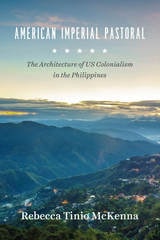
cover of American Imperial Pastoral: The Architecture of US Colonialism in the Philippines

American Imperial Pastoral

The Architecture of US Colonialism in the Philippines

Rebecca Tinio McKenna

University of Chicago Press, 2017

In 1904, renowned architect Daniel Burnham, the Progressive Era urban planner who famously “Made No Little Plans,” set off for the Philippines, the new US colonial acquisition. Charged with designing environments for the occupation government, Burnham set out to convey the ambitions and the dominance of the regime, drawing on neo-classical formalism for the Pacific colony. The spaces he created, most notably in the summer capital of Baguio, gave physical form to American rule and its contradictions.

In American Imperial Pastoral, Rebecca Tinio McKenna examines the design, construction, and use of Baguio, making visible the physical shape, labor, and sustaining practices of the US’s new empire—especially the dispossessions that underwrote market expansion. In the process, she demonstrates how colonialists conducted market-making through state-building and vice-versa. Where much has been made of the racial dynamics of US colonialism in the region, McKenna emphasizes capitalist practices and design ideals—giving us a fresh and nuanced understanding of the American occupation of the Philippines.
[more]
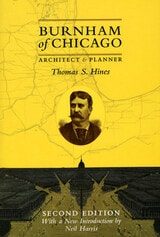
cover of Burnham of Chicago: Architect and Planner, Second Edition

Burnham of Chicago

Architect and Planner, Second Edition

Thomas S. Hines

University of Chicago Press, 2008

2009 marks the centennial of the influential Plan of Chicago. Designed by Daniel H. Burnham, coauthored by Edward Bennett and produced in collaboration with the Commercial Club of Chicago, the forward-thinking plan proposed many of the city’s most distinctive features, including its lakefront parks and roadways, the Magnificent Mile, and Navy Pier. As a result, by the time he died in 1912, Burnham was one of the most famous architects in America as well as an internationally renowned city planner. Thomas S. Hines’s book is at once both a biography of Burnham and a vivid portrait of the birth and growth of an American city. In commemoration of the historic anniversary of Burnham’s Plan, this edition of Burnham of Chicago includes a new introduction by American history scholar, Neil Harris.
           
“Indeed, the book as a whole is a model of the balanced portrait, sure of Burnham’s importance but always conscious of his failings.”—Paul Goldberger, New York Times Book Review

“In every sense this is the definitive biography.”—Harry Weese, Chicago Tribune
 
“Professor Hines has written what may prove to be an epoch-making book in the study of American civilization.”—Reyner Banham, Times Literary Supplement
 
[more]
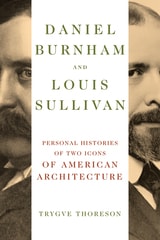
cover of Daniel Burnham and Louis Sullivan: Personal Histories of Two Icons of American Architecture

Daniel Burnham and Louis Sullivan

Personal Histories of Two Icons of American Architecture

Trygve Thoreson

University of Illinois Press, 2026

Peers, foils, colleagues, and rivals—Daniel Burnham and Louis Sullivan’s impact on each other still expresses itself in architectural masterworks that anchor Chicago’s cityscape. Trygve Thoreson’s parallel biography places their lives and careers within a panoramic history of the late 1800s and early 1900s. Thoreson delves into their influences while bringing to life the social, intellectual, and cultural milieus of their time. Unearthing a wealth of personal details, Thoreson pays particular attention to the influences that formed Burnham and Sullivan and shaped not only their designs but their conception of themselves as artists. He also examines the confluence of historical forces that pulled the two men together and pushed them apart—a fruitful back-and-forth that built surprising links into their work and steered world architecture in bold new directions.

An engaging piece of nonfiction storytelling, Daniel Burnham and Louis Sullivan reveals new facets of the architects’ personal, intellectual, and artistic lives.
[more]
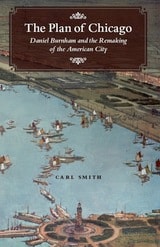
cover of The Plan of Chicago: Daniel Burnham and the Remaking of the American City

The Plan of Chicago

Daniel Burnham and the Remaking of the American City

Carl Smith

University of Chicago Press, 2006

Arguably the most influential document in the history of urban planning, Daniel Burnham’s 1909 Plan of Chicago, coauthored by Edward Bennett and produced in collaboration with the Commercial Club of Chicago, proposed many of the city’s most distinctive features, including its lakefront parks and roadways, the Magnificent Mile, and Navy Pier. Carl Smith’s fascinating history reveals the Plan’s central role in shaping the ways people envision the cityscape and urban life itself. 

Smith’s concise and accessible narrative begins with a survey of Chicago’s stunning rise from a tiny frontier settlement to the nation’s second-largest city. He then offers an illuminating exploration of the Plan’s creation and reveals how it embodies the renowned architect’s belief that cities can and must be remade for the better. The Plan defined the City Beautiful movement and was the first comprehensive attempt to reimagine a major American city. Smith points out the ways the Plan continues to influence debates, even a century after its publication, about how to create a vibrant and habitable urban environment. 

Richly illustrated and incisively written, his insightful book will be indispensable to our understanding of Chicago, Daniel Burnham, and the emergence of the modern city.

[more]