Results by title

13 books match the query '1856-1924'
cover of A Peaceful Conquest: Woodrow Wilson, Religion, and the New World Order

A Peaceful Conquest

Woodrow Wilson, Religion, and the New World Order

Cara Lea Burnidge

University of Chicago Press, 2016

A century after his presidency, Woodrow Wilson remains one of the most compelling and complicated figures ever to occupy the Oval Office. A political outsider, Wilson brought to the presidency a distinctive, strongly held worldview, built on powerful religious traditions that informed his idea of America and its place in the world.

With A Peaceful Conquest, Cara Lea Burnidge presents the most detailed analysis yet of how Wilson’s religious beliefs affected his vision of American foreign policy, with repercussions that lasted into the Cold War and beyond. Framing Wilson’s intellectual development in relationship to the national religious landscape, and paying greater attention to the role of religion than in previous scholarship, Burnidge shows how Wilson’s blend of Southern evangelicalism and social Christianity became a central part of how America saw itself in the world, influencing seemingly secular policy decisions in subtle, lasting ways. Ultimately, Burnidge makes a case for Wilson’s religiosity as one of the key drivers of the emergence of the public conception of America’s unique, indispensable role in international relations.

As the presidential election cycle once again raises questions of America’s place in the world, A Peaceful Conquest offers a fascinating excavation of its little-known roots.
 
[more]
cover of Carson Pirie Scott: Louis Sullivan and the Chicago Department Store

Carson Pirie Scott

Louis Sullivan and the Chicago Department Store

Joseph M. Siry

University of Chicago Press, 1988
Long recognized as a Chicago landmark, the Carson Pirie Scott Building also represents a milestone in the development of architecture. The last large commercial structure designed by Louis Sullivan, the Carson building reflected the culmination of the famed architect's career as a creator of tall steel buildings. In this study, Joseph Siry traces the origins of the building's design and analyzes its role in commercial, urban, and architectural history.
[more]
cover of Daniel Burnham and Louis Sullivan: Personal Histories of Two Icons of American Architecture

Daniel Burnham and Louis Sullivan

Personal Histories of Two Icons of American Architecture

Trygve Thoreson

University of Illinois Press, 2026

Peers, foils, colleagues, and rivals—Daniel Burnham and Louis Sullivan’s impact on each other still expresses itself in architectural masterworks that anchor Chicago’s cityscape. Trygve Thoreson’s parallel biography places their lives and careers within a panoramic history of the late 1800s and early 1900s. Thoreson delves into their influences while bringing to life the social, intellectual, and cultural milieus of their time. Unearthing a wealth of personal details, Thoreson pays particular attention to the influences that formed Burnham and Sullivan and shaped not only their designs but their conception of themselves as artists. He also examines the confluence of historical forces that pulled the two men together and pushed them apart—a fruitful back-and-forth that built surprising links into their work and steered world architecture in bold new directions.

An engaging piece of nonfiction storytelling, Daniel Burnham and Louis Sullivan reveals new facets of the architects’ personal, intellectual, and artistic lives.
[more]
cover of Jim Crow and the Wilson Administration: Protesting Federal Segregation in the Early Twentieth Century

Jim Crow and the Wilson Administration

Protesting Federal Segregation in the Early Twentieth Century

Nicholas Patler

University Press of Colorado, 2007

In Jim Crow and the Wilson Administration, Nicholas Patler presents the first in-depth study of the historic protest movement that challenged federal racial segregation and discrimination during the first two years of Woodrow Wilson's presidency. Before the Wilson years, as southern states and localities enshrined Jim Crow--in law and custom--and systematic racial discrimination infiltrated the North, the executive branch of the federal government moved in the opposite direction by opening federal employment to thousands of African Americans, appointing blacks to federal and diplomatic offices throughout the country and the world. Finding support from the federal government, many African Americans, supported Wilson's democratic campaign, dubbed the "New Freedom," with hopes of continuing advancement. But as president, the southern-born Wilson openly supported and directly implemented a Jim Crow policy in the federal departments unleashing a firestorm of protest.

This protest campaign, carried out on a level not seen since the abolitionist movement, galvanized a vast community of men and women. Blacks and whites, professionals and laymen, signed petitions, wrote protest letters, participated in organized mass meetings, lobbied public officials, directly confronted Wilson, made known their plight through publicity campaigns, and, in at least one case, marched to express their opposition. Patler provides a thorough examination of the two national organizations that led these protests efforts - the National Association for the Advancement of Colored People and William Monroe Trotter's National Equal Rights League - and deftly contextualizes the movement, while emphasizing the tragic, enduring consequences of the Wilson administration's actions.
[more]
cover of Making the World Safe for Workers: Labor, the Left, and Wilsonian Internationalism

Making the World Safe for Workers

Labor, the Left, and Wilsonian Internationalism

Elizabeth McKillen

University of Illinois Press, 2018
 
In this intellectually ambitious study, Elizabeth McKillen explores the significance of Wilsonian internationalism for workers and the influence of American labor in both shaping and undermining the foreign policies and war mobilization efforts of Woodrow Wilson's administration. McKillen highlights the major fault lines and conflicts that emerged within labor circles as Wilson pursued his agenda in the context of Mexican and European revolutions, World War I, and the Versailles Peace Conference. As McKillen shows, the choice to collaborate with or resist U.S. foreign policy remained an important one for labor throughout the twentieth century. In fact, it continues to resonate today in debates over the global economy, wars in Iraq and Afghanistan, and the impact of U.S. policies on workers at home and abroad.

[more]
cover of Power without Victory: Woodrow Wilson and the American Internationalist Experiment

Power without Victory

Woodrow Wilson and the American Internationalist Experiment

Trygve Throntveit

University of Chicago Press, 2017

For decades, Woodrow Wilson has been remembered as either a paternalistic liberal or reactionary conservative at home and as a naïve idealist or cynical imperialist abroad. Historians’ harsh judgments of Wilson are understandable. He won two elections by promising a deliberative democratic process that would ensure justice and political empowerment for all. Yet under Wilson, Jim Crow persisted, interventions in Latin America increased, and a humiliating peace settlement was forced upon Germany. A generation after Wilson, stark inequalities and injustices still plagued the nation, myopic nationalism hindered its responsible engagement in world affairs, and a second vastly destructive global conflict threatened the survival of democracy worldwide—leaving some Americans today to wonder what, exactly, the buildings and programs bearing his name are commemorating.

In Power without Victory, Trygve Throntveit argues that there is more to the story of Wilson than these sad truths. Throntveit makes the case that Wilson was not a “Wilsonian,” as that term has come to be understood, but a principled pragmatist in the tradition of William James. He did not seek to stamp American-style democracy on other peoples, but to enable the gradual development of a genuinely global system of governance that would maintain justice and facilitate peaceful change—a goal that, contrary to historical tradition, the American people embraced. In this brilliant intellectual, cultural, and political history, Throntveit gives us a new vision of Wilson, as well as a model of how to think about the complex relationship between the world of ideas and the worlds of policy and diplomacy.
[more]
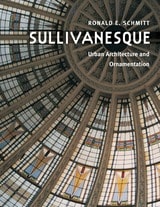
cover of Sullivanesque: Urban Architecture and Ornamentation

Sullivanesque

Urban Architecture and Ornamentation

Ronald E. Schmitt

University of Illinois Press, 2001
Sullivanesque offers a visual and historical tour of a unique but often overlooked facet of modern American architecture derived from Louis Sullivan.Highly regarded in architecture for inspiring the Chicago School and the Prairie School, Sullivan was an unwilling instigator of the method of facade composition--later influenced by Frank Lloyd Wright, William Gray Purcell, and George G. Elmslie--that came to be known as Sullivanesque. Decorative enhancements with botanical and animal themes, Sullivan's distinctive ornamentation mitigated the hard geometries of the large buildings he designed, coinciding with his "form follows function" aesthetic.Sullivan's designs offered solutions to problems presented by new types and scales of buildings. Widely popular, they were also widely copied, and the style proliferated due to a number of Chicago-based interests, including the Radford Architectural Company and several decorative plaster and terra-cotta companies. Stock replicas of Sullivan's designs manufactured by the Midland Terra Cotta Company and others gave distinction and focus to utilitarian buildings in Chicago's commercial strips and other confined areas, such as the downtown districts of smaller towns. Mass-produced Sullivanesque terra cotta endured as a result of its combined economic and aesthetic appeal, blending the sophistication of high architectural art with the pragmatic functionality of building design.Masterfully framed by the author's photographs of Sullivanesque buildings in Chicago and throughout the Midwest, Ronald E. Schmitt's in-depth exploration of the Sullivanesque tells the story of its evolution from Sullivan's intellectual and aesthetic foundations to its place as a form of commercial vernacular. The book also includes an inventory of Sullivanesque buildings.Honorable Mention recipient of the 2002 PSP Awards for Excellence in Professional/Scholarly Publishing
[more]
cover of The Charnley House: Louis Sullivan, Frank Lloyd Wright, and the Making of Chicago's Gold Coast

The Charnley House

Louis Sullivan, Frank Lloyd Wright, and the Making of Chicago's Gold Coast

Edited by Richard Longstreth

University of Chicago Press, 2004

Situated in Chicago's famed Gold Coast, just north of the Magnificent Mile, the Charnley house is one of the finest dwellings in the city and considered worldwide to be a stunning example of avant-garde architecture. Now the headquarters of the Society of Architectural Historians and designated a National Historic Landmark in 1998, the house was built in 1892 at a critical moment in urban and architectural history. The Charnley House is the first authoritative publication on the building, which has long been discussed in surveys but never before examined in detail.

In this collection of original essays, six well-known architectural historians illuminate various aspects of the house, both inside and out, as they consider its remarkable formal and spatial qualities, its historical significance in the development of Chicago's elite residential neighborhood, and its place in the context of American domestic architecture. Equally important, the contributors tackle the knotty, decades-old issue concerning the building's designer. While many have ascribed the scheme to Frank Lloyd Wright, Louis Sullivan's chief assistant at the time, this book sheds new light on how the house relates significantly to the work of both master and apprentice.

The continuing debate over the house's "authorship" highlights the importance of the Charnley house in the history of modern architecture as the seminal work of residential design in the United States. These thoroughly researched interpretations, supplemented by an abundance of never before published illustrations, analyze this house of distinction with the care and detail it deserves. Beautifully restored in late 1980s, the Charnley house now has a book worthy of it.
[more]
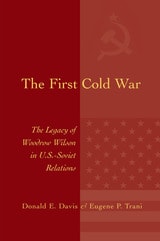
cover of The First Cold War: The Legacy of Woodrow Wilson in U.S. - Soviet Relations

The First Cold War

The Legacy of Woodrow Wilson in U.S. - Soviet Relations

Donald E. Davis & Eugene P. Trani

University of Missouri Press, 2002
In The First Cold War, Donald E. Davis and Eugene P. Trani review the Wilson administration’s attitudes toward Russia before, during, and after the Bolshevik seizure of power. They argue that before the Russian Revolution, Woodrow Wilson had little understanding of Russia and made poor appointments that cost the United States Russian goodwill. Wilson later reversed those negative impressions by being the first to recognize Russia’s Provisional Government, resulting in positive U.S.–Russian relations until Lenin gained power in 1917.
Wilson at first seemed unsure whether to recognize or repudiate Lenin and the Bolsheviks. His vacillation finally ended in a firm repudiation when he opted for a diplomatic quarantine having almost all of the ingredients of the later Cold War. Davis and Trani argue that Wilson deserves mild criticism for his early indecision and inability to form a coherent policy toward what would become the Soviet Union. But they believe Wilson rightly came to the conclusion that until the regime became more moderate, it was useless for America to engage it diplomatically.
The authors see in Wilson’s approach the foundations for the “first Cold War”—meaning not simply a refusal to recognize the Soviet Union, but a strong belief that its influence was harmful and would spread if not contained or quarantined. Wilson’s Soviet policy in essence lasted until Roosevelt extended diplomatic recognition in the 1930s. But The First Cold War suggests that Wilson’s impact extended beyond Roosevelt to Truman, showing that the policies of Wilson and Truman closely resemble each other with the exception of an arms race. Wilson’s intellectual reputation lent credibility to U.S. Cold War policy from Truman to Reagan, and the reader can draw a direct connection from Wilson to the collapse of the USSR. Wilsonians were the first Cold War warriors, and in the era of President Woodrow Wilson, the first Cold War began.
[more]
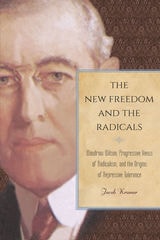
cover of The New Freedom and the Radicals: Woodrow Wilson, Progressive Views of Radicalism, and the Origins of Repressive Tolerance

The New Freedom and the Radicals

Woodrow Wilson, Progressive Views of Radicalism, and the Origins of Repressive Tolerance

Jacob Kramer

Temple University Press, 2017

Radicals such as socialists, syndicalists, and anarchists are often thought of as marginal in American history. However, in the early decades of the twentieth century, progressives—those who sought to regulate big business, reduce class conflict, and ameliorate urban poverty—took the radicals’ ideas very seriously.

In The New Freedom and the Radicals, Jacob Kramer deftly examines how progressivism emerged at a time of critical transformation in American life. Using original archival sources, Kramer presents a study of Wilsonian-era politics to convey an understanding of the progressives’ views on radical America.

The New Freedom and the Radicals shows how the reactions of progressives to radicals accelerated the pace of reform in the United States, but how the movement was at times predisposed to repressing the radical elements to its left. In addition, Kramer asks to what extent progressives were responding to and influenced by those who opposed the state, capitalism, and the class structure altogether, as well as how progressives’ views of them changed in relation to events.

[more]
cover of The Public Papers

The Public Papers

Louis Sullivan

University of Chicago Press, 1988

This volume brings together for the first time all the papers Louis Sullivan intended for a public audience, from his first interview in 1882 to his last essay in 1924. Organized chronologically, these speeches, interviews, essays, letters to editors, and committee reports enable readers to trace Sullivan's development from a brash young assistant to Dankmar Adler to an architectural elder statesman. Robert Twombly, an authority on Sullivan's work and life, has introduced each document with a headnote explaining its significance, locating it in time and place, and examining its immediate context. He has also provided a general introduction that analyzes Sullivan's writing style and objectives, his major philosophical themes, and the sources of his ideas. With the help of headnotes and introduction, readers will get a thorough sense of Sullivan's concerns, discover how his ideas evolved and changed, and appreciate the circumstances under which new interests emerged.

This collection is a handy introduction to the full range of Sullivan's thinking, the book with which readers interested in the architect's writings should begin. As a companion volume to Robert Twombly's biography of Sullivan, it gives a comprehensive picture of one of America's most important architects and cultural figures.
[more]
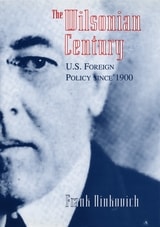
cover of The Wilsonian Century: U.S. Foreign Policy since 1900

The Wilsonian Century

U.S. Foreign Policy since 1900

Frank Ninkovich

University of Chicago Press, 1999

For most of this century, American foreign policy was guided by a set of assumptions that were formulated during World War I by President Woodrow Wilson. In this incisive reexamination, Frank Ninkovich argues that the Wilsonian outlook, far from being a crusading, idealistic doctrine, was reactive, practical, and grounded in fear. Wilson and his successors believed it absolutely essential to guard against world war or global domination, with the underlying aim of safeguarding and nurturing political harmony and commercial cooperation among the great powers. As the world entered a period of unprecedented turbulence, Wilsonianism became a "crisis internationalism" dedicated to preserving the benign vision of "normal internationalism" with which the United States entered the twentieth century.

In the process of describing Wilson's legacy, Ninkovich reinterprets most of the twentieth century's main foreign policy developments. He views the 1920s, for example, not as an isolationist period but as a reversion to Taft's Dollar Diplomacy. The Cold War, with its faraway military interventions, illustrates Wilsonian America's preoccupation with achieving a cohesive world opinion and its abandonment of traditional, regional conceptions of national interest.

The Wilsonian Century offers a striking alternative to traditional interest-based interpretations of U.S. foreign policy. In revising the usual view of Wilson's contribution, Ninkovich shows the extraordinary degree to which Wilsonian ideas guided American policy through a century of conflict and tension.
[more]
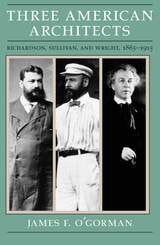
cover of Three American Architects: Richardson, Sullivan, and Wright, 1865-1915

Three American Architects

Richardson, Sullivan, and Wright, 1865-1915

James F. O'Gorman

University of Chicago Press, 1991

O'Gorman discusses the individual and collective achievement of the recognized trinity of American architecture: Henry Hobson Richardson (1838-86), Louis Sullivan (1856-1924), and Frank Lloyd Wright (1867-1959). He traces the evolution of forms created during these architects' careers, emphasizing the interrelationships among them and focusing on the designs and executed buildings that demonstrate those interrelationships. O'Gorman also shows how each envisioned the building types demanded by the growth of nineteenth-century cities and suburbs—the downtown skyscraper and the single-family home.

[A] brilliant analysis . . . a major contribution to our understanding of the beginnings of modern American architecture."—David Hamilton Eddy, Times Higher Education Supplement.
[more]