Results by title
3 books match the query '1865-1898'
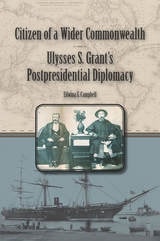
Citizen of a Wider Commonwealth
Ulysses S. Grant's Postpresidential DiplomacyEdwina S. Campbell
Southern Illinois University Press, 2012
Traveling commercially and on U.S. Navy warships, Grant visited ports of call throughout the British Empire, Europe, and Asia, including Britain, France, Egypt, the Ottoman Empire, Greece, Italy, the Netherlands, Germany, Scandinavia, Russia, Spain, Portugal, Gibraltar, Ireland, India, Singapore, Hong Kong, China, and Japan. Along the way, he met with monarchs, ministers, and average citizens, creating the model for the summitry and public diplomacy practiced by future American presidents and articulating concepts of national self-determination, international organization, and the peaceful settlement of international disputes decades before Elihu Root’s advocacy of binding international arbitration and Woodrow Wilson’s proposal for the League of Nations.
Campbell reveals Grant to be a skillful envoy who brought to his travels the deep interest in foreign policy issues he had shown during his administration. Grant confirmed the United States’ commitment to Anglo-American cooperation, demonstrated America’s interest in the territorial integrity of China, affirmed American faith in universal (male) suffrage as the basis for governmental legitimacy, and asserted the importance of an international order based on equality and justice for all states and their citizens. Grant’s efforts shaped not only John Hay’s Open Door policy in 1899–1900 but also the broader American approach to twentieth-century international relations. Throughout the trip, Julia Grant proved essential to the success of her husband’s mission, and Campbell tells how the couple impressed people around the world with an enduring image of an American president and first lady.
By illuminating the significance of Grant’s often overlooked postpresidential travels, Citizen of a Wider Commonwealth establishes the eighteenth president as a key diplomat whose work strongly influenced the direction of future U.S. foreign policy and contributes substantially to the study of American international relations.
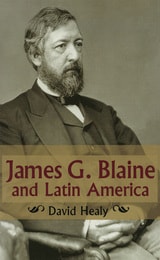
James G. Blaine and Latin America
David Healy
University of Missouri Press, 2001
James G. Blaine was one of the leading national political figures of his day, and probably the most controversial. Intensely partisan, the dominant leader of the Republican Party, and a major shaper of national politics for more than a decade, Blaine is remembered chiefly for his role as architect of the post-Civil War GOP and his two periods as secretary of state. He also was the Republican presidential candidate in the notorious mud-slinging campaign of 1884. His foreign policy was marked by its activism, its focus on Latin America, and its attempt to increase U.S. influence there.
James G. Blaine and Latin America asserts that Latin America lay at the heart of Blaine's foreign policy and his vision for America. David Healy examines seven major issues that collectively defined the secretary of state's methods, goals, and views regarding Latin America and, more broadly, the international role of the United States. Healy places his explorations within the larger context of Blaine's ongoing role as a national party leader, his relations with the presidents under whom he served, and the responses of his predecessors and successors toward the issues at hand in Latin America.
The result is a deeper understanding of Blaine's ambitious vision for his country's international role, his energy and aggressiveness in moving to achieve that vision, and his effective efforts to transmit his worldview to the public. Blaine's emphasis on the importance of Latin America to the United States and his conviction that his country should be a world power influenced a new generation of leaders who, at the end of the century, would go beyond his goals and usher in a new era.
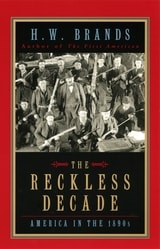
The Reckless Decade
America in the 1890sH.W. Brands
University of Chicago Press, 2002
Just as we do today, Americans of the 1890s faced changes in economics, politics, society, and technology that led to wrenching and sometimes violent tensions between rich and poor, capital and labor, white and black, East and West. In The Reckless Decade, H. W. Brands demonstrates that we can learn a lot about the contradictions that lie at the heart of America today by looking at them through the lens of the 1890s.
The 1890s saw the closing of the American frontier and a shift toward imperialist ambitions. Populists and muckrakers grappled with robber barons and gold-bugs. Americans addressed the unfinished business of Reconstruction by separating blacks and whites. Booker T. Washington, W. E. B. Du Bois, and other black leaders clashed over the proper response to continuing racial inequality. Those on top of the economic heap—Rockefeller, Carnegie, and Morgan—created vast empires of wealth, while those at the bottom worked for dimes a day. Brands brings all this to life in a vivid narrative filled with larger-than-life characters facing momentous challenges as they worked toward an uncertain future.