Results by title
4 books match the query '1868-1912'
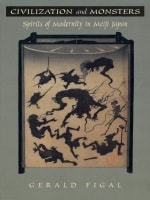
Civilization and Monsters
Spirits of Modernity in Meiji JapanGerald Figal
Duke University Press, 2000
After discussing the role of the fantastic in everyday Japan at the eve of the Meiji period, Figal draws new connections between folklorists, writers, educators, state ideologues, and policymakers, all of whom crossed paths in a contest over supernatural terrain. He shows the ways in which a determined Meiji state was engaged in a battle to suppress, denigrate, manipulate, or reincorporate folk belief as part of an effort toward the consolidation of a modern national culture. Modern medicine and education, functioning as a means for the state to exercise its power, redefined folk practices as a source of evil. Diverse local spirits were supplanted by a new Japanese Spirit, embodied by the newly constituted emperor, the supernatural source of the nation’s strength. The monsters of folklore were identified, catalogued, and characterized according to a new regime of modern reason. But whether engaged to support state power and forge a national citizenry or to critique the arbitrary nature of that power, the fantastic, as Figal maintains, is the constant condition of Japanese modernity in all its contradictions. Furthermore, he argues, modernity in general is born of fantasy in ways that have scarcely been recognized.
Bringing unexplored and provocative new ideas to the Japan specialist, Civilization and Monsters will also appeal to readers concerned with issues of modernity in general.
Essays on the Modern Japanese Church
Christianity in Meiji JapanYamaji Aizan; Translated by Graham Squires, with Introductory Essays by Graham Squires and A. Hamish Ion
University of Michigan Press, 2000
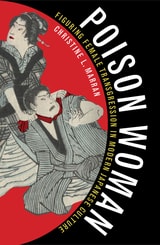
Poison Woman
Figuring Female Transgression in Modern Japanese CultureChristine L. Marran
University of Minnesota Press, 2007
Based on the lives and crimes of no less than twenty real women, dokufu (poison women) narratives emerged as a powerful presence in Japan during the 1870s. During this tumultuous time, as the nation moved from feudalism to oligarchic government, such accounts articulated the politics and position of underclass women, sexual morality, and female suffrage. Over the next century, the figure of the oversexed female criminal, usually guilty of robbery or murder, became ubiquitous in modern Japanese culture.
In Poison Woman, Christine L. Marran investigates this powerful icon, its shifting meanings, and its influence on defining women’s sexuality and place in Japan. She begins by considering Meiji gesaku literature, in which female criminality was often medically defined and marginalized as abnormal. She describes the small newspapers (koshinbun) that originally reported on poison women, establishing journalistic and legal conventions for future fiction about them. She examines zange, or confessional narratives, of female and male ex-convicts from the turn of the century, then reveals how medical and psychoanalytical literature of the 1920s and 1930s offered contradictory explanations of the female criminal as an everywoman or a historical victim of social circumstances and the press. She concludes by exploring postwar pulp fiction (kasutori), film and underground theater of the 1970s, and the feminist writer Tomioka Taeko’s take on the transgressive woman.
Persistent stories about poison women illustrate how a few violent acts by women were transformed into myriad ideological, social, and moral tales that deployed notions of female sexual desire and womanhood. Bringing together literary criticism, the history of science, media theory, and gender and sexuality studies, Poison Woman delves into genre and gender in ways that implicate both in projects of nation-building.
Christine L. Marran is associate professor of Japanese literature and cultural studies at the University of Minnesota.
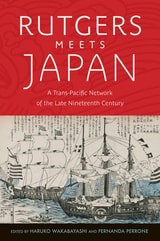
Rutgers Meets Japan
A Trans-Pacific Network of the Late Nineteenth CenturyHaruko Wakabayashi
Rutgers University Press, 2026
Griffis and Kusakabe were only a small piece of a vast transnational network of leading modernizers of Japan in the 1860s and 70s. The Japanese students in New Brunswick were young and innovative men of samurai and aristocratic lineage, who were sent by reform-minded leaders of Japan, which was undergoing a dramatic transformation. They came to New Brunswick seeking Western knowledge that was much needed for the modernization of a newly forming nation. New Brunswick became the hub of a network of Japanese nationals that extended to the major cities of New York, Philadelphia, and Boston, and from there to the smaller towns of New England. Once in New Brunswick, these Japanese students were embraced by Protestant ministers, educators, and missionaries—both men and women—whose network encompassed Rutgers College and the neighboring New Brunswick Theological Seminary, and which stretched to Dutch Reformed parishes throughout the Eastern seaboard, and westward as far as the Dutch enclave of Holland, Michigan. Meanwhile, the American teachers and missionaries who left for Japan became part of a network of reformist leaders and Japanese returnees that extended to schools, colleges, and missions in Japan, and formed the foundations of Japan’s modern educational system. Through contributions from scholars and archivists in the U.S., Canada, and Japan, Rutgers Meets Japan aims to reconstruct the early Rutgers-Japan connections and examine the role and impact of this transnational network on Japan and the U.S. in the late nineteenth century.