Results by title
5 books match the query '1874-1936'
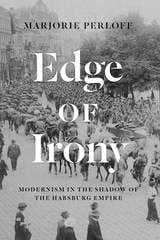
Edge of Irony
Modernism in the Shadow of the Habsburg EmpireMarjorie Perloff
University of Chicago Press, 2016
Among the brilliant writers and thinkers who emerged from the multicultural and multilingual world of the Austro-Hungarian Empire were Joseph Roth, Robert Musil, and Ludwig Wittgenstein. For them, the trauma of World War I included the sudden loss of the geographical entity into which they had been born: in 1918, the empire was dissolved overnight, leaving Austria a small, fragile republic that would last only twenty years before being annexed by Hitler’s Third Reich. In this major reconsideration of European modernism, Marjorie Perloff identifies and explores the aesthetic world that emerged from the rubble of Vienna and other former Habsburg territories—an “Austro-Modernism” that produced a major body of drama, fiction, poetry, and autobiography.
Perloff explores works ranging from Karl Kraus’s drama The Last Days of Mankind and Elias Canetti’s memoir The Tongue Set Free to Ludwig Wittgenstein’s notebooks and Paul Celan’s lyric poetry. Throughout, she shows that Austro-Modernist literature is characterized less by the formal and technical inventions of a modernism familiar to us in the work of Joyce and Pound, Dada and Futurism, than by a radical irony beneath a seemingly conventional surface, an acute sense of exile, and a sensibility more erotic and quixotic than that of its German contemporaries. Skeptical and disillusioned, Austro-Modernism prefers to ask questions rather than formulate answers.
Perloff explores works ranging from Karl Kraus’s drama The Last Days of Mankind and Elias Canetti’s memoir The Tongue Set Free to Ludwig Wittgenstein’s notebooks and Paul Celan’s lyric poetry. Throughout, she shows that Austro-Modernist literature is characterized less by the formal and technical inventions of a modernism familiar to us in the work of Joyce and Pound, Dada and Futurism, than by a radical irony beneath a seemingly conventional surface, an acute sense of exile, and a sensibility more erotic and quixotic than that of its German contemporaries. Skeptical and disillusioned, Austro-Modernism prefers to ask questions rather than formulate answers.
[more]
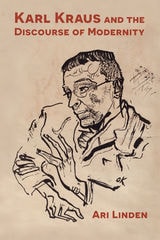
Karl Kraus and the Discourse of Modernity
Ari Linden
Northwestern University Press, 2020
Ari Linden’s Karl Kraus and the Discourse of Modernity reconsiders the literary works of the Viennese satirist, journalist, and playwright Karl Kraus (1874–1936). Combining close readings with intellectual history, Linden shows how Kraus’s two major literary achievements (The Last Days of Mankind and The Third Walpurgis Night) and his adaptation of The Birds by Aristophanes (Cloudcuckooland) address the political catastrophes of the first third of Europe’s twentieth century—from World War I to the rise of fascism.
Kraus’s central insight, Linden argues, is that the medial representations of such events have produced less an informed audience than one increasingly unmoved by mass violence. In the second part of the book, Linden explores this insight as he sees it inflected in the writings of Søren Kierkegaard, Walter Benjamin, and Theodor Adorno. This hidden dialogue, Linden claims, offers us a richer understanding of the often-neglected relationship between satire and critical theory writ large.
Kraus’s central insight, Linden argues, is that the medial representations of such events have produced less an informed audience than one increasingly unmoved by mass violence. In the second part of the book, Linden explores this insight as he sees it inflected in the writings of Søren Kierkegaard, Walter Benjamin, and Theodor Adorno. This hidden dialogue, Linden claims, offers us a richer understanding of the often-neglected relationship between satire and critical theory writ large.
[more]
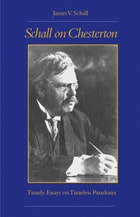
Schall on Chesterton
Timely Essays on Timeless ParadoxesJames V. Schall
Catholic University of America Press, 2000
In this book of essays, Father James V. Schall, a prolific author himself and a prominent Catholic writer, brings readers to Chesterton through a witty series of original reflections prompted by something Chesterton wrote--timely essays on timeless issues.
[more]
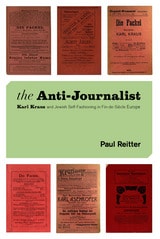
The Anti-Journalist
Karl Kraus and Jewish Self-Fashioning in Fin-de-Siècle EuropePaul Reitter
University of Chicago Press, 2008
In turn-of-the-century Vienna, Karl Kraus created a bold new style of media criticism, penning incisive satires that elicited both admiration and outrage. Kraus’s spectacularly hostile critiques often focused on his fellow Jewish journalists, which brought him a reputation as the quintessential self-hating Jew. The Anti-Journalist overturns this view with unprecedented force and sophistication, showing how Kraus’s criticisms form the center of a radical model of German-Jewish self-fashioning, and how that model developed in concert with Kraus’s modernist journalistic style.
Paul Reitter’s study of Kraus’s writings situates them in the context of fin-de-siècle German-Jewish intellectual society. He argues that rather than stemming from anti-Semitism, Kraus’s attacks constituted an innovative critique of mainstream German-Jewish strategies for assimilation. Marshalling three of the most daring German-Jewish authors—Kafka, Scholem, and Benjamin—Reitter explains their admiration for Kraus’s project and demonstrates his influence on their own notions of cultural authenticity.
The Anti-Journalist is at once a new interpretation of a fascinating modernist oeuvre and a heady exploration of an important stage in the history of German-Jewish thinking about identity.
[more]
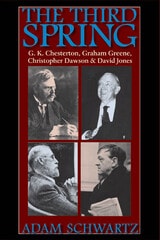
The third spring
G.K. Chesterton, Graham Greene, Christopher Dawson, and David JonesAdam Schwartz
Catholic University of America Press, 2005
This book is the first detailed examination of these four authors as part of a Roman Catholic, counter-modern community of discourse. It is informed by extensive research in the writers' works, scholarship on them, and their personal papers.
[more]