Results by title
13 books match the query 'Sonora'
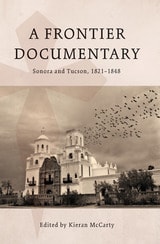
A Frontier Documentary
Sonora and Tucson, 1821–1848Edited by Kieran McCarty
University of Arizona Press, 1997
These documents give a sense of immediacy to the military operations, Indian activities, and missionary work going on in Tucson and the surrounding areas. They also demonstrate that Hispanic families maintained continuity in military and political control on the frontier, and clearly show that the frontier was not beset by anarchy in spite of the change in national government. In the forty chapters of translated documents in this collection, the voices of those who lived in what is now the Arizona-Sonora border region provide firsthand accounts of the people and events that shaped their era. These documents record such events as the arrival of the first Americans, the reconstruction of Tucson’s presidio wall, and conflict between Tohono O’odham villagers and Mexicans. All are set against the backdrop of an unrelenting Apache offensive that heightened after the departure of the Spanish military but that was held in check by civilian militias. Each chapter begins with a brief introduction in which historian Kieran McCarty provides background on the documents’ context and authorship. Taken together, they offer a fascinating look at this little-known period and provide a unique panorama of southwestern history.
Adventures in the Apache Country
A Tour Through Arizona and Sonora, 1864J. Ross Browne
University of Arizona Press, 1974
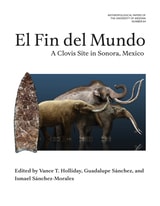
El Fin del Mundo
A Clovis Site in Sonora, MexicoVance T. Holliday, Guadalupe Sánchez, and Ismael Sánchez-Morales
University of Arizona Press, 2024
El Fin del Mundo presents and synthesizes the archaeological, geological, paleontological, and paleoenvironmental records of an important Clovis site.
Contributors
Joaquín Arroyo-Cabrales
Jordan Bright
James K. Feathers
Edmund P. Gaines
Thanairi Gamez
Gregory W. L. Hodgins
Vance T. Holliday
Susan M. Mentzer
Carmen Isela Ortega-Rosas
Manuel R. Palacios-Fest
Guadalupe Sánchez
Ismael Sánchez-Morales
Kayla B. Worthey
Kristen Wroth
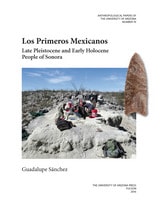
Los Primeros Mexicanos
Late Pleistocene and Early Holocene People of SonoraGuadalupe Sánchez
University of Arizona Press, 2016
Los Primeros Mexicanos explores the Clovis occupation of Mexico’s northwest region of Sonora. Using extensive primary data concerning specific artifacts, assemblages, and Paleoindian archaeology, Mexican archaeologist Guadalupe Sánchez presents a synopsis and critical review of current data and a unique summary of information about the First People of México that is difficult to find in Spanish and until now not available in English.
Sánchez’s essential framework for early Sonora prehistory includes the Sonoran landscape, the biotic communities, a history of investigations, the regional cultural-historical chronology of Sonora, and the Clovis record in the surrounding area. The Sonoran settlement pattern, she asserts, indicates that Clovis groups were hunter-gatherers who exploited a wide range of environments, locating their settlements near lithic sources for tool-making, water sources, large-prey animals, and a variety of edible plants and small animals.
In 1592, a Jesuit priest, José de Acosta, chronicled his puzzlement over when man first arrived in the New World. Four hundred years later, the peopling of the American continent is still intensely interesting to scientists and researchers. Los Primeros Mexicanos offers an exhaustive synthesis of available archaeological evidence to shed light on Clovis occupation in Sonora, Mexico.
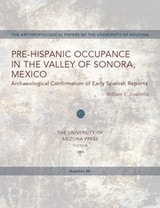
Pre-Hispanic Occupance in the Valley of Sonora, Mexico
Archaeological Confirmations of Early Spanish ReportsWilliam E. Doolittle
University of Arizona Press, 1988
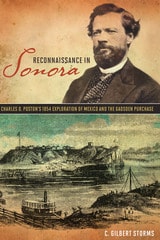
Reconnaissance in Sonora
Charles D. Poston’s 1854 Exploration of Mexico and the Gadsden PurchaseC. Gilbert Storms
University of Arizona Press, 2015
Poston led his party through Sonora and the territory of the 1854 Gadsden Purchase, which today encompasses southern Arizona and a portion of southern New Mexico. The syndicate’s charge to the young adventurer was to acquire land in Mexico in anticipation of the Gadsden Purchase and the building of the transcontinental railroad. Reconnaissance in Sonora details Poston’s expedition, including the founding of the town of Colorado City at the site of present-day Yuma, Arizona.
C. Gilbert Storms explores the American ideas of territorial expansion and Manifest Destiny, the national debate over a route for a transcontinental railroad, the legends of rich gold and silver mines in northern Mexico, and the French and American filibusters that plagued northern Mexico in the early 1850s.
Rudo Ensayo
A Description of Sonora and Arizona in 1764Juan Nentvig; Translated, Clarified, and Annotated by Alberto Francisco Pradeau and Robert R. Rasmussen
University of Arizona Press, 1980

Saints, Statues, and Stories
A Folklorist Looks at the Religious Art of SonoraJames S. Griffith
University of Arizona Press, 2019
So describes well-known and beloved folklorist James S. Griffith as he takes us back through the decades to a town in northern Sonora where a statue is saved—and in so doing, a community is saved as well.
In Saints, Statues, and Stories Griffith shares stories of nearly sixty years of traveling through Sonora. As we have come to expect through these journeys, “Big Jim”—as he is affectionately known by many—offers nothing less than the living traditions of Catholic communities. Themes of saints as agents of protection or community action are common throughout Sonora: a saint coming out of the church to protect the village, a statue having a say in where it resides and paying social calls to other communities, or a beloved image rescued from destruction and then revered on a private altar. A patron saint saves a village from outside attackers in one story—a story that has at least ten parallels in Sonora’s former mission communities. Details may vary, but the general narrative remains the same: when hostile nonbelievers attack the village, the patron saint of the church foils them.
Griffith uncovers the meanings behind the devotional uses of religious art from a variety of perspectives—from artist to audience, preservationist to community member. The religious artworks transcend art objects, Griffith believes, and function as ways of communicating between this world and the next. Setting the stage with a brief geography, Griffith introduces us to roadside shrines, artists, fiestas, saints, and miracles. Full-color images add to the pleasure of this delightful journey through the churches and towns of Sonora.

Sonora
A Description of the ProvinceIgnaz Pfefferkorn; Foreword by Bernard L. Fontana; Translated and Annotated by Theodore E. Treutlein
University of Arizona Press, 1989
"To be read for enjoyment; nevertheless, the historian will find in it a wealth of information that has been shrewdly appraised, carefully sifted, and creditably related."—Catholic Historical Review
"Of interest not only to the historian but to the geographer and anthropologist."—Pacific Historical Review
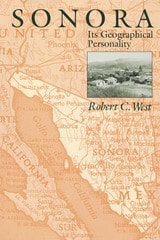
Sonora
Its Geographical PersonalityBy Robert C. West
University of Texas Press, 1993
A land where some streams ran with gold. A landscape nearly empty of inhabitants in the wake of Apache raids from the north. And a former desert transformed by irrigation into vast fields of wheat and cotton. This was and is the state of Sonora in northwest Mexico.
In this cultural historical geography, Robert C. West explores the dual geographic "personality" of this part of Mexico's northern frontier. Utilizing the idea of "old" and "new" landscapes, he describes two Sonoras—to the east, a semiarid to subhumid mountainous region that reached its peak of development in the colonial era and still lives largely in its colonial past; and, to the west, a desert region that in the twentieth century has become a major agricultural producer and the modern center of economic and cultural activity.
After a description of the physical and biotic aspects of Sonora, West describes the aboriginal farming cultures that inhabited eastern Sonora before the Spanish conquest. Following the conquest, he traces the spread of Jesuit missions and Spanish mining and ranching communities into this land where gold, silver, and copper ores were easily extracted by surface mining. He charts the decline of eastern Sonora with the coming of Apache and Seri raids during the eighteenth and nineteenth centuries. And he shows how western Sonora has become one of Mexico's most powerful political and economic entities in the twentieth century.
For geographers, historians, anthropologists, and economists, as well as travelers to Sonora and its coastal resorts, this lively and interesting book will be important reading.
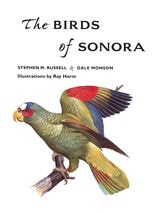
The Birds of Sonora
Stephen M. Russell
University of Arizona Press, 1998
The Birds of Sonora describes all the species known from that state and includes information on distribution, seasonal patterns of occurrence, abundance, and habitats. The first book of its kind in more than half a century to treat birds of this Mexican state immediately south of Arizona, it also contains details of nesting activity for breeding species, provides insight into factors influencing distribution, and notes historical changes in status. Each account is accompanied by a range map depicting the bird's range in Sonora—valuable information not available from any other source and useful to anyone interested in the distribution and ecology of North American birds. Drawings by internationally known wildlife artist Ray Harm enhance many of the entries.
Because other books on Mexican birds don't treat Sonora in detail, The Birds of Sonora is an indispensable resource for birders, and its background descriptions of Sonoran geography, climate, and habitats also make it a key reference for conservation and land use planning. A useful companion to field guides, it is a narrative account that puts readers in touch with birds of this important biogeographic area.
The People of Sonora and Yankee Capitalists
Ramón Eduardo Ruiz
University of Arizona Press, 1988
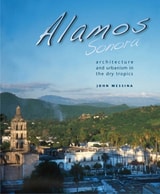
Álamos, Sonora
Architecture and Urbanism in the Dry TropicsJohn Messina
University of Arizona Press, 2008
Until now, there has never been a book about the architecture and urban form of Álamos. In this much-needed work, John Messina, who teaches architecture and is a practicing architect, provides a well-informed history and interpretive description of the town. He also examines building materials and construction techniques, as well as issues of building preservation and restoration. At the same time, the author considers what other cities might learn from Álamos. Particularly for cities in the American Southwest that are struggling to reduce sprawl and increase density without compromising their quality of life, Álamos offers a range of possible solutions.
Thoroughly illustrated and designed for lay readers and professionals alike, this engaging book captures the essence and the uniqueness of Álamos while asking what lessons can be drawn by architects and planners who are attempting to reshape our own cities and towns into more livable, viable, and people-friendly environments.