Results by title
3 books match the query '1874-1945'
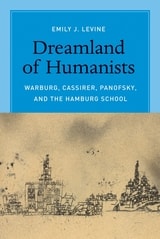
Dreamland of Humanists
Warburg, Cassirer, Panofsky, and the Hamburg SchoolEmily J. Levine
University of Chicago Press, 2013
Deemed by Heinrich Heine a city of merchants where poets go to die, Hamburg was an improbable setting for a major intellectual movement. Yet it was there, at the end of World War I, at a new university in this commercial center, that a trio of twentieth-century pioneers in the humanities emerged. Working side by side, Aby Warburg, Ernst Cassirer, and Erwin Panofsky developed new avenues in art history, cultural history, and philosophy, changing the course of cultural and intellectual history in Weimar Germany and throughout the world.
In Dreamland of Humanists, Emily J. Levine considers not just these men, but the historical significance of the time and place where their ideas took form. Shedding light on the origins of their work on the Renaissance and the Enlightenment, Levine clarifies the social, political, and economic pressures faced by German-Jewish scholars on the periphery of Germany’s intellectual world. By examining the role that context plays in our analysis of ideas, Levine confirms that great ideas—like great intellectuals—must come from somewhere.
In Dreamland of Humanists, Emily J. Levine considers not just these men, but the historical significance of the time and place where their ideas took form. Shedding light on the origins of their work on the Renaissance and the Enlightenment, Levine clarifies the social, political, and economic pressures faced by German-Jewish scholars on the periphery of Germany’s intellectual world. By examining the role that context plays in our analysis of ideas, Levine confirms that great ideas—like great intellectuals—must come from somewhere.
[more]
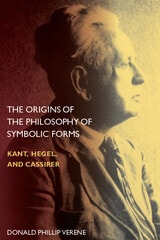
The Origins of the Philosophy of Symbolic Forms
Kant, Hegel, and CassirerDonald Phillip Verene
Northwestern University Press, 2012
The Origins of the Philosophy of Symbolic Forms marks the culmination of Donald Phillip Verene’s work on Ernst Cassirer and heralds a major step forward in the critical work on the twentieth-century philosopher. Verene argues that Cassirer’s philosophy of symbolic forms cannot be understood apart from a dialectic between the Kantian and Hegelian philosophy that lies within it.
Verene takes as his departure point that Cassirer never wishes to argue Kant over Hegel. Instead he takes from each what he needs, realizing that philosophical idealism itself did not stop with Kant but developed to Hegel, and that much of what remains problematic in Kantian philosophy finds particular solutions in Hegel’s philosophy. Cassirer never replaces transcendental reflection with dialectical speculation, but he does transfer dialectic from a logic of illusion, that is, the form of thinking beyond experience as Kant conceives it in the Critique of Pure Reason, to a logic of consciousness as Hegel employs it in the Phenomenology of Spirit. Cassirer rejects Kant’s thing-in-itself but he also rejects Hegel’s Absolute as well as Hegel’s conception of Aufhebung. Kant and Hegel remain the two main characters on his stage, but they are accompanied by a large secondary cast, with Goethe in the foreground. Cassirer not only contributes to Goethe scholarship, but in Goethe he finds crucial language to communicate his assertions. Verene introduces us to the originality of Cassirer’s philosophy so that we may find access to the riches it contains.
Verene takes as his departure point that Cassirer never wishes to argue Kant over Hegel. Instead he takes from each what he needs, realizing that philosophical idealism itself did not stop with Kant but developed to Hegel, and that much of what remains problematic in Kantian philosophy finds particular solutions in Hegel’s philosophy. Cassirer never replaces transcendental reflection with dialectical speculation, but he does transfer dialectic from a logic of illusion, that is, the form of thinking beyond experience as Kant conceives it in the Critique of Pure Reason, to a logic of consciousness as Hegel employs it in the Phenomenology of Spirit. Cassirer rejects Kant’s thing-in-itself but he also rejects Hegel’s Absolute as well as Hegel’s conception of Aufhebung. Kant and Hegel remain the two main characters on his stage, but they are accompanied by a large secondary cast, with Goethe in the foreground. Cassirer not only contributes to Goethe scholarship, but in Goethe he finds crucial language to communicate his assertions. Verene introduces us to the originality of Cassirer’s philosophy so that we may find access to the riches it contains.
[more]
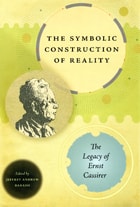
The Symbolic Construction of Reality
The Legacy of Ernst CassirerEdited by Jeffrey Andrew Barash
University of Chicago Press, 2008
In 1933 eminent philosopher Ernst Cassirer (1874–1945) fled Nazi Germany for the United States. His fame in Europe having already been established through a public debate with Martin Heidegger in 1929, Cassirer would go on to become a noteworthy influence on American culture. His most important early writings focused on the symbol and symbolic interaction, exploring how human cultures—from early myth-based ones to our own modern, scientifically oriented time—have used symbols to mediate the basic forms of experience. Following this work, Cassirer extended his insights to encompass a broad spectrum of philosophical themes: from investigations into Western epistemological and scientific traditions to aesthetics and the philosophy of history to anthropology and political philosophy. Reflecting this diversity in Cassirer’s own work, The Symbolic Construction of Reality collects eleven essays by a wide range of contributors from different fields. Each essay analyzes a different aspect of his legacy, reassessing its significance for our contemporary world and bringing much-needed attention to this seminal thinker.
[more]