Results by title
5 books match the query '1886-1965'
A Tanizaki Feast
The International Symposium in VeniceAdriana Boscaro and Anthony Hood Chambers, Editors
University of Michigan Press, 1998
This volume presents 18 eighteen essays, written by scholars from six countries, on Tanizaki Jun’ichiro (1886–1965), one of the great writers of the 20th century. The essays were originally prepared for a landmark international symposium in Venice in 1995, at which 22 speakers addressed an audience of about two hundred students and scholars in the Aula Magna of the University of Venice. Topics include Tanizaki’s fiction, plays, and film scenarios; his aesthetics; his place in Japanese intellectual history; his depiction of the West; his use of humor; and film adaptations of his works. In 1964 Tanizaki was elected to honorary membership in the American Academy and Institute of Arts and Letters, the first Japanese to be so honored; and it is widely believed that he was being considered for the Nobel Prize in Literature.
[more]
Childhood Years
A MemoirTanizaki Jun'ichiro; Translated by Paul McCarthy
University of Michigan Press, 2017
In Childhood Years, originally published serially in a literary magazine between 1955 and 1956, Tanizaki Jun’ichirō (1886–1965) takes a meandering look back on his early life in Tokyo. He reflects on his upbringing, family, and the capital city with a conversational—and not necessarily honest—eye, offering insights into his later life and his writing.
[more]
Red Roofs and Other Stories
Tanizaki Jun'ichiro; Translated by Anthony H. Chambers and Paul McCarthy
University of Michigan Press, 2016
Tanizaki Jun'ichiro (1886–1965), the author of Naomi; A Cat, a Man, and Two Women; and The Makioka Sisters, was one of the great writers of the twentieth century. The four stories in this volume date from the first and second decades of Tanizaki’s long career and reflect themes that appear throughout his work: exoticism, sexuality, sadomasochism, contrasts between traditional and modern societies, disparities between appearance and reality, the power of dreams, amorality, an interest in cinema, and a fascination with the techniques of storytelling. The stories—translated into English here for the first time—are: “The Strange Case of Tomoda and Matsunaga” (“Tomoda to Matsunaga no hanashi,” 1926), “A Night in Qinhuai” (“Shinwai no yo,” 1919), “The Magician” (“Majutsushi,” 1917), and “Red Roofs” (“Akai yane,” 1925).
[more]
Remembering Tanizaki Jun’ichiro and Matsuko
Diary Entries, Interview Notes, and Letters, 1954-1989Anthony H. Chambers
University of Michigan Press, 2017
Remembering Tanizaki Jun’ichirō and Matsuko provides previously unpublished memories, anecdotes, and insights into the lives, opinions, personalities, and writings of the great novelist Tanizaki Jun’ichirō (1886–1965) and his wife Matsuko (1903–1991), gleaned from the diaries of Edward Seidensticker and two decades of Anthony Chambers’s conversations with Mrs. Tanizaki and others who were close to the Tanizaki family.
[more]
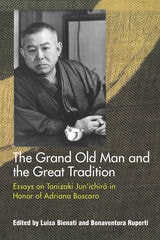
The Grand Old Man and the Great Tradition
Essays on Tanizaki Jun’ichiro in Honor of Adriana BoscaroLuisa Bienati and Bonaventura Ruperti, Editors
University of Michigan Press, 2009
In 1995, on the thirtieth anniversary of Tanizaki Jun’ichirō’s death, Adriana Boscaro organized an international conference in Venice that had an unusally lasting effect on the study of this major Japanese novelist. Thanks to Boscaro’s energetic commitment, Venice became a center for Tanizaki studies that produced two volumes of conference proceedings now considered foundational for all scholarly works on Tanizaki. In the years before and after the Venice Conference, Boscaro and her students published an abundance of works on Tanizaki and translations of his writings, contributing to his literary success in Italy and internationally.
The Grand Old Man and the Great Tradition honors Boscaro’s work by collecting nine essays on Tanizaki’s position in relation to the “great tradition” of Japanese classical literature. To open the collection, Edward Seidensticker contributes a provocative essay on literary styles and the task of translating Genji into a modern language. Gaye Rowley and Ibuki Kazuko also consider Tanizaki’s Genji translations, from a completely different point of view, documenting the author’s three separate translation efforts. Aileen Gatten turns to the influence of Heian narrative methods on Tanizaki’s fiction, arguing that his classicism, far from being superficial, “reflects a deep sensitivity to Heian narrative.” Tzevetana Kristeva holds a different perspective on Tanizaki’s classicism, singling out specific aspects of Tanizaki’s eroticism as the basis of comparison.
The next two essays emphasize Tanizaki’s experimental engagement with the classical literary genres—Amy V. Heinrich treats the understudied poetry, and Bonaventura Ruperti considers a 1933 essay on performance arts. Taking up cinema, Roberta Novelli focuses on the novel Manji, exploring how it was recast for the screen by Masumura Yasuzō. The volume concludes with two contributions interpreting Tanizaki’s works in the light of Western and Meiji literary traditions: Paul McCarthy considers Nabokovas a point of comparison, and Jacqueline Pigeot conducts a groundbreaking comparison with a novel by Natsume Sōseki.
[more]