Results by title
6 books match the query 'Break'
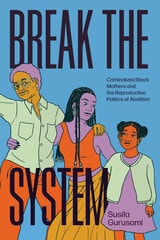
Break the System
Criminalized Black Mothers and the Reproductive Politics of AbolitionSusila Gurusami
University of Chicago Press, 2026
Upends the “broken systems” myth and reveals how the law deliberately criminalizes and punishes Black women, inflicting lasting harm on Black communities in the process.
The United States has one of the highest rates of incarceration in the world, with Black Americans representing a disproportionate share of theimprisoned. Many view this statistic as evidence of a broken system. But sociologist Susila Gurusami argues that the carceral system that so disproportionately harms Black families is not broken at all. In fact, it works just as it was intended. Looking closely at the lives of formerly incarcerated Black mothers, Gurusami shows how state institutions—the criminal-legal, child welfare, and healthcare systems—keep Black mothers from their families, harming Black communities in the process. She also shows how Black women work towards conditions that seem impossible—and even utopian—as part of their everyday mothering labor, but find themselves criminalized for these same actions.
Drawing on ethnographic data and interviews with formerly incarcerated Black women in South Los Angeles, Gurusami challenges dominant assumptions about mothering and criminal justice reform. Gurusami finds that criminalized Black women endure multigenerational political, social, and embodied assaults–what she calls “reproductive warfare”— and still, they build networks, practices, and theories of radical care that protect Black maternal life, legacies, and futures. With incarcerated, formerly incarcerated, and system-impacted Black mothers at the forefront of the growing movement to abolish prisons and jails, Gurusami demonstrates how their everyday mothering work—what she calls “abolitionist motherwork”—is essential to imagining the end of incarceration and ultimately achieving it.
Written with a tender and honest voice, Break the System shares moving vignettes that underscore why we must break the system, rather than reform it, and why we must imagine a future that is radically different than the one we’re told we must accept or salvage.
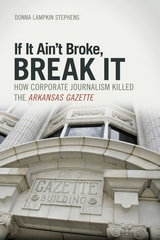
If It Ain't Broke, Break It
How Corporate Journalism Killed the Arkansas GazetteDonna Lampkin Stephens
University of Arkansas Press, 2015
Whereas the Heiskell/Patterson family had been committed to quality journalism, Gannett was focused on the bottom line. The corporation shifted the Gazette’s editorial focus from giving readers what they needed to be engaged citizens to informing them about what they should do in their leisure time. While in many ways the chain trivialized the Gazette’s mission, the paper managed to retain its superior quality. But financial concerns made the difference in Arkansas’s ongoing newspaper war. As the head of a privately held company, Hussman had only himself to answer to, and he never flinched while spending $42 million in his battle with the Pattersons and millions more against Gannett. Gannett ultimately lost $108 million during its five years in Little Rock; Hussman said his losses were far less but still in the tens of millions.
Gannett had to answer to nervous stockholders, most of whom had no tie to, or knowledge of, Arkansas or the Gazette. For Hussman, the Arkansan, the battle had been personal since at least 1978. It is no surprise that the corporation blinked first, and the Arkansas Gazette died on October 18, 1991, the victim of corporate journalism.
In The Break
The Aesthetics Of The Black Radical TraditionFred Moten
University of Minnesota Press, 2003
Investigates the connections between jazz, sexual identity, and radical black politics
In his controversial essay on white jazz musician Burton Greene, Amiri Baraka asserted that jazz was exclusively an African American art form and explicitly fused the idea of a black aesthetic with radical political traditions of the African diaspora. In the Break is an extended riff on “The Burton Greene Affair,” exploring the tangled relationship between black avant-garde in music and literature in the 1950s and 1960s, the emergence of a distinct form of black cultural nationalism, and the complex engagement with and disavowal of homoeroticism that bridges the two. Fred Moten focuses in particular on the brilliant improvisatory jazz of John Coltrane, Ornette Coleman, Albert Ayler, Eric Dolphy, Charles Mingus, and others, arguing that all black performance—culture, politics, sexuality, identity, and blackness itself—is improvisation.
For Moten, improvisation provides a unique epistemological standpoint from which to investigate the provocative connections between black aesthetics and Western philosophy. He engages in a strenuous critical analysis of Western philosophy (Heidegger, Kant, Husserl, Wittgenstein, and Derrida) through the prism of radical black thought and culture. As the critical, lyrical, and disruptive performance of the human, Moten’s concept of blackness also brings such figures as Frederick Douglass and Karl Marx, Cecil Taylor and Samuel R. Delany, Billie Holiday and William Shakespeare into conversation with each other.
Stylistically brilliant and challenging, much like the music he writes about, Moten’s wide-ranging discussion embraces a variety of disciplines—semiotics, deconstruction, genre theory, social history, and psychoanalysis—to understand the politicized sexuality, particularly homoeroticism, underpinning black radicalism. In the Break is the inaugural volume in Moten’s ambitious intellectual project-to establish an aesthetic genealogy of the black radical tradition
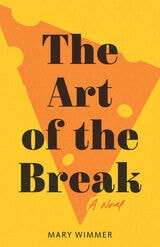
The Art of the Break
Mary Wimmer
University of Wisconsin Press, 2022
Hyperaware of her own childhood losses and the challenges posed by Rick’s PTSD and heavy drinking, Charlie strives to build a stable home for Lucy. Her degree in biochemistry from the University of Wisconsin gives her a leg up, and the quiet joys of working at the cheese vat provide a deep, healing peace that points the way toward happiness.
But Falls River is too narrow-minded to accept a female business owner, and Charlie is ill-prepared for the pettiness and conventions of small-town life. When debts come due, including a lien against her family’s land, she must quickly figure out who is on her side—and how to keep her dreams alive.
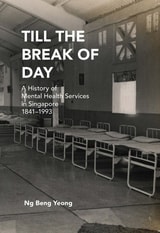
Till The Break of Day
A History of Mental Health Services in Singapore, 1841-1993Ng Beng Yeong
National University of Singapore Press, 2017
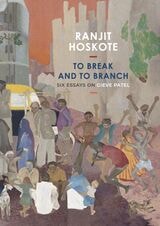
To Break and to Branch
Six Essays on Gieve PatelRanjit Hoskote
Seagull Books, 2024
To Break and to Branch is a collection of six essays on the artist Gieve Patel (1940–2023), written by poet, cultural theorist, and curator Ranjit Hoskote over nearly two decades, gathered together for the first time and accompanied by over fifty illustrations of Patel's paintings. In an introductory essay written especially for this edition, Hoskote looks back over the long friendship he shared with Patel, contextualizing it within the vibrant artistic milieu that was once special to Bombay, their home city: a milieu premised on a mutual curiosity that brought the arts together, hospitable to poetry, painting, theater, cinema, music, and architecture.
Embodying this spirit, Hoskote engages with Patel’s evolving oeuvre as a painter and his experiments with sculpture, while connecting them to his investments in poetry, theater, and his growing philosophical awareness of the more-than-human. Hoskote’s writings trace both the constant preoccupations and the changing interests that gave Patel’s art its distinctive character and reflect on the aesthetic, philosophical, and political dimensions of Patel’s gradual movement from a human-centric understanding of the world to a more holistic view as generated and sustained by interrelationships across orders of being.