Results by title
4 books match the query '1890 - 1930'
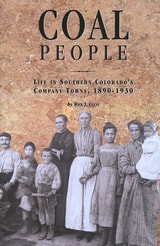
Coal People
Life in Southern Colorado's Company Towns, 1890-1930Rick J. Clyne
University Press of Colorado, 1999
Clyne reveals that a strong sense of community and tolerance existed in the camps, into which families journeyed from such far-flung locales as eastern and southern Europe to carve out a living. The shared immigrant experience—and the shared risks of mining—more often than not strengthened the bonds between both miners and families.
Coal People contains historic images of coal-town life culled from the collections of the Colorado Historical Society, as well as the author's own photographs of how several of these camps appear today.

Everyday Anarchism
Prefiguring Utopia in Spain and Argentina, 1890-1930Nathaniel Andrews
University of Illinois Press, 2027
In Spain and Argentina during the late nineteenth and early twentieth centuries, anarchists sought to build their ideal society in the present rather than wait for the revolution. These radicals built their daily lives around their beliefs—a far-sighted cultural project that shaped education, family life, leisure time, and moral values.
Nathaniel Andrews looks at life in four communities to explore how anarchists fused radical politics with the everyday. As Andrews shows, anarchists created networks across the Atlantic that not only shared people and ideas, but practices, too. Small actions—picnics, childrearing, using time differently—became a part of pursuing larger political goals. But these practices also revealed tensions within the movement by highlighting the gap separating ideas and actions, particularly in matters of gender.
Vivid and surprising, <i>Everyday Anarchism</i> reveals a daring program to model a radical society within the very world anarchism hoped to transform.

The Cult of Health and Beauty in Germany
A Social History, 1890-1930Michael Hau
University of Chicago Press, 2003
Hau argues that the obsession with personal health and fitness was often rooted in anxieties over professional and economic success, as well as fears that modern industrialized civilization was causing Germany and its people to degenerate. He also examines how different social groups gave different meanings to the same hygienic practices and aesthetic ideals. What results is a penetrating look at class formation in pre-Nazi Germany that will interest historians of Europe and medicine and scholars of culture and gender.

The Socialist Party of Argentina, 1890–1930
By Richard J. Walter
University of Texas Press, 1977
In the early part of the twentieth century, Argentina's Socialist Party became the largest and most effective socialist organization in Latin America. Richard J. Walter's interpretive study begins with the party's origins in the 1890s, traces its development through 1912, and then offers a comprehensive analysis of its activities and programs during the almost two decades of civilian, democratic government that ended with the military coup of 1930. His aim has been to provide a detailed case study of a Latin American political party within a specific historical context.
The work gives particular attention to the nature of party leadership, internal party organization, attempts to win the support of the Argentine working class, party activities in national elections and the National Congress, and internal disputes and divisions. In discussing these topics, Walter draws heavily on government documents, including national and municipal censuses, ministerial reports, and the Argentine Congressional Record. He also makes extensive use of national and party newspapers and journals, political memoirs, and collections of essays by party leaders.
Walter concludes that the party enjoyed relative electoral and legislative success because of efficient organization, capable leadership, and specific, well-reasoned programs. On the other hand, it failed to create a firm working-class base or to extend its influence much beyond Buenos Aires, mainly because of its inability to relate adequately to the needs of the proletariat and to the growth of nationalist sentiment. The analysis of these successes and failures also provides an important background for understanding the rise to power of Juan Perón and Peronism.