Results by title
6 books match the query '1890s'
Nashville in the 1890s
William Waller
Vanderbilt University Press, 1970
It is, however, not a complete insight into Nashville in the 1890s. Readers should take note that the book focuses almost exclusively on the experiences and worldviews of white Nashvillians. These stories have incredible value for local historians and anyone interested in Nashville history, but the book’s failure to deal with race—as evidenced by Waller’s belief that “the social order was thought to be providential,” which was clearly not true for Nashville’s Black residents who struggled against the unjust systems designed to oppress them—is a grave shortcoming.
The Cycling City
Bicycles and Urban America in the 1890sEvan Friss
University of Chicago Press, 2015
The Cycling City is a sharp history of the bicycle’s rise and fall in the late nineteenth century. In the 1890s, American cities were home to more cyclists, more cycling infrastructure, more bicycle friendly legislation, and a richer cycling culture than anywhere else in the world. Evan Friss unearths the hidden history of the cycling city, demonstrating that diverse groups of cyclists managed to remap cities with new roads, paths, and laws, challenge social conventions, and even dream up a new urban ideal inspired by the bicycle. When cities were chaotic and filthy, bicycle advocates imagined an improved landscape in which pollution was negligible, transportation was silent and rapid, leisure spaces were democratic, and the divisions between city and country were blurred. Friss argues that when the utopian vision of a cycling city faded by the turn of the century, its death paved the way for today’s car-centric cities—and ended the prospect of a true American cycling city ever being built.
The Cycling City
Bicycles and Urban America in the 1890sEvan Friss
University of Chicago Press, 2015
Cycling has experienced a renaissance in the United States, as cities around the country promote the bicycle as an alternative means of transportation. In the process, debates about the nature of bicycles—where they belong, how they should be ridden, how cities should or should not accommodate them—have played out in the media, on city streets, and in city halls. Very few people recognize, however, that these questions are more than a century old.
The Cycling City is a sharp history of the bicycle’s rise and fall in the late nineteenth century. In the 1890s, American cities were home to more cyclists, more cycling infrastructure, more bicycle friendly legislation, and a richer cycling culture than anywhere else in the world. Evan Friss unearths the hidden history of the cycling city, demonstrating that diverse groups of cyclists managed to remap cities with new roads, paths, and laws, challenge social conventions, and even dream up a new urban ideal inspired by the bicycle. When cities were chaotic and filthy, bicycle advocates imagined an improved landscape in which pollution was negligible, transportation was silent and rapid, leisure spaces were democratic, and the divisions between city and country were blurred. Friss argues that when the utopian vision of a cycling city faded by the turn of the century, its death paved the way for today’s car-centric cities—and ended the prospect of a true American cycling city ever being built.

The Fin-de-Siècle Poem
English Literary Culture and the 1890sJoseph Bristow
Ohio University Press, 2005
The Reckless Decade
America in the 1890sH.W. Brands
University of Chicago Press, 2002
Just as we do today, Americans of the 1890s faced changes in economics, politics, society, and technology that led to wrenching and sometimes violent tensions between rich and poor, capital and labor, white and black, East and West. In The Reckless Decade, H. W. Brands demonstrates that we can learn a lot about the contradictions that lie at the heart of America today by looking at them through the lens of the 1890s.
The 1890s saw the closing of the American frontier and a shift toward imperialist ambitions. Populists and muckrakers grappled with robber barons and gold-bugs. Americans addressed the unfinished business of Reconstruction by separating blacks and whites. Booker T. Washington, W. E. B. Du Bois, and other black leaders clashed over the proper response to continuing racial inequality. Those on top of the economic heap—Rockefeller, Carnegie, and Morgan—created vast empires of wealth, while those at the bottom worked for dimes a day. Brands brings all this to life in a vivid narrative filled with larger-than-life characters facing momentous challenges as they worked toward an uncertain future.
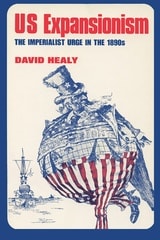
US Expansionism
The Imperialist Urge in the 1890sDavid Healy
University of Wisconsin Press, 1976
Americans, in viewing the globe in 1897, saw a world of empires that were dynamic and fast-growing. Western powers such as Germany, France, and particularly Great Britain were making colonial imperialism fashionable, and the United States, eager to flex its muscles as an emerging world power, was swept along with the European tide. One year later, the United States had truly established itself as a contender in the global game, victorious in a war with Spain and committed to imperialism.
In US Expansionism, David Healy examines this brief but important chapter in American history. Analyzing the various intellectual, cultural, and economic forces that engendered and shaped America’s imperialist drive, Healy also illustrates the key personalities involved, including the soon-to-be president, Theodore Roosevelt. A final section of the book examines the anti-imperialist opposition inspired by the new policy, and the ensuing debates about the proper role of American power.