Results by title
2 books match the query '1903-1963'
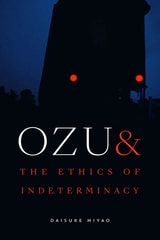
Ozu and the Ethics of Indeterminacy
Daisuke Miyao
Duke University Press, 2026
Ozu and the Ethics of Indeterminacy re-examines cinema studies through the work of Japanese filmmaker Yasujirō Ozu, employing the multiple methodologies and indeterminacy of Ozu’s films as a model for discussions of cinema’s relationship to the world and the formation of film studies as a discipline. Centering a selection of Ozu films in each chapter, Daisuke Miyao builds a method based on the way films directed by Ozu avoid unitary perspective and allow multiple possibilities of standpoint and spectatorial position, which Miyao calls the ethics of indeterminacy. Analyzing Ozu’s use of cinematography, narrative, and color, Miyao theorizes the indeterminate in film—the seen and unseen, human and nonhuman, domestic and international—to initiate a multi-directional dialogue on the study of cinema that reaches beyond auteurism and culturalism to establish a new basis for disciplinary conversations.
[more]

Ozu’s Anti-Cinema
Yoshida Kiju; Translated by Daisuke Miyao & Kyoko Hirano
University of Michigan Press, 2003
Yoshida starts his award-winning Ozu’s Anti-Cinema with a story about his trip to Ozu’s deathbed. Yoshida writes that a dying Ozu whispered to him twice, as if speaking to himself, “Cinema is drama, not accident.” These cryptic last words troubled Yoshida for decades, and throughout this book he examines Ozu’s films and tries to uncover what Ozu really meant.
Ozu’s Anti-Cinema concerns Ozu’s films, but it is also Yoshida’s manifesto on films and filmmaking. In other words, this book is Yoshida’s personal journey into Ozu’s thoughts on filmmaking and, simultaneously, into his own thoughts on the nature of cinema. Every page displays the sensibility of one artist discussing another—this is probably a book that only a filmmaker could write. Within Yoshida’s luminous prose lies a finely tuned, rigorous analysis of Ozu’s films, which have rarely been engaged as closely and personally as here.
[more]