Results by title
19 books match the query '1918-1933'

Beyond the Bauhaus
Cultural Modernity in Breslau, 1918-33Deborah Ascher Barnstone
University of Michigan Press, 2016
This richly illustrated volume is the first book in English to address this history, constituting an invaluable addition to the literature on the Weimar period. Its readership includes scholars of German history, art, architecture, urban design, planning, collecting, and exhibition history; of the avant-garde, and of the development of arts academies and arts pedagogy.

Constitutional Failure
Carl Schmitt in WeimarEllen Kennedy
Duke University Press, 2004
Kennedy reveals how Schmitt’s argument for a strong but neutral state supported the maximization of market freedom at the cost of the political constitution. She argues that the major fault lines of Weimar liberalism—emergency powers, the courts as “defenders of the constitution,” mass mobilization of anti-liberal politics, ethnic-identity politics, a culture of resentment and contested legitimacy—are not exceptions within the liberal-democratic orders of the West, but central to them. Contending that Schmitt’s thought remains vital today because liberal norms are inadequate to the political challenges facing constitutional systems as diverse as those of Eastern Europe and the United States, Kennedy develops a compelling, rigorous argument that unsettles many assumptions about liberalism, democracy, and dictatorship.

Hitler in History
Eberhard Jäckel
Brandeis University Press, 2000

In Search of "Aryan Blood"
Serology in Interwar and National Socialist GermanyRachel E. Boaz
Central European University Press, 2012
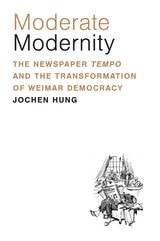
Moderate Modernity
The Newspaper Tempo and the Transformation of Weimar DemocracyJochen Hung
University of Michigan Press, 2023
The newspaper’s idea of a modern, democratic Germany was undermined by the political and economic crises that hit Germany at the beginning of the 1930s. The way the newspaper described German democracy changed under these pressures. Flappers, American fridges, and modern music—the things that Tempo had once marshalled as representatives of a German future—were now rejected by the newspaper as emblems of a bygone age. The changes in Tempo’s vision of Germany’s future show that descriptions of Weimar politics as a standoff between upright democrats and rabid extremists do not do justice to the historical complexity of the period. Rather, we need to accept the Nazis as a lethal product of a German democracy itself. The history of Tempo teaches us how liberal democracies can create and nurture their own worst enemies.

Murder Scenes
Normality, Deviance, and Criminal Violence in Weimar BerlinSace Elder
University of Michigan Press, 2010
---Kenneth Ledford, Case Western Reserve University
Nazi Ideology before 1933
A DocumentationIntroduced and translated by Barbara Miller Lane and Leila J. Rupp
University of Texas Press, 1978
This volume brings together a hitherto scattered and inaccessible body of material crucial to the understanding of the evolution of Nazi political thought. Before the publication of this volume, scholars had virtually ignored the extensive writings and programs published by leading Nazi ideologues before 1933. Barbara Miller Lane and Leila J. Rupp have collected the political writings of Nazi theorists—Dietrich Eckart, Alfred Rosenberg, Gottfried Feder, Joseph Goebbels, Gregor and Otto Strasser, Heinrich Himmler, and Richard Walther Darré—during the period before the National Socialists came to power. The Strassers are given considerable space because of their great intellectual importance within the party before 1933. In commentary by the editors, the significance of each Nazi theorist is weighed and evaluated at each stage of the history of the party.
Lane and Rupp conclude that Nazi ideology, before 1933 at least, was not a consistent whole but a doctrine in the process of rapid development to which new ideas were continually introduced. By the time the Nazis came to power, however, a group of interrelated assertions and official promises had been made to party followers and to the public. Hitler and the Third Reich had to accommodate this ideology, even when not implementing it. Hitler’s role in the development of Nazi ideology, interpreted here as a very permissive one, is thoroughly assessed. His own writings, however, have been omitted since they are readily available elsewhere.
The twenty-eight documents included in this book illustrate themes and phases in Nazi ideology which are discussed in the introduction and the detailed prefatory notes. Long selections, as often as possible full-length, are provided to allow the reader to follow the arguments. Each selection is accompanied by an introductory note and annotations which clarify its relationship to other works of the author and other writings of the period. Also included are original translations of the “Twenty-Five Points” and a number of little-known official party statements.
Passing Illusions
Jewish Visibility in Weimar GermanyKerry Wallach
University of Michigan Press, 2017

Popular Sovereignty and the Crisis of German Constitutional Law
The Theory and Practice of Weimar ConstitutionalismPeter C. Caldwell
Duke University Press, 1997
Caldwell makes accessible the rich literature in German constitutional thought of the Weimar period, most of which has been unavailable in English until now. On the liberal left, Hugo Preuss and Hans Kelsen defended a concept of democracy that made the constitution sovereign and, in a way, created the "Volk" through constitutional procedure. On the right, Carl Schmitt argued for a substantial notion of the "Volk" that could overrule constitutional procedure in a state of emergency. Rudolf Smend and Heinrich Triepel located in the constitution a set of inviolable values of the political community, while Hermann Heller saw in it a guarantee of substantial social equality. Drawing on the work of these major players from the 1920s, Caldwell reveals the various facets of the impassioned constitutional struggles that permeated German legal and political culture during the Weimar Republic.

Society, Culture, and the State in Germany, 1870-1930
Geoff Eley, Editor
University of Michigan Press, 1997

Stop Reading! Look!
Modern Vision and the Weimar Photographic BookPepper Stetler
University of Michigan Press, 2015

The Brown Plague
Travels in Late Weimar and Early Nazi GermanyDaniel Guérin
Duke University Press, 1994
Guérin’s travels took him across the countryside and into the cities of Germany. He describes with extraordinary clarity, for example, his encounters with large groups of unemployed workers in Berlin and the spectacle of Goering presiding over the Reichstag. Staying in youth hostels, Guérin met individuals representing a range of various groups and movements, including the Wandervögel, leftist brigades, Hitler Youth, and the strange, semicriminal sexual underground of the Wild-frei. Devoting particular attention to the cultural politics of fascism and the lure of Nazism for Germany’s disaffected youth, he describes the seductive rituals by which the Nazis were able to win over much of the population. As Robert Schwartzwald makes clear in his introduction, Guérin’s interest in Germany at this time was driven, in part, by a homoerotic component that could not be stated explicitly in his published material. This excellent companion essay also places The Brown Plague within a broad historical and literary context while drawing connections between fascism, aesthetics, and sexuality.
Informed by an epic view of class struggle and an admiration for German culture, The Brown Plague, a notable primary source in the literature of modern Europe, provides a unique view onto the rise of Nazism.
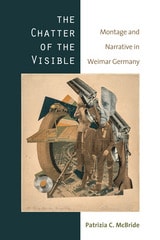
The Chatter of the Visible
Montage and Narrative in Weimar GermanyPatrizia C. McBride
University of Michigan Press, 2016
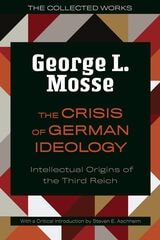
The Crisis of German Ideology
Intellectual Origins of the Third ReichGeorge L. Mosse
University of Wisconsin Press, 2021
George L. Mosse (1918–99) was a legendary scholar, teacher, and mentor. A refugee from Nazi Germany, in 1955 he joined the Department of History at the University of Wisconsin–Madison, where he was both influential and popular. Mosse was an early leader in the study of modern European cultural and intellectual history, fascism, and the history of sexuality and masculinity. Over his career he authored more than two dozen books.
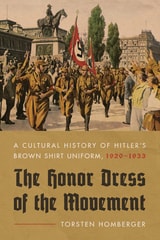
The Honor Dress of the Movement
A Cultural History of Hitler’s Brown Shirt Uniform, 1920–1933Torsten Homberger
University of Massachusetts Press, 2021
In The Honor Dress of the Movement, Torsten Homberger contends that the brown-shirted Stormtrooper uniform was central to Hitler's rise to power. By analyzing its design and marketing, he investigates how Nazi leaders used it to project a distinct political and military persona that was simultaneously violent and orderly, retrograde and modern—a dual image that proved popular with the German people and was key to the Nazis' political success. Based on a wealth of sources that includes literature, films, and newspapers of the era, Homberger exhibits how the Nazis shaped and used material culture to destroy democracy.
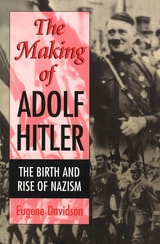
The Making of Adolf Hitler
The Birth and Rise of NazismEugene Davidson
University of Missouri Press, 1997
The harsh Armistice terms of 1918, the short-lived Weimar Republic, Hindenburg's senile vacillations, and behind-the-scene power plays form the backbone of this excellent study covering German history during the first three-and-a-half decades of the century.
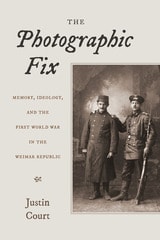
The Photographic Fix
Memory, Ideology, and the First World War in the Weimar RepublicJustin Court
University of Michigan Press, 2026
The Weimar Origins of Rhetorical Inquiry
David L. Marshall
University of Chicago Press, 2020
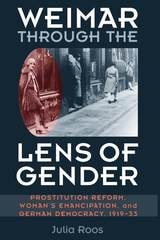
Weimar through the Lens of Gender
Prostitution Reform, Woman's Emancipation, and German Democracy, 1919-33Julia Roos
University of Michigan Press, 2010
"This book will make a valuable contribution to the field of German history, as well as the histories of gender and sexuality. The argument that Weimar feminism did bring about tangible gains for women needs to be made, and Roos has done so convincingly."
---Julia Sneeringer, Queens College
Until 1927, Germany had a system of state-regulated prostitution, under which only those prostitutes who submitted to regular health checks and numerous other restrictions on their personal freedom were tolerated by the police. Male clients of prostitutes were not subject to any controls. The decriminalization of prostitution in 1927 resulted from important postwar gains in women's rights; yet this change---while welcomed by feminists, Social Democrats, and liberals—also mobilized powerful conservative resistance. In the early 1930s, the right-wing backlash against liberal gender reforms like the 1927 prostitution law played a fateful role in the downfall of the Weimar Republic and the rise of Nazism.
Weimar through the Lens of Gender combines the political history of early twentieth-century Germany with analytical perspectives derived from the fields of gender studies and the history of sexuality. The book's argument will be of interest to a broad readership: specialists in the fields of gender studies and the history of sexuality, as well as historians and general readers interested in Weimar and Nazi Germany.
Julia Roos is Assistant Professor of History at Indiana University, Bloomington.
Jacket art: "Hamburg, vermutlich St. Pauli, 1920er–30er Jahre," photographer unknown, s/w-Fotografie. (Courtesy of the Museum für Hamburgische Geschichte.)