Results by title
6 books match the query '1942-2016'

Muhammad Ali, the People's Champ
Edited by Elliott J. Gorn
University of Illinois Press, 1995
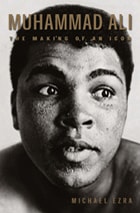
Muhammad Ali
The Making of an IconMichael Ezra
Temple University Press, 2009
Muhammad Ali (born Cassius Clay) has always engendered an emotional reaction from the public. From his appearance as an Olympic champion to his iconic status as a national hero, his carefully constructed image and controversial persona has always been intensely scrutinized. In Muhammad Ali, Michael Ezra considers the boxer who calls himself “The Greatest” from a new perspective. He writes about Ali’s pre-championship bouts, the management of his career and his current legacy, exploring the promotional aspects of Ali and how they were wrapped up in political, economic, and cultural “ownership.”
Ezra’s incisive study examines the relationships between Ali’s cultural appeal and its commercial manifestations. Citing examples of the boxer’s relationship to the Vietnam War and the Nation of Islam—which serve as barometers of his “public moral authority”—Muhammad Ali analyzes the difficulties of creating and maintaining these cultural images, as well as the impact these themes have on Ali’s meaning to the public.
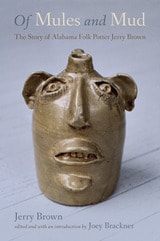
Of Mules and Mud
The Story of Alabama Folk Potter Jerry BrownJerry Brown, edited and with an introduction by Joey Brackner
University of Alabama Press, 2022
The life and times of Alabama folk potter Jerry Brown, as told in his own words
Born in 1942, Jerry Brown helped out in his father’s pottery shop as a young boy. There he learned the methods and techniques for making pottery in a family tradition dating back to the 1830s. His responsibilities included tending the mule that drove the mill that was used to mix clay (called “mud” by traditional potters). Business suffered as demand for stoneware churns, jugs, and chamber pots waned in the postwar years, and manufacture ceased following the deaths of Brown’s father and brother in the mid-1960s. Brown turned to logging for his livelihood, his skill with mules proving useful in working difficult and otherwise inaccessible terrain. In the early 1980s, he returned to the family trade and opened a new shop that relied on the same methods of production with which he had grown up, including a mule-powered mill for mixing clay and the use of a wood-fired rather than gas-fueled kiln.
Folklorist Joey Brackner met Brown in 1983, and the two quickly became close friends who collaborated together on a variety of documentary and educational projects in succeeding years—efforts that led to greater exposure, commercial success, and Brown’s recognition as a National Heritage Fellow by the National Endowment for the Arts. For years, Brown spoke of the urge to write his life story, but he never set pen to paper. In 2015, Brackner took the initiative and interviewed Brown, recording his life story over the course of a weekend at Brown’s home. Of Mules and Mud is the result of that marathon interview session, conducted one year before Brown passed away.
Brackner has captured Jerry Brown’s life in his own words as recounted that weekend, lightly edited and elaborated. Of Mules and Mud is illustrated with photos from all phases of Brown’s life, including a color gallery of 28 photos of vessel forms made by Brown throughout his career that collectors of folk pottery will find invaluable.
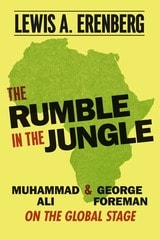
The Rumble in the Jungle
Muhammad Ali and George Foreman on the Global StageLewis A. Erenberg
University of Chicago Press, 2019
TheRumble in the Jungle orbits around Ali and Foreman, placing them at the convergence of the American Civil Rights movement and the Great Society, the rise of Islamic and African liberation efforts, and the ongoing quest to cast off the shackles of colonialism. With his far-reaching take on sports, music, marketing, and mass communications, Erenberg shows how one boxing match became nothing less than a turning point in 1970s culture.
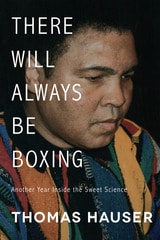
There Will Always Be Boxing
Another Year Inside the Sweet ScienceThomas Hauser
University of Arkansas Press, 2017
There Will Always Be Boxing continues this tradition of excellence. A poignant look at Muhammad Ali—whose life was celebrated throughout the world following his death on June 3, 2016—highlights this collection of Hauser’s work. The year’s biggest fights are, as always, put in perspective. And once again, Hauser takes readers behind the scenes, giving them a seat at the table with boxing’s biggest power brokers as he reveals the inner workings of the sport and business of boxing.
There Will Always Be Boxing is sure not to disappoint the readers, writers, and critics who look forward to Hauser’s annual collection of articles about the contemporary boxing scene. This collection shows, once again, why Hauser is one of the last real champions of boxing and one of the very best who has ever written about the sport.

What's My Name
Black Vernacular IntellectualsGrant Farred
University of Minnesota Press, 2003
Whom does society consider an intellectual and on what grounds? Antonio Gramsci’s democratic vision of intelligence famously suggested that “all men are intellectuals,” yet within academic circles and among the general public, intellectuals continue to be defined by narrow, elite criteria.
In this study of four celebrated citizens of the African diaspora—American boxer Muhammad Ali, West Indian Marxist critic C. L. R. James, British cultural theorist Stuart Hall, and Jamaican musician Bob Marley—Grant Farred develops a new category of engaged thinker: the vernacular intellectual. Extending Gramsci’s concept of the organic intellectual, Farred conceives of vernacular intellectuals as individuals who challenge social injustice from inside and outside traditional academic or political spheres. Muhammad Ali, for example, is celebrated as much for his dazzling verbal skills and courageous political stands as for his pugilistic talents; Bob Marley’s messages of liberation are as central to his popularity as his lyrical and melodic sophistication. Neither man is described as an intellectual, yet both perform crucial intellectual functions: shaping how people see the world, oppose hegemony, and understand their own history. In contrast, the careers of C. L. R. James and Stuart Hall reflect a dynamic blend of the traditional and the vernacular. Conventionally trained and situated, James and Hall examine racism, history, and the lasting impact of colonialism in ways that draw on both established scholarship and more popular cultural experiences.
Challenging existing paradigms, What’s My Name offers an expansive and inclusive vision of intellectual activity that is as valid and meaningful in the boxing ring, the press conference, and the concert hall as in academia.