Results by title
3 books match the query '1953-1985'
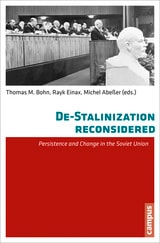
De-Stalinisation Reconsidered
Persistence and Change in the Soviet UnionEdited by Thomas M. Bohn, Rayk Einax, and Michel Abeßer
Campus Verlag, 2014
Joseph Stalin’s death was a defining event in Soviet history. In its aftermath, the state was forced to reconceive its political, economic, social, and cultural identity. This volume includes new contributions from an international collection of researchers that critically engage with this period of de-Stalinization in the Soviet Union. Together, they offer fresh perspectives not just on Stalinism, but also on questions of change and continuity in Soviet politics, modernization, and society more generally, moving broad-scale processes such as urbanization into the center of interpreting Soviet history. And in so doing, De-Stalinisation Reconsidered makes clear that the Soviet history of the 1950s and ’60s is crucial for understanding not only glasnost and perestroika, but contemporary Russia, as well.
[more]
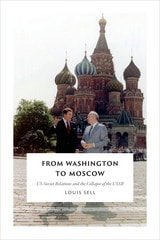
From Washington to Moscow
US-Soviet Relations and the Collapse of the USSRLouis Sell
Duke University Press, 2016
When the United States and the Soviet Union signed the first Strategic Arms Limitation Talks accords in 1972 it was generally seen as the point at which the USSR achieved parity with the United States. Less than twenty years later the Soviet Union had collapsed, confounding experts who never expected it to happen during their lifetimes. In From Washington to Moscow veteran US Foreign Service officer Louis Sell traces the history of US–Soviet relations between 1972 and 1991 and explains why the Cold War came to an abrupt end. Drawing heavily on archival sources and memoirs—many in Russian—as well as his own experiences, Sell vividly describes events from the perspectives of American and Soviet participants. He attributes the USSR's fall not to one specific cause but to a combination of the Soviet system's inherent weaknesses, mistakes by Mikhail Gorbachev, and challenges by Ronald Reagan and other US leaders. He shows how the USSR's rapid and humiliating collapse and the inability of the West and Russia to find a way to cooperate respectfully and collegially helped set the foundation for Vladimir Putin’s rise.
[more]
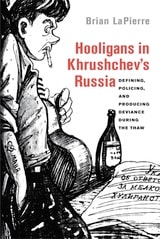
Hooligans in Khrushchev's Russia
Defining, Policing, and Producing Deviance during the ThawBrian LaPierre
University of Wisconsin Press, 2012
Swearing, drunkenness, promiscuity, playing loud music, brawling—in the Soviet Union these were not merely bad behavior, they were all forms of the crime of "hooliganism." Defined as "rudely violating public order and expressing clear disrespect for society," hooliganism was one of the most common and confusing crimes in the world's first socialist state. Under its shifting, ambiguous, and elastic terms, millions of Soviet citizens were arrested and incarcerated for periods ranging from three days to five years and for everything from swearing at a wife to stabbing a complete stranger.
Hooligans in Khrushchev's Russia offers the first comprehensive study of how Soviet police, prosecutors, judges, and ordinary citizens during the Khrushchev era (1953–64) understood, fought against, or embraced this catch-all category of criminality. Using a wide range of newly opened archival sources, it portrays the Khrushchev period—usually considered as a time of liberalizing reform and reduced repression—as an era of renewed harassment against a wide range of state-defined undesirables and as a time when policing and persecution were expanded to encompass the mundane aspects of everyday life. In an atmosphere of Cold War competition, foreign cultural penetration, and transatlantic anxiety over "rebels without a cause," hooliganism emerged as a vital tool that post-Stalinist elites used to civilize their uncultured working class, confirm their embattled cultural ideals, and create the right-thinking and right-acting socialist society of their dreams.
Hooligans in Khrushchev's Russia offers the first comprehensive study of how Soviet police, prosecutors, judges, and ordinary citizens during the Khrushchev era (1953–64) understood, fought against, or embraced this catch-all category of criminality. Using a wide range of newly opened archival sources, it portrays the Khrushchev period—usually considered as a time of liberalizing reform and reduced repression—as an era of renewed harassment against a wide range of state-defined undesirables and as a time when policing and persecution were expanded to encompass the mundane aspects of everyday life. In an atmosphere of Cold War competition, foreign cultural penetration, and transatlantic anxiety over "rebels without a cause," hooliganism emerged as a vital tool that post-Stalinist elites used to civilize their uncultured working class, confirm their embattled cultural ideals, and create the right-thinking and right-acting socialist society of their dreams.
[more]