Results by title
25 books match the query 'Lines'
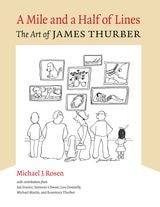
A Mile and a Half of Lines
The Art of James ThurberMichael J. Rosen, with contributions from Ian Frazier, Seymour Chwast, Liza Donnelly, Michael Maslin, and Rosemary Thurber
The Ohio State University Press, 2019
Including some 260 drawings, this collection is the first comprehensive focus on his work as an artist, a cartoonist, and an illustrator. With commentary from a host of preeminent cartoonists and writers, including Ian Frazier, Seymour Chwast, and Michael Maslin, A Mile and a Half of Lines celebrates the significance of Thurber’s spontaneous, unstudied, and novel drawing style that not only altered the nature of American cartooning but also expanded the very possibilities of an illustrated line. Coinciding with the first major retrospective of Thurber’s art presented by the Columbus Museum of Art in 2019, A Mile and a Half of Lines showcases both classic Thurber as well as visual material never before seen in print.
Behind the Lines
Bugulma and Other StoriesJaroslav Hasek
Karolinum Press, 2012
Jaroslav Hašek is a Czech writer most famous for his wickedly funny, widely read, yet incomplete novel The Good Soldier Schweik, a series of absurdist vignettes about a recalcitrant WWI soldier. Hašek—in spite of a life of buffoonery and debauchery—was remarkably prolific. He wrote hundreds of short stories that all display both his extraordinary gift for satire and his profound distrust of authority. Behind the Lines presents a series of nine short stories first published in the Prague Tribune and considered to be some of Hašek’s best. Based on his experiences as a Red Commissar in the Russian Civil War and his return to Czechoslovakia, Behind the Lines focuses on the Russian town of Bugulma, taking aim, with mordant wit, at the absurdities of a revolution.
Providing important background and insight into The Good Soldier Schweik, this collection by a writer some call the Bolshevik Mark Twain is nevertheless much more than a tool for understanding his better-known novel; it is a significant work in its own right. A hidden gem remarkable for its modern, ribald sense of humor, Behind the Lines is an enjoyable, fast-paced anthology of great literary and historical value.
Behind the Lines
Bugulma and Other StoriesJaroslav Hasek
Karolinum Press, 2012
Jaroslav Hašek is a Czech writer most famous for his wickedly funny, widely read, yet incomplete novel The Good Soldier Schweik, a series of absurdist vignettes about a recalcitrant WWI soldier. Hašek—in spite of a life of buffoonery and debauchery—was remarkably prolific. He wrote hundreds of short stories that all display both his extraordinary gift for satire and his profound distrust of authority. Behind the Lines presents a series of nine short stories first published in the Prague Tribune and considered to be some of Hašek’s best. Based on his experiences as a Red Commissar in the Russian Civil War and his return to Czechoslovakia, Behind the Lines focuses on the Russian town of Bugulma, taking aim, with mordant wit, at the absurdities of a revolution.
Providing important background and insight into The Good Soldier Schweik, this collection by a writer some call the Bolshevik Mark Twain is nevertheless much more than a tool for understanding his better-known novel; it is a significant work in its own right. A hidden gem remarkable for its modern, ribald sense of humor, Behind the Lines is an enjoyable, fast-paced anthology of great literary and historical value.
Behind the Lines
War Resistance Poetry on the American Home Front since 1941Philip Metres
University of Iowa Press, 2007
Behind the Lines investigates American war resistance poetry from the Second World War through the Iraq wars. Rather than simply chronicling the genre, Philip Metres argues that this poetry gets to the heart of who is authorized to speak about war and how it can be represented. As such, he explores a largely neglected area of scholarship: the poet’s relationship to dissenting political movements and the nation.
In his elegant study, Metres examines the ways in which war resistance is registered not only in terms of its content but also at the level of the lyric. He proposes that protest poetry constitutes a subgenre that—by virtue of its preoccupation with politics, history, and trauma—probes the limits of American lyric poetry. Thus, war resistance poetry—and the role of what Shelley calls unacknowledged legislators—is a crucial, though largely unexamined, body of writing that stands at the center of dissident political movements.
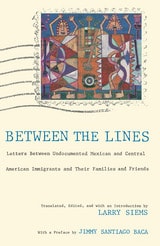
Between the Lines
Letters Between Undocumented Mexican and Latin American Immigrants and Their Families and FriendsLarry Siems
University of Arizona Press, 1992
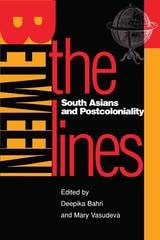
Between the Lines
South Asians and Postcolonialityedited by Deepika Bahri and Mary Vasudeva
Temple University Press, 1996
This ground-breaking collection of new interviews, critical essays, and commentary explores South Asian identity and culture. Sensitive to the false homogeneity implied by "South Asian," "diaspora," "postcolonial," and "Asian American," the contributors attempt to unpack these terms. By examining the social, economic, and historical particularities of people who live "between the lines"—on and between borders—they reinstate questions of power and privilege, agency and resistance. As South Asians living in the United States and Canada, each to some degree must reflect on the interaction of the personal "I," the collective "we," and the world beyond.
The South Asian scholars gathered together in this volume speak from a variety of theoretical perspectives; in the essays and interviews that cross the boundaries of conventional academic disciplines, they engage in intense, sometimes contentious, debate.
Contributors: Meena Alexander, Gauri Viswanathan, Gayatri Chakravorty Spivak, Amritjit Singh, M. G. Vassanji, Sohail Inayatullah, Ranita Chatterjee, Benita Mehta, Sanjoy Majumder, Mahasveta Barua, Sukeshi Kamra, Samir Dayal, Pushpa Naidu Parekh, Indrani Mitra, Huma Ibrahim, Amitava Kumar, Shantanu DuttaAhmed, Uma Parameswaran.
In the series Asian American History and Culture, edited by Sucheng Chan, David Palumbo-Liu, Michael Omi, K. Scott Wong, and Linda Trinh Võ.
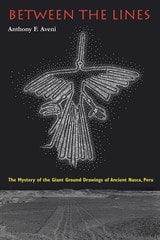
Between the Lines
The Mystery of the Giant Ground Drawings of Ancient Nasca, PeruBy Anthony F. Aveni
University of Texas Press, 2000
The Nasca Lines are one of the world's great enigmas. Who etched the more than 1,000 animal, human, and geometric figures that cover 400 square miles of barren pampa in southern Peru? How did the makers create lifelike images of monkeys, birds, and spiders without an aerial vantage point from which to view these giant figures that stretch across thousands of square yards? Most puzzling of all, why did the ancient Nasca lay out these lines and images in the desert? These are the questions that pioneering archaeoastronomer Anthony Aveni seeks to answer in this book.
Writing for a wide public audience, Aveni begins by establishing the Nasca Lines as a true wonder of the ancient world. He describes how viewers across the centuries have tried to interpret the lines and debunks the wilder theories. Then he vividly recounts his own years of exploration at Nasca in collaboration with other investigators and the discoveries that have answered many of the riddles about who made the Nasca Lines, when, and for what purposes. This fascinating overview of what the leading expert and his colleagues currently understand about the lines is required reading for everyone intrigued by ancient mysteries.
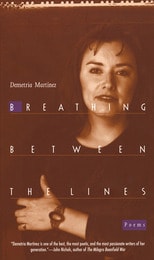
Breathing Between the Lines
PoemsDemetria Martínez
University of Arizona Press, 1997
Weaving together threads of love and family, social conviction and activism, loss and renewal, Breathing between the Lines carries the reader deep inside the head and heart of a talented Chicana writer. Page by page, the journey is an exhilarating one. What we find at the end is up to us.
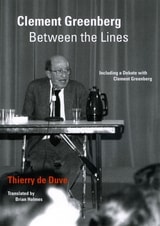
Clement Greenberg Between the Lines
Including a Debate with Clement GreenbergThierry de Duve
University of Chicago Press, 2010
Clement Greenberg (1909–1994), champion of abstract expressionism and modernism—of Pollock, Miró, and Matisse—has been esteemed by many as the greatest art critic of the second half of the twentieth century, and possibly the greatest art critic of all time. This volume, a lively reassessment of Greenberg’s writings, features three approaches to the man and his work: Greenberg as critic, doctrinaire, and theorist. The book also features a transcription of a public debate with Greenberg that de Duve organized at the University of Ottawa in 1988. Clement Greenberg Between the Lines will be an indispensable resource for students, scholars, and enthusiasts of modern art.
“In this compelling study, Thierry de Duve reads Greenberg against the grain of the famous critic’s critics—and sometimes against the grain of the critic himself. By reinterpreting Greenberg’s interpretations of Pollock, Duchamp, and other canonical figures, de Duve establishes new theoretical coordinates by which to understand the uneasy complexities and importance of Greenberg’s practice.” John O’Brian, editor of Clement Greenberg: The Collected Essays and Criticisms
“De Duve is an expert on theoretical aesthetics and thus well suited to reassess the formalist tenets of the late American art critic's theory on art and culture. . . . De Duve's close readings of Greenberg . . . contain much of interest, and the author clearly enjoys matching wits with ‘the world's best known art critic.’” Library Journal
Disability and Passing
Blurring the Lines of IdentityJeffrey A Brune
Temple University Press, 2013
Passing—an act usually associated with disguising race—also relates to disability. Whether a person classified as mentally ill struggles to suppress aberrant behavior to appear "normal" or a person falsely claims a disability to gain some advantage, passing is a pervasive and much discussed phenomenon. Nevertheless, Disability and Passing is the first anthology to examine this issue.
The editors and contributors to this volume explore the intersections of disability, race, gender, and sexuality as these various aspects of identity influence each other and make identity fluid. They argue that the line between disability and normality is blurred, discussing disability as an individual identity and as a social category. And they discuss the role of stigma in decisions about whether or not to pass.
Focusing on the United States from the nineteenth century to the present, the essays in Disability and Passing speak to the complexity of individual decisions about passing and open the conversation for broader discussion.
Contributors include: Dea Boster, Allison Carey, Peta Cox, Kristen Harmon, David Linton, Michael Rembis, and the editors.
Fidel between the Lines
Paranoia and Ambivalence in Late Socialist Cuban CinemaLaura-Zoë Humphreys
Duke University Press, 2019
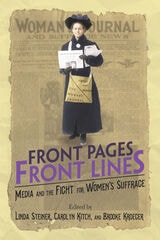
Front Pages, Front Lines
Media and the Fight for Women's SuffrageEdited by Linda Steiner, Carolyn Kitch, and Brooke Kroeger
University of Illinois Press, 2020
This collection offers new research on media issues related to the women's suffrage movement. Contributors incorporate media theory, historiography, and innovative approaches to social movements while discussing the vexed relationship between the media and debates over suffrage. Aiming to correct past oversights, the essays explore overlooked topics such as coverage by African American and Mormon-oriented media, media portrayals of black women in the movement, suffragist rhetorical strategies, elites within the movement, suffrage as part of broader campaigns for social transformation, and the influence views of white masculinity had on press coverage.
Contributors: Maurine H. Beasley, Sherilyn Cox Bennion, Jinx C. Broussard, Teri Finneman, Kathy Roberts Forde, Linda M. Grasso, Carolyn Kitch, Brooke Kroeger, Linda J. Lumsden, Jane Marcellus, Jane Rhodes, Linda Steiner, and Robin Sundaramoorthy
Lines in the Sand
Congressional Redistricting in Texas and the Downfall of Tom DeLayBy Steve Bickerstaff
University of Texas Press, 2007
The events of 2003 in Texas were important to the political history of this country. Congressman Tom DeLay led a Republican effort to gerrymander the state's thirty-two congressional districts to defeat all ten of the Anglo Democratic incumbents and to elect more Republicans; Democratic state lawmakers fled the state in an effort to defeat the plan. The Lone Star State uproar attracted attention worldwide. The Republicans won this showdown, gaining six additional seats from Texas and protecting the one endangered Republican incumbent. Some of the methods used by DeLay to achieve this result, however, led to his criminal indictment and ultimately to his downfall.
With its eye-opening research, readable style, and insightful commentary, Lines in the Sand provides a front-line account of what happened in 2003, often through the personal stories of members of both parties and of the minority activist groups caught in a political vortex. Law professor Steve Bickerstaff provides much-needed historical perspective and also probes the aftermath of the 2003 redistricting, including the criminal prosecutions of DeLay and his associates and the events that led to DeLay's eventual resignation from the U.S. House of Representatives. As a result, Bickerstaff graphically shows a dark underside of American politics—the ruthless use of public institutional power for partisan gain.
Lines of Activity
Performance, Historiography, Hull-House DomesticityShannon Jackson
University of Michigan Press, 2001
This groundbreaking book demonstrates how performance analysis can contribute to the historical study of American reform as well as to critical inquiry on the arts and social change. She develops connections between performativity and sex/gender difference by interpreting Hull-House as a sphere of queer kinship and alternative gender performance. Lines of Activity also engages a variety of debates on the nature of historical representation, and the role of "theory" in historical writing.
As the notion of "performance historiography" gains currency, Jackson's study exposes the gender politics of such scholarly trends. By selecting the Progressive Era and Hull-House as arenas of inquiry, Jackson foregrounds how past discourses of domesticity, pragmatism, transnationalism, and environmentalism already contain performance-centered notions of identity, space, and community. Through these and other arguments, Lines of Activity reveals the intimate connection between a history of Hull-House performance and the performance of Hull-House history.
Shannon Jackson is Assistant Professor of Rhetoric and of Dramatic Art and Dance, University of California, Berkeley.
Lines of Connection
Drawing and Printmaking, 1400-1850Edina Adam
J. Paul Getty Trust, The, 2025
While often viewed and studied separately, drawings and prints have always been closely intertwined. They facilitated and generated the production of one another, and in some instances, clear distinctions between the two dissolved. Many artists created drawings specifically intended for translation into print, and an even greater number used prints as a training tool, copying from them to hone drawing skills. This reciprocal relationship goes even deeper, however, as innovative artists made fascinating hybrid works that blurred the boundaries between the two media, pushing against modern definitions and hierarchies.
Lines of Connection charts these historical and geographical continuities for the first time by bringing together works on paper of superb quality, foregrounding issues of artistic process and collaboration, technical innovation, and creative ingenuity. Featuring over 170 prints and drawings by such artists as Albrecht Dürer, Parmigianino, Hendrick Goltzius, Maria Sibylla Merian, Rembrandt van Rijn, and William Blake, this catalogue is a rich narrative introduction to the compelling, yet understudied, relationship between drawing and printmaking.
This volume is published to accompany an exhibition on view at The Art Institute of Chicago from March 15 to June 1, 2025 and at the J. Paul Getty Museum at the Getty Center from July 1 to September 14, 2025.
Lines of Flight
Discursive Time and Countercultural Desire in the Work of Thomas PynchonStefan Mattessich
Duke University Press, 2002
Mattessich theorizes a new kind of time—subjective displacement—dramatized in the parody, satire, and farce deployed through Pynchon’s oeuvre. In particular, he is interested in showing how this sense of time relates to the counterculture of the 1960s and 1970s. Examining this movement as an instance of flight or escape and exposing the beliefs behind it, Mattessich argues that the counterculture’s rejection of the dominant culture ultimately became an act of self-cancellation, a rebellion in which the counterculture found itself defined by the very order it sought to escape. He points to parallels in Pynchon’s attempts to dramatize and enact a similar experience of time in the doubling-back, crisscrossing, and erasure of his writing. Mattessich lays out a theory of cultural production centered on the ethical necessity of grasping one’s own susceptibility to discursive forms of determination.
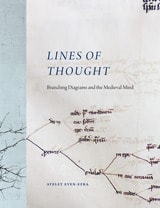
Lines of Thought
Branching Diagrams and the Medieval MindAyelet Even-Ezra
University of Chicago Press, 2021
These diagrams not only allow a glimpse into the thinking practices of the past but also constitute a chapter in the history of how people learned to rely on external devices—from stone to parchment to slide rules to smartphones—for recording, storing, and processing information. Beautifully illustrated throughout with previously unstudied and unedited diagrams, Lines of Thought is a historical overview of an important cognitive habit, providing a new window into the world of medieval scholars and their patterns of thinking.
Lines of Thought
Discourse, Architectonics, and the Origin of Modern PhilosophyClaudia Brodsky Lacour
Duke University Press, 1996
While Cartesianism has long served as a synonym for rationalism, the contents of Descartes’s method and cogito have remained infamously resistant to rational analysis. Similarly, although modern phenomenological analyses descend from Descartes’s notion of intuition, the “things” Cartesian intuitions represent bear no resemblance to phenomena. By returning to what Descartes calls the construction of his “foundation” in the Discours, Brodsky Lacour identifies the conceptual problems at the root of Descartes’s literary and aesthetic theory as well as epistemology. If, for Descartes, linear extension and “I” are the only “things” we can know exist, the Cartesian subject of thought, she shows, derives first from the intersection of discourse and drawing, representation and matter. The crux of that intersection, Brodsky Lacour concludes, is and must be the cogito, Descartes’s theoretical extension of thinking into material being. Describable in accordance with the Géométrie as a freely constructed line of thought, the cogito, she argues, extends historically to link philosophy with theories of discursive representation and graphic delineation after Descartes. In conclusion, Brodsky Lacour analyzes such a link in the writings of Claude Perrault, the architectural theorist whose reflections on beauty helped shape the seventeenth-century dispute between “the ancients and the moderns.”
Part of a growing body of literary and interdisciplinary considerations of philosophical texts, Lines of Thought will appeal to theorists and historians of literature, architecture, art, and philosophy, and those concerned with the origin and identity of the modern.
Mechademia 7
Lines of SightFrenchy Lunning
University of Minnesota Press, 2012
Lines of Sight—the seventh volume in the Mechademia series, an annual forum devoted to Japanese anime and manga—explores the various ways in which anime, manga, digital media, fan culture, and Japanese art—from scroll paintings to superflat—challenge, undermine, or disregard the concept of Cartesian (or one-point) perspective, the dominant mode of visual culture in the West since the seventeenth century. More than just a visual mode or geometric system, Cartesianism has shaped nearly every aspect of modern rational thought, from mathematics and science to philosophy and history.
Framed by Thomas Lamarre’s introduction, “Radical Perspectivalism,” the essays here approach Japanese popular culture as a visual mode that employs non-Cartesian formations, which by extension make possible new configurations of perception and knowledge. Whether by shattering the illusion of visual or narrative seamlessness through the use of multiple layers or irregular layouts, blurring the divide between viewer and creator, providing diverse perspectives within a single work of art, or rejecting dualism, causality, and other hallmarks of Cartesianism, anime and manga offer in their radicalization of perspective the potential for aesthetic and even political transformation.
Contributors: David Beynon, Deakin U; Fujimoto Yukari, Meiji U; Yuriko Furuhata, McGill U; Craig Jackson, Ohio Wesleyan U; Reginald Jackson, U of Chicago; Thomas Lamarre, McGill U; Jinying Li; Waiyee Loh; Livia Monnet, U of Montreal; Sharalyn Orbaugh, U of British Columbia; Stefan Riekeles; Atsuko Sakaki, U of Toronto; Miryam Sas, U of California, Berkeley; Timon Screech, U of London; Emily Somers; Marc Steinberg, Concordia U.
Outside the Lines
Talking with Contemporary Gay PoetsChristopher Hennessy, Editor
University of Michigan Press, 2005
---Bernard Cooper, author of Maps to Anywhere
Editor Christopher Hennessy gathers interviews with some of the most significant figures in contemporary American poetry. While each poet is gay, these encompassing, craft-centered interviews reflect the diversity of their respective arts and serve as a testament to the impact gay poets have had and will continue to have on contemporary poetics.
The book includes twelve frank, intense interviews with some of America's best-known and loved poets, who have not only enjoyed wide critical acclaim but who have had lasting impact on both the gay tradition and the contemporary canon writ large, for example, Frank Bidart, the late Thom Gunn, and J. D. McClatchy. Some of the most honored and respected poets, still in the middle of their careers, are also included, for example, Mark Doty, Carl Phillips, and Reginald Shepherd. Each interview explores the poet's complete work to date, often illuminating the poet's technical evolution and emotional growth, probing shifts in theme, and even investigating links between verse and sexuality.
In addition to a selected bibliography of works by established poets, the book also includes a list of works by newer and emerging poets who are well on their way to becoming important voices of the new millennium.
Philosophy Between the Lines
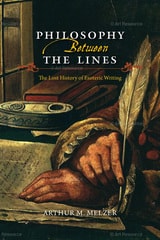
The Lost History of Esoteric WritingArthur M. Melzer
University of Chicago Press, 2014
Arthur M. Melzer serves as our deeply knowledgeable guide in this capacious and engaging history of philosophical esotericism. Walking readers through both an ancient (Plato) and a modern (Machiavelli) esoteric work, he explains what esotericism is—and is not. It relies not on secret codes, but simply on a more intensive use of familiar rhetorical techniques like metaphor, irony, and insinuation. Melzer explores the various motives that led thinkers in different times and places to engage in this strange practice, while also exploring the motives that lead more recent thinkers not only to dislike and avoid this practice but to deny its very existence. In the book’s final section, “A Beginner’s Guide to Esoteric Reading,” Melzer turns to how we might once again cultivate the long-forgotten art of reading esoteric works.
Philosophy Between the Lines is the first comprehensive, book-length study of the history and theoretical basis of philosophical esotericism, and it provides a crucial guide to how many major writings—philosophical, but also theological, political, and literary—were composed prior to the nineteenth century.

Redrawing the Lines
Analytic Philosophy, Deconstruction, and Literary TheoryReed Way Dasenbrock, Editor
University of Minnesota Press, 1989
Redrawing the Lines was first published in 1989. Minnesota Archive Editions uses digital technology to make long-unavailable books once again accessible, and are published unaltered from the original University of Minnesota Press editions.
Since 1970 literary theory has experienced a period of rich interaction with both Anglo-American analytic and Continental philosophy, particularly deconstruction. Yet these two philosophical schools have regarded each other with hostility, if at all, as in the 1977 exchange between John Searle and Jacques Derrida over the work of J. L. Austin. Since then, the two philosophical traditions have begun to interact as each has influenced literary theory, and some suggest that they are not diametrically opposed.
Redrawing the Lines,the first book to focus on that interaction, brings together ten essays by key figures who have worked to connect literary theory and philosophy and to reassess the relationship between analytic and Continental philosophy. The editor's introduction establishes the debate's historical context, and his annotated bibliography directs the interested reader to virtually everything written on this issue.
The contributors: Reed Way Dasenbrock, Henry Staten, Michael Fischer, Charles Altieri, Richard Shusterman, Samuel C. Wheeler III, Jules David Law, Steven Winspur, Christopher Norris, Richard Rorty, and Anthony J. Cascardi.
Reed Way Dasenbrock is associate professor of English at New Mexico State University. He is the author of The Literary Vorticism of Ezra Pound and Wyndham Lewis: Toward the Condition of Painting.
Shouting Softly
Lines on Law, Literature, and CultureAllen Mendenhall
St. Augustine's Press, 2020
The work is given in three parts. The first section on law explores legal minds, rules and commentary on seminal jurisprudence. The second part explores literature and the influence of the writer and the disconcerting truths stories often seek to convey. Thirdly, Mendenhall delves into culture and the more obvious situations wherein we gain insight into our manner of living, and here Mendenhall exudes a Southern accent that in no way compromises his universal bearings. One of the highlights is his echo of Larry Seidentop’s question: “If we in the West do not understand the moral depth of our own tradition, how can we hope to shape the conversation of mankind?” This is all the more meaningful given that Mendenhall is a member of the Millennial generation, and part of the intellectual minority who sees the urgency of “a studied appreciation for nuanced story and linguistic narrative.”
The Lines
Anthony Varallo
University of Iowa Press, 2019
The Soviet Jewish Bookshelf
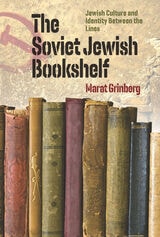
Jewish Culture and Identity Between the LinesMarat Grinberg
Brandeis University Press, 2022
In The Soviet Jewish Bookshelf, Marat Grinberg argues that in an environment where Judaism had been all but destroyed, and a public Jewish presence routinely delegitimized, reading uniquely provided many Soviet Jews with an entry to communal memory and identity. The bookshelf was both a depository of selective Jewish knowledge and often the only conspicuously Jewish presence in their homes. The typical Soviet Jewish bookshelf consisted of a few translated works from Hebrew and numerous translations from Yiddish and German as well as Russian books with both noticeable and subterranean Jewish content. Such volumes, officially published, and not intended solely for a Jewish audience, afforded an opportunity for Soviet Jews to indulge insubordinate feelings in a largely safe manner. Grinberg is interested in pinpointing and decoding the complex reading strategies and the specifically Jewish uses to which the books on the Soviet Jewish bookshelf were put. He reveals that not only Jews read them, but Jews read them in a specific way.