Results by title
6 books match the query '284-476'
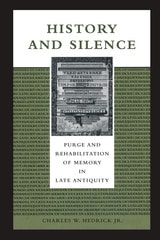
History and Silence
Purge and Rehabilitation of Memory in Late AntiquityBy Charles W. Hedrick Jr.
University of Texas Press, 2000
The ruling elite in ancient Rome sought to eradicate even the memory of their deceased opponents through a process now known as damnatio memoriae. These formal and traditional practices included removing the person's name and image from public monuments and inscriptions, making it illegal to speak of him, and forbidding funeral observances and mourning. Paradoxically, however, while these practices dishonored the person's memory, they did not destroy it. Indeed, a later turn of events could restore the offender not only to public favor but also to re-inclusion in the public record.
This book examines the process of purge and rehabilitation of memory in the person of Virius Nicomachus Flavianus(?-394). Charles Hedrick describes how Flavian was condemned for participating in the rebellion against the Christian emperor Theodosius the Great—and then restored to the public record a generation later as members of the newly Christianized senatorial class sought to reconcile their pagan past and Christian present. By selectively remembering and forgetting the actions of Flavian, Hedrick asserts, the Roman elite honored their ancestors while participating in profound social, cultural, and religious change.
Poverty and Leadership in the Later Roman Empire
Peter Brown
Brandeis University Press, 2001
Power & Persuasion Late Antiquity
Towards A Christian EmpirePeter Brown
University of Wisconsin Press, 1992
Q. Aurelius Symmachus
A Political BiographyCristiana Sogno
University of Michigan Press, 2010
Symmachus was a brilliant orator, writer, and statesman, often flatly labeled as one of the last pagan senators. Cristiana Sogno offers a reconstruction of the political career of Symmachus through close analysis of his extensive writings, while also proposing a critical reevaluation of his historical importance. In contrast to traditional interpretation, Sogno's study demonstrates that Symmachus was primarily an influential politician, rather than a mere pagan zealot.
By portraying the individual experience of Symmachus, the book sets forth a new approach for interpreting the political aspirations, mentality, and attitudes of Roman senators. The much-studied question of the Christianization of the Western aristocracy has created the illusion of a Christian and a pagan aristocracy rigidly separated from each other. Through her study of Symmachus, Sogno demonstrates the primary importance of politics over religion in the public activity of the late Roman aristocracy. Although the book is specifically addressed to scholars and students of Late Antiquity, it will also be of interest to classicists, ancient historians, and non-specialists who wish to know more about this pivotal period in Roman history.
Cristiana Sogno received her Ph.D. in Classics and History from Yale University. Currently she is Townsend Assistant Professor of Classics at Cornell University. Visit Professor Sogno's website at: http://www.fordham.edu.
The Restoration of the Roman Forum in Late Antiquity
Transforming Public SpaceBy Gregor Kalas
University of Texas Press, 2015
In The Restoration of the Roman Forum in Late Antiquity, Gregor Kalas examines architectural conservation during late antiquity period at Rome’s most important civic center: the Roman Forum. During the fourth and fifth centuries CE—when emperors shifted their residences to alternate capitals and Christian practices overtook traditional beliefs—elite citizens targeted restoration campaigns so as to infuse these initiatives with political meaning. Since construction of new buildings was a right reserved for the emperor, Rome’s upper echelon funded the upkeep of buildings together with sculptural displays to gain public status. Restorers linked themselves to the past through the fragmentary reuse of building materials and, as Kalas explores, proclaimed their importance through prominently inscribed statues and monuments, whose placement within the existing cityscape allowed patrons and honorees to connect themselves to the celebrated history of Rome.
Building on art historical studies of spolia and exploring the Forum over an extended period of time, Kalas demonstrates the mutability of civic environments. The Restoration of the Roman Forum in Late Antiquity maps the evolution of the Forum away from singular projects composed of new materials toward an accretive and holistic design sensibility. Overturning notions of late antiquity as one of decline, Kalas demonstrates how perpetual reuse and restoration drew on Rome’s venerable past to proclaim a bright future.
Themistius and the Imperial Court
Oratory, Civic Duty, and Paideia from Constantius to TheodosiusJohn Vanderspoel
University of Michigan Press, 1995