Results by title
23 books match the query 'Abraham Lincoln'
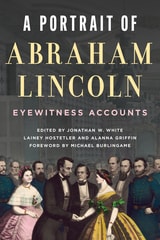
A Portrait of Abraham Lincoln
Eyewitness AccountsEdited by Jonathan W. White, Lainey Hostetler, and Alanna Griffin, with a foreword by Michael Burlingame
University of Illinois Press, 2027
Deeply researched and accessible, A Portrait of Abraham Lincoln is a valuable collection for anyone interested in a towering historical figure.
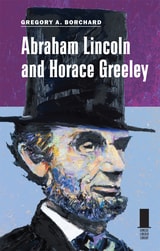
Abraham Lincoln and Horace Greeley
Gregory A. Borchard
Southern Illinois University Press, 2011
Borchard begins with an overview of the lives of both Lincoln and Greeley, delving particularly into their mutual belief in Henry Clay’s much-debated American System, and investigating the myriad similarities between the two political giants, including their comparable paths to power and their statuses as self-made men, their reputations as committed reformers, and their shared dedication to social order and developing a national infrastructure. Also detailed are Lincoln’s and Greeley’s personal quests to end slavery in the United States, as well as their staunch support of free-soil homesteads in the West.
Yet despite their ability to work together productively, both men periodically found themselves on opposite ends of the political spectrum. Their by turns harmonious and antagonistic relationship often played out on the front pages of Greeley’s influential newspaper, the New York Tribune. Drawing upon historical gems from the Tribune, as well as the personal papers of both Lincoln and Greeley, Borchard explores in depth the impact the two men had on their times and on each other, and how, as Lincoln’s and Greeley’s paths often crossed—and sometimes diverged—they personified the complexities, virtues, contradictions, and faults of their eras.
Abraham Lincoln and Horace Greeley goes beyond tracing each man’s personal and political evolution to offer a new perspective on the history-changing events of the times, including the decline of the Whig Party and the rise of the Republicans, the drive to extend American borders into the West; and the bloody years of the Civil War. Borchard finishes with reflections on the deaths of Lincoln and Greeley and how the two men have been remembered by subsequent generations.
Sure to become an essential volume in the annals of political history and journalism, Abraham Lincoln and Horace Greeley is a compelling testament to the indelible mark these men left on both their contemporaries and the face of America’s future.
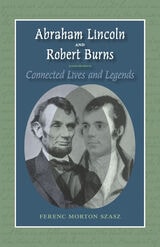
Abraham Lincoln and Robert Burns
Connected Lives and LegendsFerenc Morton Szasz
Southern Illinois University Press, 2008
Today the images of Robert Burns and Abraham Lincoln are recognized worldwide, yet few are aware of the connection between the two. In Abraham Lincoln and Robert Burns: Connected Lives and Legends, author Ferenc Morton Szasz reveals how famed Scots poet Robert Burns—and Scotland in general—influenced the life and thought of one of the most beloved and important U.S. presidents and how the legends of the two men became intertwined after their deaths. This is the first extensive work to link the influence, philosophy, and artistry of these two larger-than-life figures.
Lacking a major national poet of their own in the early nineteenth century, Americans in the fledgling frontier country ardently adopted the poignant verses and songs of Scotland’s Robert Burns. Lincoln, too, was fascinated by Scotland’s favorite son and enthusiastically quoted the Scottish bard from his teenage years to the end of his life. Szasz explores the ways in which Burns’s portrayal of the foibles of human nature, his scorn for religious hypocrisy, his plea for nonjudgmental tolerance, and his commitment to social equality helped shape Lincoln’s own philosophy of life. The volume also traces how Burns’s lyrics helped Lincoln develop his own powerful sense of oratorical rhythm, from his casual anecdotal stories to his major state addresses.
Abraham Lincoln and Robert Burns connects the poor-farm-boy upbringings, the quasi-deistic religious views, the shared senses of destiny, the extraordinary gifts for words, and the quests for social equality of two respected and beloved world figures. This book is enhanced by twelve illustrations and two appendixes, which include Burns poems Lincoln particularly admired and Lincoln writings especially admired in Scotland.
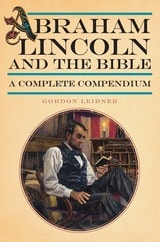
Abraham Lincoln and the Bible
A Complete CompendiumGordon Leidner
Southern Illinois University Press, 2023
How did Abraham Lincoln’s lifelong study of scripture influence him as a man and, ultimately, as president? Historian Gordon Leidner believes the impact was profound—more than previously recognized—and has investigated all the known writings of Abraham Lincoln to identify, catalog, and study every instance in which Lincoln quoted from or alluded to the Bible. Rather than dwelling on the never-ending debate about Lincoln’s religious beliefs, Leidner shows how scripture affected Lincoln personally, professionally, and politically.
Leidner offers first a short biography that focuses on Lincoln’s use of the Bible, how it shaped him as a person, how its influence changed over time, and how biblical quotations peppered his letters, speeches, and conversations. The book concludes with an unparalleled appendix that tabulates nearly 200 instances of Lincoln’s quoting from or alluding to scripture, giving locators for the Bible and Roy P. Basler’s nine volume Collected Works of Abraham Lincoln and quotations from both sources. The appendix also includes when and where Lincoln used each quote, providing valuable context, whether the use was in personal letters such as one to Queen Victoria after the death of Prince Albert, political speeches such as the Gettysburg Address, or state addresses such as the Second Inaugural Address.
By showcasing Lincoln’s specific biblical references and influences, Leidner reframes the question of Lincoln’s religious beliefs so that readers may evaluate for themselves what solace and guidance the Bible afforded the sixteenth president.
Abraham Lincoln and the Forge of National Memory
Barry Schwartz
University of Chicago Press, 2000
Schwartz draws on a wide array of materials—painting and sculpture, popular magazines and school textbooks, newspapers and oratory—to examine the role that Lincoln's memory has played in American life. He explains, for example, how dramatic funeral rites elevated Lincoln's reputation even while funeral eulogists questioned his presidential actions, and how his reputation diminished and grew over the next four decades. Schwartz links transformations of Lincoln's image to changes in the society. Commemorating Lincoln helped Americans to think about their country's development from a rural republic to an industrial democracy and to articulate the way economic and political reform, military power, ethnic and race relations, and nationalism enhanced their conception of themselves as one people.
Lincoln's memory assumed a double aspect of "mirror" and "lamp," acting at once as a reflection of the nation's concerns and an illumination of its ideals, and Schwartz offers a fascinating view of these two functions as they were realized in the commemorative symbols of an ever-widening circle of ethnic, religious, political, and regional communities. The first part of a study that will continue through the present, Abraham Lincoln and the Forge of National Memory is the story of how America has shaped its past selectively and imaginatively around images rooted in a real person whose character and achievements helped shape his country's future.
Abraham Lincoln as a Man of Ideas
Allen C. Guelzo, with a Foreword by Michael Lind
Southern Illinois University Press, 2009
Despite the most meager of formal educations, Lincoln had a tremendous intellectual curiosity that drove him into the circle of Enlightenment philosophy and democratic political ideology. And from these, Lincoln developed a set of political convictions that guided him throughout his life and his presidency. This compilation of ten essays from Lincoln scholar Allen C. Guelzo uncovers the hidden sources of Lincoln’s ideas and examines the beliefs that directed his career and brought an end to slavery and the Civil War.
Abraham Lincoln in the Post-Heroic Era
History and Memory in Late Twentieth-Century AmericaBarry Schwartz
University of Chicago Press, 2008
Abraham Lincoln, Philosopher Statesman
Joseph R. Fornieri
Southern Illinois University Press, 2014
2015 ISHS Superior Achievement Award
What constitutes Lincoln’s political greatness as a statesman? As a great leader, he saved the Union, presided over the end of slavery, and helped to pave the way for an interracial democracy. His great speeches provide enduring wisdom about human equality, democracy, free labor, and free society. Joseph R. Fornieri contends that Lincoln’s political genius is best understood in terms of a philosophical statesmanship that united greatness of thought and action, one that combined theory and practice. This philosophical statesmanship, Fornieri argues, can best be understood in terms of six dimensions of political leadership: wisdom, prudence, duty, magnanimity, rhetoric, and patriotism. Drawing on insights from history, politics, and philosophy, Fornieri tackles the question of how Lincoln’s statesmanship displayed each of these crucial elements.
Providing an accessible framework for understanding Lincoln’s statesmanship, this thoughtful study examines the sixteenth president’s political leadership in terms of the traditional moral vision of statecraft as understood by epic political philosophers such as Aristotle and St. Thomas Aquinas. Fornieri contends that Lincoln’s character is best understood in terms of Aquinas’s understanding of magnanimity or greatness of soul, the crowning virtue of statesmanship. True political greatness, as embodied by Lincoln, involves both humility and sacrificial service for the common good. The enduring wisdom and timeless teachings of these great thinkers, Fornieri shows, can lead to a deeper appreciation of statesmanship and of its embodiment in Abraham Lincoln.
With the great philosophers and books of western civilization as his guide, Fornieri demonstrates the important contribution of normative political philosophy to an understanding of our sixteenth president. Informed by political theory that draws on the classics in revealing the timelessness of Lincoln’s example, his interdisciplinary study offers profound insights for anyone interested in the nature of leadership, statesmanship, political philosophy, political ethics, political history, and constitutional law.
Abraham Lincoln, Statesman Historian
Jesse Derber
University of Illinois Press, 2024
Abraham Lincoln drew upon history in his political career and particularly when crafting the rhetorical masterpieces that still resonate in the present day. Jesse Derber explores how Lincoln’s views of the limits of human understanding drove a belief in--and untiring pursuit of--historical truth.
Lincoln embraced the traditional ideas that good history made good statesmanship and that an understanding of the past informed decision-making in the present. Seeing history as a source of wisdom, Lincoln strove for accuracy through a combination of research, reasoning ability, emotional maturity, and a willingness to admit his mistakes and challenge his biases. His philosophy flowed from an idea that authentic history could enlighten people about human nature. Though he revered precedents, Lincoln understood the past could be imperfect, and that progress through change was an ineffable part of building a better nation.
Perceptive and revealing, Abraham Lincoln, Statesman Historian looks at how the Lincoln practiced history and applied its lessons to politics and leadership.
Abraham Lincoln
A BiographyBenjamin P. Thomas. Foreword by Michael Burlingame
Southern Illinois University Press, 1952
Long considered a classic, Benjamin P. Thomas's Abraham Lincoln: A Biography takes an incisive look at one of American history's greatest figures. Originally published in 1952 to wide acclaim, this eloquent account rises above previously romanticized depictions of the sixteenth president to reveal the real Lincoln: a complex, shrewd, and dynamic individual whose exceptional life has long intrigued the public.
Thomas traces the president from his hardscrabble beginnings and early political career, through his years as an Illinois lawyer and his presidency during the Civil War. Although Lincoln is appropriately placed against the backdrop of the dramatic times in which he lived, the author's true focus is on Lincoln the man and his intricate personality. While Thomas pays tribute to Lincoln's many virtues and accomplishments, he is careful not to dramatize a persona already larger than life in the American imagination. Instead he presents a candid and balanced representation that provides compelling insight into Lincoln's true character and the elements that forged him into an extraordinary leader. Thomas portrays Lincoln as a man whose conviction, resourcefulness, and inner strength enabled him to lead the nation through the most violent crossroads in its history.
Thomas's direct, readable narrative is concise while losing none of the crucial details of Lincoln's remarkable life. The volume's clarity of style makes it accessible to beginners, but it is complex and nuanced enough to interest longtime Lincoln scholars. After more than half a century, Abraham Lincoln: A Biography is still an essential source for anyone interested in learning more about the many facets of the sixteenth president, and it remains the definitive single-volume work on the life of an American legend.
Abraham Lincoln
The Observations of John G. Nicolay and John HayEdited by Michael Burlingame
Southern Illinois University Press, 2007
Editor Michael Burlingame sifted through the original forty-seven-hundred-page work and selected only the personal observations of the secretaries during the Lincoln presidency, placing ten excerpts in chronological order in Abraham Lincoln: The Observations of John G. Nicolay and John Hay. The result is an important collection of Nicolay and Hay’s interpretations of Lincoln’s character, actions, and reputation, framed by Burlingame’s compelling preface, introduction, chapter introductions, and notes. The volume provides vivid descriptions of such events as Election Day in 1860, the crisis at Fort Sumter, the first major battle of the war at Bull Run, and Lincoln’s relationship with Edwin Stanton and George McClellan.
In this clear and captivating new work, Burlingame has made key portions of Nicolay and Hay’s immense biography available to a wide audience of today’s readers.
An Oral History of Abraham Lincoln
John G. Nicolay's Interviews and EssaysEdited by Michael Burlingame
Southern Illinois University Press, 2006
John C. Nicolay, who had known Lincoln in Springfield, Illinois, served as chief White House secretary from 1861 to 1865. Trained as a journalist, Nicolay had hoped to write a campaign biography of Lincoln in 1860, a desire that was thwarted when an obscure young writer named William Dean Howells got the job. Years later, however, Nicolay fulfilled his ambition; with John Hay, he spent the years from 1872 to 1890 writing a monumental ten-volume biography of Lincoln.
In preparation for this task, Nicolay interviewed men who had known Lincoln both during his years in Springfield and later when he became the president of the United States. "When it came time to write their massive biography, however," Burlingame notes, "he and Hay made sparing use of the interviews" because they had become "skeptical about human memory." Nicolay and Hay also feared that Robert Todd Lincoln might censor material that reflected "poorly on Lincoln or his wife."
Nicolay had interviewed such Springfield friends as Lincoln’s first two law partners, John Todd Stuart and Stephen T. Logan. At the Illinois capital in June and July 1875, he talked to a number of others including Orville H. Browning, U.S. senator and Lincoln’s close friend and adviser for over thirty-five years, and Ozias M. Hatch, Lincoln’s political ally and Springfield neighbor. Four years later he returned briefly and spoke with John W. Bunn, a young political "insider" from Springfield at the time Lincoln was elected president, and once again with Hatch.
Browning shed new light on Lincoln’s courtship and marriage, telling Nicolay that Lincoln often told him "that he was constantly under great apprehension lest his wife should do something which would bring him into disgrace" while in the White House. During their research, Nicolay and Hay also learned of Lincoln’s despondency and erratic behavior following his rejection by Matilda Edwards, and they were subsequently criticized by friends for suppressing the information. Burlingame argues that this open discussion of Lincoln’s depression of January 1841 is "perhaps the most startling new information in the Springfield interviews."
Briefer and more narrowly focused than the Springfield interviews, the Washington interviews deal with the formation of Lincoln’s cabinet, his relations with Congress, his behavior during the war, his humor, and his grief. In a reminiscence by Robert Todd Lincoln, for example, we learn of Lincoln’s despair at General Lee's escape after the Battle of Gettysburg: "I went into my father’s office ... and found him in [much] distress, his head leaning upon the desk in front of him, and when he raised his head there were evidences of tears upon his face. Upon my asking the cause of his distress he told me that he had just received the information that Gen. Lee had succeeded in escaping across the Potomac river. . ."
To supplement these interviews, Burlingame has included Nicolay’s unpublished essays on Lincoln during the 1860 campaign and on Lincoln’s journey from Springfield to Washington in 1861, essay’s based on firsthand testimony.
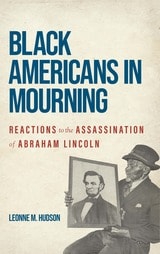
Black Americans in Mourning
Reactions to the Assassination of Abraham LincolnLeonne M. Hudson
Southern Illinois University Press, 2025
Centering Black grief in the aftermath of Lincoln’s assassination
On April 14, 1865, John Wilkes Booth carried out the first presidential assassination in United States history. The euphoria resulting from General Lee’s surrender evaporated at the news of Abraham Lincoln’s murder. The nation—excepting many white Southerners—found itself consumed with grief, and no group mourned Lincoln more deeply than people of color. African Americans did not speak with a monolithic voice on social or political issues, but even Lincoln’s Black contemporaries who may not have approved of him while he was alive mourned his death, understanding its implications for their future.
Beginning with the assassination itself and chronicling Lincoln’s three-week-long national funeral, historian Leonne M. Hudson captures the profound sadness of Black Americans as they mourned the crafter of the Emancipation Proclamation and the man they thought of as their earthly Moses, father, friend, and benefactor. Hudson continues the narrative by detailing the postwar efforts of African Americans to gain citizenship and voting rights.
Black Americans in Mourning includes the tributes of prominent figures such as Frederick Douglass, Martin R. Delany, and Elizabeth Keckley, who raised their voices to honor Lincoln, as well as formal expressions of grief by institutions and organizations such as the United States Colored Troops. In a triumph of research, Hudson also features the voices of lesser-known Black people who mourned Lincoln across the country, showing that the outpouring of individual and collective grief helped set the stage for his enduring glorification.
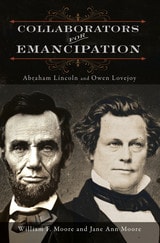
Collaborators for Emancipation
Abraham Lincoln and Owen LovejoyWilliam F. Moore and Jane Ann Moore
University of Illinois Press, 2019
In Collaborators for Emancipation: Abraham Lincoln and Owen Lovejoy, the authors examine the thorny issue of the pragmatism typically ascribed to Lincoln versus the radicalism of Lovejoy, and the role each played in ending slavery. Exploring the men's politics, personal traits, and religious convictions, the book traces their separate paths in life as well as their frequent interactions. Collaborators for Emancipation shows how Lincoln and Lovejoy influenced one another and analyzes the strategies and systems of belief each brought to the epic controversies of slavery versus abolition and union versus disunion.
Moore and Moore, editors of a previous volume of Lovejoy's writings, use their deep knowledge of his words and life to move beyond mere politics to a nuanced perspective on the fabric of religion and personal background that underlay the minister's worldview. Their multifaceted work of history and biography reveals how Lincoln embraced the radical idea of emancipation, and how Lovejoy shaped his own radicalism to wield the pragmatic political tools needed to reach that ultimate goal.
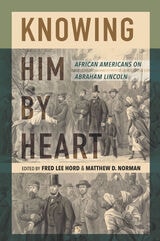
Knowing Him by Heart
African Americans on Abraham LincolnEdited by Frederick Hord and Matthew D. Norman
University of Illinois Press, 2023
Winner of an Abraham Lincoln Institute Book Award
Though not blind to Abraham Lincoln's imperfections, Black Americans long ago laid a heartfelt claim to his legacy. At the same time, they have consciously reshaped the sixteenth president's image for their own social and political ends. Frederick Hord and Matthew D. Norman's anthology explores the complex nature of views on Lincoln through the writings and thought of Frederick Douglass, Ida B. Wells-Barnett, Mary McLeod Bethune, Thurgood Marshall, Malcolm X, Gwendolyn Brooks, Barbara Jeanne Fields, Barack Obama, and dozens of others. The selections move from speeches to letters to book excerpts, mapping the changing contours of the bond--emotional and intellectual--between Lincoln and Black Americans over the span of one hundred and fifty years.
A comprehensive and valuable reader, Knowing Him by Heart examines Lincoln’s still-evolving place in Black American thought.
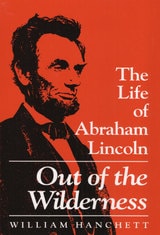
Out of the Wilderness
THE LIFE OF ABRAHAM LINCOLNWilliam Hanchett
University of Illinois Press, 1994
follows Abraham Lincoln from his birth and chronicles his thirst for education,
his achievements as a lawyer and congressman, his presidency, and his
assassination.
Hanchett gives readers a deeper understanding of how Lincoln's self-directed
study and clear thinking offset his lack of a formal education, enabling
him to become a respected and successful attorney. He also shows how Lincoln's
uncanny leadership helped him to end slavery and still keep the divided
North sufficiently united to win the Civil War. By focusing on a variety
of roles and settings, Hanchett invites readers to get to know Lincoln
as a president, as well as a lover, husband, father, and friend.
"Excellent! Hanchett is a fine writer, and his biography of Lincoln
is succinct and thought-provoking."
-- Frank J. Williams, president, Abraham Lincoln Association
Prairie Defender
The Murder Trials of Abraham LincolnGeorge R. Dekle, Sr.
Southern Illinois University Press, 2017
2018 ISHS Annual Award Winner for a Scholarly Publication
According to conventional wisdom, Abraham Lincoln spent most of his law career collecting debt and representing railroads, and this focus made him inept at defending clients in homicide cases. In this unprecedented study of Lincoln’s criminal cases, George Dekle disproves these popular notions, showing that Lincoln was first and foremost a trial lawyer. Through careful examination of Lincoln’s homicide cases and evaluation of his legal skills, Dekle demonstrates that criminal law was an important part of Lincoln's practice, and that he was quite capable of defending people accused of murder, trying approximately one such case per year.
Dekle begins by presenting the viewpoints of not only those who see Lincoln as a perfect lawyer whose only flaw was his inability to represent the wrong side of a case but also those who believe Lincoln was a less-than-honest legal hack. The author invites readers to compare these wildly different stereotypes with the flesh-and-blood Lincoln revealed in each case described in the book, including an axe murder suit in which Lincoln assisted the prosecution, a poisoning case he refused to prosecute for $200 but defended for $75, and a case he won by proving that a supposed murder victim was actually still alive.
For each case Dekle covers, he first tells the stories of the feuds, arguments, and insults that led to murder and other criminal activity, giving a gripping view of the seamy side of life in nineteenth-century Illinois. Then he traces the course of the pretrial litigation, describes the trials and the various tactics employed in the prosecution and defense, and critiques the performance of both Lincoln and his adversaries.
Dekle concludes that Lincoln was a competent, diligent criminal trial lawyer who knew the law, could argue it effectively to both judge and jury, and would use all lawful means to defend clients whether he believed them to be innocent or guilty. His trial record shows Lincoln to have been a formidable defense lawyer who won many seemingly hopeless cases through his skill as a courtroom tactician, cross-examiner, and orator. Criminal defendants who could retain Lincoln as a defense attorney were well represented, and criminal defense attorneys who sought him as co-counsel were well served. Providing insight into both Lincoln’s legal career and the culture in which he practiced law, Prairie Defender resolves a major misconception concerning one of our most important historical figures.
Sixteenth President-in-Waiting
Abraham Lincoln and the Springfield Dispatches of Henry Villard, 1860–1861Edited by Michael Burlingame
Southern Illinois University Press, 2018
Between Abraham Lincoln’s election in November 1860 and his departure for Washington three months later, journalist Henry Villard sent scores of dispatches from Springfield, Illinois, to various newspapers describing the president-elect’s doings, quoting or paraphrasing his statements, chronicling events in the Illinois capital, and analyzing the city’s mood. With Sixteenth President-in-Waiting Michael Burlingame has collected all of these dispatches in one insightful and informative volume.
Best known as a successful nineteenth-century railroad promoter and financier, German-born Henry Villard (1835–1900) was also among the most conscientious and able journalists of the 1860s. The dispatches gathered in this volume constitute the most intensive journalistic coverage that Lincoln ever received, for Villard filed stories from the Illinois capital almost daily to the New York Herald, slightly less often to the Cincinnati Commercial, and occasionally to the San Francisco Bulletin.
Lincoln welcomed Villard and encouraged him to ask questions, as he was the only full-time correspondent for out-of-town papers. He spoke with inside sources, such as Lincoln’s private secretaries John G. Nicolay and John Hay, devoted friends like Jesse K. Dubois and Stephen T. Logan, political leaders like Governor Richard Yates, and journalists like William M. Springer and Robert R. Hitt.
Villard boasted that he did Lincoln a service by scaring off would-be office seekers who, fearing to see their names published in newspapers, gave up plans to visit the Illinois capital to badger the president-elect. Villard may have done an even greater service by publicizing Lincoln’s views on the secession crisis.
His little-known coverage of the 1858 Lincoln-Douglas Senate race, translated from the German for the first time, is included as an appendix. At the time Villard was an ardent Douglas supporter, and his reports criticized Lincoln.
Not only informative but also highly readable, Villard’s vivid descriptions of Lincoln’s appearance, daily routine, and visitors, combined with fresh information about Springfielders, state political leaders, and the capital, constitute an invaluable resource.
The Black Heavens
Abraham Lincoln and DeathBrian R. Dirck
Southern Illinois University Press, 2019
From multiple personal tragedies to the terrible carnage of the Civil War, death might be alongside emancipation of the slaves and restoration of the Union as one of the great central truths of Abraham Lincoln’s life. Yet what little has been written specifically about Lincoln and death is insufficient, sentimentalized, or devoid of the rich historical literature about death and mourning during the nineteenth century. The Black Heavens: Abraham Lincoln and Death is the first in-depth account of how the sixteenth president responded to the riddles of mortality, undertook personal mourning, and coped with the extraordinary burden of sending hundreds of thousands of soldiers to be killed on battlefields.
Going beyond the characterization of Lincoln as a melancholy, tragic figure, Brian R. Dirck investigates Lincoln’s frequent encounters with bereavement and sets his response to death and mourning within the social, cultural, and political context of his times. At a young age Lincoln saw the grim reality of lives cut short when he lost his mother and sister. Later, he was deeply affected by the deaths of two of his sons, three-year-old Eddy in 1850 and eleven-year-old Willie in 1862, as well as the combat deaths of close friends early in the war. Despite his own losses, Lincoln learned how to approach death in an emotionally detached manner, a survival skill he needed to cope with the reality of his presidency.
Dirck shows how Lincoln gradually turned to his particular understanding of God’s will in his attempts to articulate the meaning of the atrocities of war to the American public, as showcased in his allusions to religious ideas in the Gettysburg Address and the Second Inaugural. Lincoln formed a unique approach to death: both intellectual and emotional, typical and yet atypical of his times. In showing how Lincoln understood and responded to death, both privately and publicly, Dirck paints a compelling portrait of a commander in chief who buried two sons and gave the orders that sent an unprecedented number of Americans to their deaths.

The Inner World of Abraham Lincoln
Michael Burlingame
University of Illinois Press, 1994
The Lincoln Image
ABRAHAM LINCOLN AND THE POPULAR PRINTHarold Holzer, Gabor S. Boritt, and Mark E . Neely Jr.
University of Illinois Press, 1984
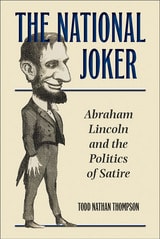
The National Joker
Abraham Lincoln and the Politics of SatireTodd Nathan Thompson
Southern Illinois University Press, 2015
In his speeches, writings, and public persona, Lincoln combined modesty and attack, engaging in strategic self-deprecation while denouncing his opponents, their policies, and their arguments, thus refiguring satiric discourse as political discourse and vice versa. At the same time, he astutely deflected his opponents’ criticisms of him by embracing and sometimes preemptively initiating those criticisms. Thompson traces Lincoln’s comic sources and explains how, in reapplying others’ jokes and stories to political circumstances, he transformed humor into satire. Time and time again, Thompson shows, Lincoln engaged in self-mockery, turning negative assumptions or depictions of him—as ugly, cowardly, jocular, inexperienced—into positive traits that identified him as an everyman while attacking his opponents’ claims to greatness, heroism, and experience as aristocratic or demagogic. Thompson also considers how Lincoln took advantage of political cartoons and other media to help proliferate the particular Lincoln image of the “self-made man”; underscores exceptions to Lincoln’s ability to mitigate negative, satiric depictions of him; and closely examines political cartoons from both the 1860 and 1864 elections. Throughout, Thompson’s deft analysis brings to life Lincoln’s popular humor.
The Soul of Abraham Lincoln
William E. Barton. Introduction by Michael Nelson
University of Illinois Press, 2005
Modern secularists have been reluctant to recognize Abraham Lincoln's deep spirituality, in spite of the fact that he was often known as "Father Abraham" and has been described as one of the most deeply religious presidents the country has ever seen. Yet for all of his familiarity with the Bible, his invocation of Providence, and of the Almighty, he did not actively participate in a church or lend his name and authority to a denomination.
After more than fifty years of hagiographic and contradictory accounts of Abraham Lincoln's life, William Barton stepped boldly into the bedlam of claims and counterclaims about Lincoln's religion. Armed with an enormous collection of Lincoln materials and his own strict evidentiary rules, Barton worked to avoid partisan politicking over Lincoln's legacy and instead to simply "lay bare the facts."
To enable a better examination of the vexed questions surrounding Lincoln's faith and religious principles, Barton gathered Lincoln's most important writing and speeches about religion, and topically and chronologically assembled testimonies by his friends, family, and associates, about the most important and most debated issues. This volume, Barton's first and most important work on Lincoln, is introduced by Michael Nelson who provides a history of the literature on Lincoln's religion, the historical context of Barton's writing, and the details of the method that made Barton's approach to this American icon such a distinctive success.