Results by title
2 books match the query 'Abu-Lughod, Lila'
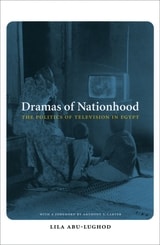
Dramas of Nationhood
The Politics of Television in EgyptLila Abu-Lughod
University of Chicago Press, 2004
How do people come to think of themselves as part of a nation? Dramas of Nationhood identifies a fantastic cultural form that binds together the Egyptian nation—television serials. These melodramatic programs—like soap operas but more closely tied to political and social issues than their Western counterparts—have been shown on television in Egypt for more than thirty years. In this book, Lila Abu-Lughod examines the shifting politics of these serials and the way their contents both reflect and seek to direct the changing course of Islam, gender relations, and everyday life in this Middle Eastern nation.
Representing a decade's worth of research, Dramas of Nationhood makes a case for the importance of studying television to answer larger questions about culture, power, and modern self-fashionings. Abu-Lughod explores the elements of developmentalist ideology and the visions of national progress that once dominated Egyptian television—now experiencing a crisis. She discusses the broadcasts in rich detail, from the generic emotional qualities of TV serials and the depictions of authentic national culture, to the debates inflamed by their deliberate strategies for combating religious extremism.
Representing a decade's worth of research, Dramas of Nationhood makes a case for the importance of studying television to answer larger questions about culture, power, and modern self-fashionings. Abu-Lughod explores the elements of developmentalist ideology and the visions of national progress that once dominated Egyptian television—now experiencing a crisis. She discusses the broadcasts in rich detail, from the generic emotional qualities of TV serials and the depictions of authentic national culture, to the debates inflamed by their deliberate strategies for combating religious extremism.
[more]
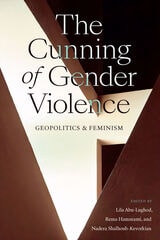
The Cunning of Gender Violence
Geopolitics and FeminismLila Abu-Lughod, Rema Hammami, and Nadera Shalhoub-Kevorkian, editors
Duke University Press, 2023
The Cunning of Gender Violence focuses on how a once visionary feminist project has folded itself into contemporary world affairs. Combating violence against women and gender-based violence constitutes a highly visible and powerful agenda enshrined in international governance and law and embedded in state violence and global securitization. Case studies on Palestine, Bangladesh, Iran, India, Pakistan, Israel, and Turkey as well as on UN and US policies trace the silences and omissions, along with the experiences of those subjected to violence, to question the rhetoric that claims the agenda as a “feminist success story.” Because religion and racialized ethnicity, particularly “the Muslim question,” run so deeply through the institutional structures of the agenda, the contributions explore ways it may be affirming or enabling rationales and systems of power, including civilizational hierarchies, that harm the very people it seeks to protect.
Contributors. Lila Abu-Lughod, Nina Berman, Inderpal Grewal, Rema Hammami, Janet R. Jakobsen, Shenila Khoja-Moolji, Vasuki Nesiah, Samira Shackle, Sima Shakhsari, Nadera Shalhoub-Kevorkian, Dina M Siddiqi, Shahla Talebi, Leti Volpp, Rafia Zakaria
Contributors. Lila Abu-Lughod, Nina Berman, Inderpal Grewal, Rema Hammami, Janet R. Jakobsen, Shenila Khoja-Moolji, Vasuki Nesiah, Samira Shackle, Sima Shakhsari, Nadera Shalhoub-Kevorkian, Dina M Siddiqi, Shahla Talebi, Leti Volpp, Rafia Zakaria
[more]