Results by title

12 books match the query 'Admission'
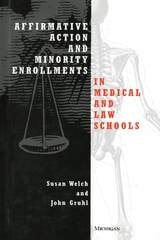
cover of Affirmative Action and Minority Enrollments in Medical and Law Schools

Affirmative Action and Minority Enrollments in Medical and Law Schools

Susan Welch and John Gruhl

University of Michigan Press, 1998
Affirmative action is one of the central issues of American politics today, and admission to colleges and universities has been at the center of the debate. While this issue has been discussed for years, there is very little real data on the impact of affirmative action programs on admissions to institutions of higher learning. Susan Welch and John Gruhl in this groundbreaking study look at the impact on admissions of policies developed in the wake of the United States Supreme Court's landmark 1978 Bakke decision. In Bakke, the Court legitimized the use of race as one of several factors that could be considered in admissions decisions, while forbidding the use of quotas. Opponents of affirmative action claim that because of the Bakke decision thousands of less-qualified minorities have been granted admission in preference to more qualified white students; proponents claim that without the affirmative action policies articulated in Bakke, minorities would not have made the gains they have made in higher education.
Based on a survey of admissions officers for law and medical schools and national enrollment data, the authors give us the first analysis of the real impact of the Bakke decision and affirmative action programs on enrollments in medical and law schools. Admission to medical schools and law schools is much sought after and is highly competitive. In examining admissions patterns to these schools the authors are able to identify the effects of affirmative action programs and the Bakke decision in what may be the most challenging case.
This book will appeal to scholars of race and gender in political science, sociology and education as well as those interested in the study of affirmative action policies. Susan Welch is Dean of the College of Liberal Arts and Professor of Political Science, Pennsylvania State University. John Gruhl is Professor of Political Science, University of Nebraska-Lincoln.
[more]
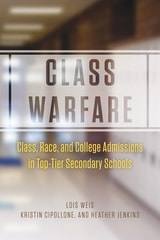
cover of Class Warfare: Class, Race, and College Admissions in Top-Tier Secondary Schools

Class Warfare

Class, Race, and College Admissions in Top-Tier Secondary Schools

Lois Weis, Kristin Cipollone, and Heather Jenkins

University of Chicago Press, 2014

Stories abound about the lengths to which middle- and upper-middle-class parents will go to ensure a spot for their child at a prestigious university. From the Suzuki method to calculus-based physics, from AP tests all the way back to early-learning Kumon courses, students are increasingly pushed to excel with that Harvard or Yale acceptance letter held tantalizingly in front of them. And nowhere is this drive more apparent than in our elite secondary schools. In Class Warfare, Lois Weis, Kristin Cipollone, and Heather Jenkins go inside the ivy-yearning halls of three such schools to offer a day-to-day, week-by-week look at this remarkable drive toward college admissions and one of its most salient purposes: to determine class.
             
Drawing on deep and sustained contact with students, parents, teachers, and administrators at three iconic secondary schools in the United States, the authors unveil a formidable process of class positioning at the heart of the college admissions process. They detail the ways students and parents exploit every opportunity and employ every bit of cultural, social, and economic capital they can in order to gain admission into a “Most Competitive” or “Highly Competitive Plus” university. Moreover, they show how admissions into these schools—with their attendant rankings—are used to lock in or improve class standing for the next generation. It’s a story of class warfare within a given class, the substrata of which—whether economically, racially, or socially determined—are fiercely negotiated through the college admissions process.
In a historic moment marked by deep economic uncertainty, anxieties over socioeconomic standing are at their highest. Class, as this book shows, must be won, and the collateral damage of this aggressive pursuit may just be education itself, flattened into a mere victory banner.  
[more]
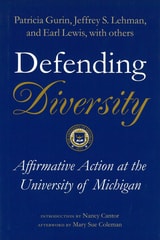
cover of Defending Diversity: Affirmative Action at the University of Michigan

Defending Diversity

Affirmative Action at the University of Michigan

Patricia Gurin, Jeffrey S. Lehman, and Earl Lewis, with Eric L. Dey, Gerald Gurin, and Sylvia Hurtado

University of Michigan Press, 2004
Even as lawsuits challenging its admissions policies made their way through the courts, the University of Michigan carried the torch for affirmative action in higher education.In June 2003, the Supreme Court vindicated UM's position on affirmative action when it ruled that race may be used as a factor for universities in their admissions programs, thus confirming what the UM had argued all along: diversity in the classroom translates to a beneficial and wide-ranging social value. With the green light given to the law school's admissions policies, Defending Diversity validates the positive benefits gained by students in a diverse educatioN/Al setting.Written by prominent University of Michigan faculty, Defending Diversity is a timely response to the court's ruling. Providing factual background, historical setting, and the psychosocial implications of affirmative action, the book illumiN/Ates the many benefits of a diverse higher educational setting -- including preparing students to be full participants in a pluralistic democracy -- and demonstrates why affirmative action is necessary to achieve that diversity.Defending Diversity is a significant contribution to the ongoing discussion on affirmative action in higher education. Perhaps more important, it is a valuable record of the history, events, arguments, and issues surrounding the original lawsuits and the Supreme Court's subsequent ruling, and helps reclaim the debate from those forces opposed to affirmative action.
[more]
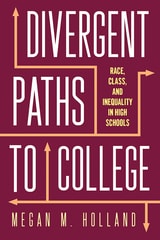
cover of Divergent Paths to College: Race, Class, and Inequality in High Schools

Divergent Paths to College

Race, Class, and Inequality in High Schools

Holland, Megan M

Rutgers University Press, 2019
In Divergent Paths to College, Megan M. Holland examines how high schools structure different pathways that lead students to very different college destinations based on race and class. She finds that racial and class inequalities are reproduced through unequal access to key sources of information, even among students in the same school and even in schools with well-established college-going cultures. As the college application process becomes increasingly complex and high-stakes, social capital, or relationships with people who can provide information as well as support and guidance, becomes much more critical. Although much has been written about the college-bound experience, we know less about the role that social capital plays, and specifically how high schools can serve as organizational brokers of social ties. The relationships that high schools cultivate between students and higher education institutions by inviting college admissions officers into their schools to market to students, is a particularly critical, yet unexplored source of college information.
[more]
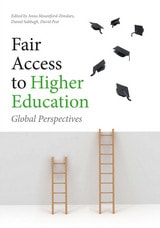
cover of Fair Access to Higher Education: Global Perspectives

Fair Access to Higher Education

Global Perspectives

Edited by Anna Mountford-Zimdars, Daniel Sabbagh, and David Post

University of Chicago Press, 2014

What does “fairness” mean internationally in terms of access to higher education? Increased competition for places in elite universities has prompted a worldwide discussion regarding the fairness of student admission policies. Despite budget cuts from governments—and increasing costs for students—competition is fierce at the most prestigious institutions. Universities, already under stress, face a challenge in balancing institutional research goals, meeting individual aspirations for upward social mobility, and promoting the democratic ideal of equal opportunity.

Fair Access to Higher Education addresses this challenge from a broad, transnational perspective. The chapters in this volume contribute to our thinking and reflection on policy developments and also offer new empirical findings about patterns of advantage and disadvantage in higher education access. Bringing together insights drawn from a variety of fields, including philosophy, linguistics, social psychology, sociology, and public policy, the book sheds light on how “fairness” in university admissions has been articulated worldwide.
[more]
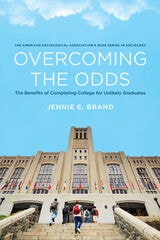
cover of Overcoming the Odds: The Benefits of Completing College for Unlikely Graduates

Overcoming the Odds

The Benefits of Completing College for Unlikely Graduates

Jennie E. Brand

Russell Sage Foundation, 2023

Each year, millions of high school students consider whether to continue their schooling and attend and complete college. Despite evidence showing that a college degree yields far-reaching benefits, critics of higher education increasingly argue that college “does not pay off” and some students - namely, disadvantaged prospective college goers - would be better served by forgoing higher education. But debates about the value of college often fail to carefully consider what is required to speak knowledgeably about the benefits –what a person’s life might look like had they not completed college, or their college counterfactual. In Overcoming the Odds sociologist Jennie E. Brand reveals the benefits of completing college by comparing life outcomes of college graduates with their college counterfactuals.  
 
Drawing on two cohorts of nationally representative data from the Bureau of Labor Statistics National Longitudinal Surveys program, Brand uses matching and machine learning methods to estimate the effects of college completion across students with varying likelihoods of completing four-year degrees. To illustrate her findings, Brand describes outcomes using matched vignettes of college and non-college graduates. Brand shows that four-year college completion enables graduates to increase wages and household income, while also circumventing unemployment, low-wage work, job instability, poverty, and social assistance. Completing college also increases civic engagement. Most of these benefits are larger for disadvantaged than for more advantaged students, rendering arguments that college has limited benefits for unlikely graduates as flawed. Brand concludes that greater long-term earnings, and less job instability and unemployment, and thus more tax revenue, less reliance on public assistance, and high levels of volunteering indicate that public investment in higher education for students from disadvantaged backgrounds yields far-reaching collective benefits. She asserts that it is better for our society when more people complete college.
 
Overcoming the Odds is an innovative and enlightening exploration of how college can transform lives.


[more]
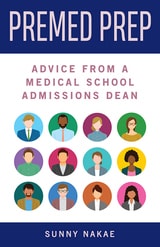
cover of Premed Prep: Advice from a Medical School Admissions Dean

Premed Prep

Advice from a Medical School Admissions Dean

Sunny Nakae

Rutgers University Press, 2021

If you’re a student hoping to apply to medical school, you might be anxious or stressed about how best to prepare. What classes should you take? What kinds of research, clinical, and volunteer opportunities should you be pursuing? What grades and MCAT scores do you need? How can you stand out among thousands of applicants?
 
Premed Prep answers all these questions and more, with detailed case studies and insider tips that can help premed students authentically prepare and enjoy the journey from the very beginning. Sunny Nakae draws from her many years of experience as a medical school admissions dean to offer wise and compassionate advice that can help premed students of all backgrounds. She also has specific tips for students who are first-generation, minority, non-traditional, and undocumented.
 
Both forthright and supportive, Nakae’s advice is offered in a keep-it-real style that gives premed students a unique window into how admissions committees view and assess them. Premed Prep covers how to approach preparation with a focus on exploration and growth, and how to stop obsessing over med school application checklists. This book will do more than help you get a seat in medical school; it will start you on the process of becoming a successful future physician.
[more]
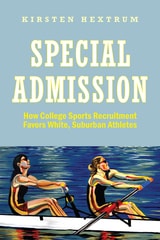
cover of Special Admission: How College Sports Recruitment Favors White Suburban Athletes

Special Admission

How College Sports Recruitment Favors White Suburban Athletes

Kirsten Hextrum

Rutgers University Press, 2021

Honorable Mention - 2022 Society of Professors of Education Outstanding Book Award​

Special Admission contradicts the national belief that college sports provide upward mobility opportunities. Kirsten Hextrum documents how white middle-class youth become overrepresented on college teams. Her institutional ethnography of one elite athletic and academic institution includes over 100 hours of interviews with college rowers and track & field athletes. She charts the historic and contemporary relationships between colleges, athletics, and white middle-class communities that ensure white suburban youth are advantaged in special athletic admissions. Suburban youth start ahead in college admissions because athletic merit—the competencies desired by university recruiters—requires access to vast familial, communal, and economic resources, all of which are concentrated in their neighborhoods. Their advantages increase as youth, parents, and coaches strategically invest in and engineer novel opportunities to maintain their race and class status. Thus, college sports allow white, middle-class athletes to accelerate their racial and economic advantages through admission to elite universities.
[more]
cover of Successfully Serving the College Bound

Successfully Serving the College Bound

Africa S. Hands

American Library Association, 2014
[more]
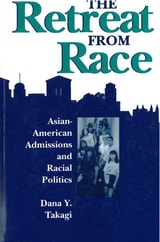
cover of The Retreat from Race: Asian-American Admissions and Racial Politics

The Retreat from Race

Asian-American Admissions and Racial Politics

Takagi, Dana Y

Rutgers University Press, 1993

“An excellent book. Takagi takes a very complex and sensitive subject—racial politics—and shows, through a careful analysis . . . that changes in the discourse about Asian American admissions have facilitated a 'retreat from race' in the area of affirmative action. . . . This book will appeal to an audience significantly wider than a typical academic one.”— David Karen, Bryn Mawr College

Charges by Asian Americans that the top universities in the United States used quotas to limit the enrollment of Asian-American students developed into one of the most controversial public controversies in higher education since the Bakke case. In Retreat from Race, Dana Takagi follows the debates over Asian-American admissions at Berkeley, UCLA, Brown, Stanford, Harvard, and Princeton. She explains important developments in the politics of race:  changes in ethnic coalitions, reconstruction of the debate over affirmative action, and the conservative challenge to the civil rights agenda of the 1960s. Takagi examines the history and significance of the Asian American admissions controversy on American race relations both inside and outside higher education.

Takagi's central argument is that the Asian-American admissions controversy facilitated a subtle but important shift in affirmative action policy away from racial preferences toward class preferences. She calls this development a retreat from race. Takagi suggests that the retreat signals not only an actual policy shift but also the increasing reluctance on the part of intellectuals, politicans, and policy analysts to identify and address social problems as explicitly racial problems.

Moving beyond the university setting, Takagi explores the political significance of the retreat from race by linking Asian-American admissions to other controversies in higher education and in American politics, including the debates over political correctness and multiculturalism. In her assessment, the retreat from race is likely to fail at its promise of easing racial tension and promoting racial equality.
 

[more]
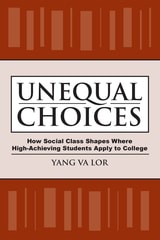
cover of Unequal Choices: How Social Class Shapes Where High-Achieving Students Apply to College

Unequal Choices

How Social Class Shapes Where High-Achieving Students Apply to College

Yang Va Lor

Rutgers University Press, 2023
High-achieving students from socioeconomically disadvantaged backgrounds are more likely to end up at less selective institutions compared to their socioeconomically advantaged peers with similar academic qualifications. A key reason for this is that few highly able, socioeconomically disadvantaged students apply to selective institutions in the first place. In Unequal Choices, Yang Va Lor examines the college application choices of high-achieving students, looking closely at the ways the larger contexts of family, school, and community influence their decisions. For students today, contexts like high schools and college preparation programs shape the type of colleges that they deem appropriate, while family upbringing and personal experiences influence how far from home students imagine they can apply to college. Additionally, several mechanisms reinforce the reproduction of social inequality, showing how institutions and families of the middle and upper-middle class work to procure advantages by cultivating dispositions among their children for specific types of higher education opportunities.
[more]
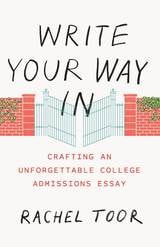
cover of Write Your Way In: Crafting an Unforgettable College Admissions Essay

Write Your Way In

Crafting an Unforgettable College Admissions Essay

Rachel Toor

University of Chicago Press, 2017

Writing, for most of us, is bound up with anxiety. It’s even worse when it feels like your whole future—or at least where you’ll spend the next four years in college—is on the line. It’s easy to understand why so many high school seniors put off working on their applications until the last minute or end up with a generic and clichéd essay.

The good news? You already have the “secret sauce” for crafting a compelling personal essay: your own experiences and your unique voice.
 
The best essays rarely catalog how students have succeeded or achieved. Good writing shows the reader how you’ve struggled and describes mistakes you’ve made. Excellent essays express what you’re fired up about, illustrate how you think, and illuminate the ways you’ve grown.

More than twenty million students apply to college every year; many of them look similar in terms of test scores, grades, courses taken, extracurricular activities. Admissions officers wade through piles of files. As an applicant, you need to think about what will interest an exhausted reader. What can you write that will make her argue to admit you instead of the thousands of other applicants?

A good essay will be conversational and rich in vivid details, and it could only be written by one person—you. This book will help you figure out how to find and present the best in yourself. You’ll acquire some useful tools for writing well—and may even have fun—in the process.
[more]