Results by title
26 books match the query 'Advocacy'
"The Wrong Side of Privilege"
Advocacy, Community, and Politics: The Collected Essays of Stephen J. Parks, 2000–2020Stephen J. Parks
University Press of Colorado, 2025
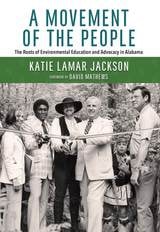
A Movement of the People
The Roots of Environmental Education and Advocacy in AlabamaKatie Lamar Jackson, Foreword by David Mathews
University of Alabama Press, 2017
A Movement of the People: The Roots of Environmental Education and Advocacy in Alabama is a detailed history of the Alabama Environmental Quality Association (AEQA). The AEQA helped to establish groundbreaking environmental protection and natural resource preservation policies for the state and the region and grew into one of the nation’s most progressive environmental education efforts.
The AEQA began in 1966 with the relatively simple political action agenda of cleaning up unsightly and unsanitary roadside trash. These inspired citizens collaborated with civic leaders to identify and remove illegal rural dumps and create more regulated landfills statewide. Eventually they became involved in the “Keep America Beautiful” campaign and with the US Public Health Service in its attempt to rid the state of the yellow-fever mosquito vector, Aedes aegypti, which breeds in standing, fetid water. The acme of these early efforts was the passage of Alabama’s Solid Waste Disposal Law of 1969, one of the nation’s first such bills.
The AEQA’s dedicated staff and supporters spearheaded other environmental projects, many of which remain active today, such as recycling programs with industry giants throughout the Southeast and the founding of the Bartram Trail Conference, a multistate initiative to identify and preserve the path that Quaker botanist William Bartram took through the territory before its formation into states.
Using recorded interviews with Martha McInnis, executive vice president of the AEQA, and full access to a meticulously preserved archive of the organization’s papers and artifacts, Katie Lamar Jackson relates this previously untold story of remarkable “citizen activism.” A Movementof the People is a valuable account of the organization’s growth and advancement, both economically and societally, which serves as a blueprint for successful civic activism and grassroots organizing.
Administrative Justice
Advocacy and Change in a Government AgencyPhilippe Nonet
Russell Sage Foundation, 1969
Advocacy and Awareness for Archivists
Kathleen D. Roe
Society of American Archivists, 2019

Advocacy and Awareness for Archivists
Kathleen D. Roe
American Library Association, 2019

Advocacy, Outreach & the Nation’s Academic Libraries
A Call for ActionWilliam C. Welburn
Assoc of College & Research Libraries, 2011
Advocacy, Outreach & the Nation’s Academic Libraries
A Call for ActionWilliam C. Welburn
Assoc of College & Research Libraries, 2011
Assessment and Advocacy
Using Project Outcome for Academic LibrariesGena Parsons-Diamond
Assoc of College & Research Libraries, 2024
In celebration of Project Outcome’s fifth anniversary, Assessment and Advocacy: Using Project Outcome for Academic Libraries collects case studies demonstrating how a variety of libraries have used Project Outcome to make improvements in their practice and highlighting the value the toolkit has brought to institutions and the academic library profession. Chapters capture ways to use Project Outcome to make small changes, like the optimal arrangement of a library’s study room furniture, to using Project Outcome data in conversation with datasets from other sources to provide greater insights into the contributions of academic libraries to student learning and success, as well as evidence that can be used in advocating for institutional, state, and federal funding.
Academic librarians know that their work makes a difference. You set students on the road to success and researchers on the road to results, providing valuable skills and access to knowledge that help our colleges and universities thrive. The challenge for libraries can be capturing meaningful data to support that story. Since 2019, the Project Outcome for Academic Libraries toolkit has helped library workers measure learning outcomes to drive change, make data-informed decisions, and demonstrate the impact and value of academic libraries. Learn how to use this data in your library, institution, and the profession with Assessment and Advocacy, all proceeds of which go to keeping Project Outcome free.
Deaf People in the Criminal Justice System
Selected Topics on Advocacy, Incarceration, and Social JusticeDebra Guthmann
Gallaudet University Press, 2021
The contributors address issues such as accessibility needs; gaps regarding data collection and the need for more research; additional training for attorneys, court personnel, and prison staff; the need for more qualified sign language interpreters, including Certified Deaf Interpreters who provide services in court, prison, and juvenile facilities; substance use disorders; the school to prison nexus; and the need for advocacy. Students in training programs, researchers, attorneys, mental health professionals, sign language interpreters, family members, and advocates will be empowered by this much-needed resource to improve the experiences and outcomes for deaf people in the criminal justice system.
Editing and Advocacy
Patrick Barry
Michigan Publishing Services, 2022
This book— which is based on a popular course taught at the University of Chicago Law School, the University of Michigan Law School, and the UCLA School of Law— is designed to help you become one of those editors. You’ll learn how to edit with empathy. You’ll learn how to edit with statistics. You’ll learn, in short, a wide range of compositional skills you can use to elevate your advocacy and better champion the causes you care about the most.
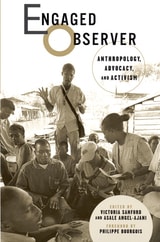
Engaged Observer
Anthropology, Advocacy, and ActivismSanford, Victoria
Rutgers University Press, 2006
Anthropology has long been associated with an ethos of “engagement.” The field’s core methods and practices involve long-term interpersonal contact between researchers and their study participants, giving major research topics in the field a distinctively human face. Can research findings be authentic and objective? Are anthropologists able to use their data to aid the participants of their study, and is that aid always welcome?
In Engaged Observer, Victoria Sanford and Asale Angel-Ajani bring together an international array of scholars who have been embedded in some of the most conflict-ridden and dangerous zones in the world to reflect on the role and responsibility of anthropological inquiry. They explore issues of truth and objectivity, the role of the academic, the politics of memory, and the impact of race, gender, and social position on the research process. Through ethnographic case studies, they offer models for conducting engaged research and illustrate the contradictions and challenges of doing so.
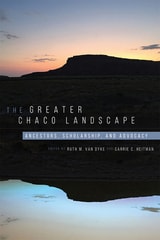
Greater Chaco Landscape
Ancestors, Scholarship, and AdvocacyRuth M. Van Dyke
University Press of Colorado, 2020
Contributors analyze many different dimensions of the Chacoan landscape and present the most effective, innovative, and respectful means of studying them, focusing on the significance of thousand-year-old farming practices; connections between early great houses outside the canyon and the rise of power inside it; changes to Chaco’s roads over time as observed in aerial imagery; rock art throughout the greater Chaco area; respectful methods of examining shrines, crescents, herraduras, stone circles, cairns, and other landscape features in collaboration with Indigenous colleagues; sensory experiences of ancient Chacoans via study of the sightlines and soundscapes of several outlier communities; and current legal, technical, and administrative challenges and options concerning preservation of the landscape.
An unusually innovative and timely volume that will be available both in print and online, with the online edition incorporating video chapters presented by Acoma, Diné, Zuni, and Hopi cultural experts filmed on location in Chaco Canyon, The Greater Chaco Landscape is a creative collaboration with Native voices that will be a case study for archaeologists and others working on heritage management issues across the globe. It will be of interest to archaeologists specializing in Chaco and the Southwest, interested in remote sensing and geophysical landscape-level investigations, and working on landscape preservation and phenomenological investigations such as viewscapes and soundscapes.
Contributors: R. Kyle Bocinsky, G. B. Cornucopia, Timothy de Smet, Sean Field, Richard A. Friedman, Dennis Gilpin, Presley Haskie, Tristan Joe, Stephen H. Lekson, Thomas Lincoln, Michael P. Marshall, Terrance Outah, Georgiana Pongyesva, Curtis Quam, Paul F. Reed, Octavius Seowtewa, Anna Sofaer, Julian Thomas, William B. Tsosie Jr., Phillip Tuwaletstiwa, Ernest M. Vallo Jr., Carla R. Van West, Ronald Wadsworth, Robert S. Weiner, Thomas C. Windes, Denise Yazzie, Eurick Yazzie
Growing Community Forests
Practice, Research, and AdvocacyRyan Bullock
University of Manitoba Press, 2017
Image Makers
Advertising, Public Relations, and the Ethos of AdvocacyRobert Jackall and Janice M. Hirota
University of Chicago Press, 2000
Robert Jackall and Janice M. Hirota explore the fashioning of the apparatus of advocacy through the stories of two organizations, the Committee on Public Information, which sold the Great War to the American public, and the Advertising Council, which since the Second World War has been the main coordinator of public service advertising. They then turn to the career of William Bernbach, the adman's adman, who reinvented advertising and grappled creatively with the profound skepticism of a propaganda-weary midcentury public. Jackall and Hirota argue that the tools-in-trade and habits of mind of "image makers" have now migrated into every corner of modern society. Advocacy is now a vocation for many, and American society abounds as well with "technicians in moral outrage," including street-smart impresarios, feminist preachers, and bombastic talk-radio hosts.
The apparatus and ethos of advocacy give rise to endlessly shifting patterns of conflicting representations and claims, and in their midst Image Makers offers a clear and spirited understanding of advocacy in contemporary society and the quandaries it generates.
Legal Care
Advocacy and Friction in Family DetentionErin Routon
University of Arizona Press, 2026
Family detention garnered much public attention when it expanded dramatically in 2014 as significantly increased numbers of migrant groups began arriving and requesting asylum at the Mexico-U.S. border. During this period, the Obama administration designated three detention facilities, two in South Texas, to hold such families while they underwent part of the asylum legal process. One became the largest immigrant detention facility in the country.
In Legal Care anthropologist Erin Routon explores the operations of these facilities through the unique perspectives of volunteer legal advocates. Routon offers a compelling ethnographic account of the hidden labor and emotional resilience of those advocates. Through the lens of “legal care,” Routon reframes legal aid as a form of caregiving, revealing how these advocates resist the structural and legal violence of family detention while supporting asylum-seeking parents and children. Drawing on immersive fieldwork and firsthand narratives, the book exposes the human cost of administrative incarceration and the quiet power of care in spaces designed to exclude.
Timely, urgent, and deeply humane, this work speaks to scholars and practitioners across anthropology, law and society, migration studies, and carceral justice. Routon’s accessible and evocative writing invites readers to reconsider activism and advocacy, offering new language for understanding resistance and solidarity in the face of institutional violence. This book is essential reading for anyone committed to justice, care, and the future of immigration policy in the United States.
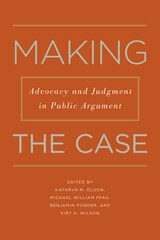
Making the Case
Advocacy and Judgment in Public ArgumentKathryn M. Olson
Michigan State University Press, 2012
In an era when the value of the humanities and qualitative inquiry has been questioned in academia and beyond, Making the Case is an engaging and timely collection that brings together a veritable who’s who of public address scholars to illustrate the power of case-based scholarly argument and to demonstrate how critical inquiry into a specific moment speaks to general contexts and theories. Providing both a theoretical framework and a wealth of historically situated texts, Making the Case spans from Homeric Greece to twenty-first-century America. The authors examine the dynamic interplay of texts and their concomitant rhetorical situations by drawing on a number of case studies, including controversial constitutional arguments put forward by activists and presidents in the nineteenth century, inventive economic pivots by Franklin Roosevelt and Alan Greenspan, and the rhetorical trajectory and method of Barack Obama.
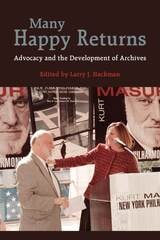
Many Happy Returns
Advocacy and the Development of ArchivesLarry J. Hackman
Society of American Archivists, 2011
Maximizing School Librarian Leadership
Building Connections for Learning and AdvocacyJudi Moreillon
American Library Association, 2018

Museum Archives
Practice, Issues, and AdvocacySusan Hernandez
Society of American Archivists, 2022
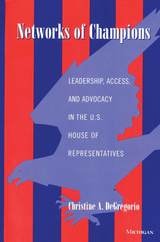
Networks of Champions
Leadership, Access, and Advocacy in the U.S. House of RepresentativesChristine A. DeGregorio
University of Michigan Press, 1999
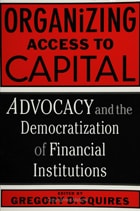
Organizing Access To Capital
Advocacy And The Democratizationedited by Gregory D. Squires
Temple University Press, 2003
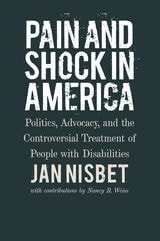
Pain and Shock in America
Politics, Advocacy, and the Controversial Treatment of People with DisabilitiesJan Nisbet
Brandeis University Press, 2021
For more than forty years, professionals in the field of disability studies have engaged in debates over the use of aversive interventions (such as electric shock) like the ones used at the Judge Rotenberg Center. Advocates and lawyers have filed complaints and lawsuits to both use them and ban them, scientists have written hundreds of articles for and against them, and people with disabilities have lost their lives and, some would say, lived their lives because of them. There are families who believe deeply in the need to use aversives to control their children’s behavior. There are others who believe the techniques used are torture. All of these families have children who have been excluded from numerous educational and treatment programs because of their behaviors. For most of the families, placement at the Judge Rotenberg Center is the last resort.
This book is a historical case study of the Judge Rotenberg Center, named after the judge who ruled in favor of keeping its doors open to use aversive interventions. It chronicles and analyzes the events and people involved for over forty years that contributed to the inability of the state of Massachusetts to stop the use of electric shock, and other severe forms of punishment on children and adults with disabilities. It is a long story, sad and tragic, complex, filled with intrigue and questions about society and its ability to protect and support its most vulnerable citizens.
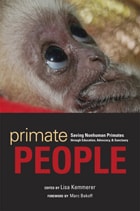
Primate People
Saving Nonhuman Primates through Education, Advocacy, and SanctuaryLisa Kemmerer
University of Utah Press, 2012
In the last 30 years the bushmeat trade has led to the slaughter of nearly 90 percent of West Africa’s bonobos, perhaps our closest relatives, and has recently driven Miss Waldron’s red colobus monkey to extinction. Earth was once rich with primates, but every species—except one—is now extinct or endangered because of one primate—Homo sapiens. How have our economic and cultural practices pushed our cousins toward destruction? Would we care more about their fate if we knew something of their individual lives and sufferings? Would we help them if we understood how our choices threaten their existence? This anthology helps to answer these questions.
The first section of Primate People introduces forces that threaten nonhuman primates, such as the entertainment and “pet” industries, the bushmeat trade, habitat destruction, and logging. The second section exposes the exploitation of primates in research facilities, including the painful memories of an undercover agent, and suggests models of more enlightened scientific methods. The final section tells the stories of those who lobby for change, educate communities, and tenderly care for our displaced cousins in sanctuaries.
Sometimes shocking and disturbing, sometimes poignant and encouraging, Primate People always draws the reader into the lives of nonhuman primates. Activists around the world reveal the antics and pleasures of monkeys, the tendencies and idiosyncrasies of chimpanzees, and the sufferings and fears of macaques. Charming, difficult, sensitive—these testimonies demonstrate that nonhuman primates and human beings are, indeed, closely related. Woven into the anthology’s lucid narratives are the stories of how we harm and create the conditions that endanger primates, and what we can and must do to prevent their ongoing suffering and fast-approaching extinction.
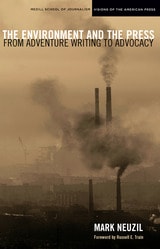
The Environment and the Press
From Adventure Writing to AdvocacyMark Neuzil
Northwestern University Press, 2008
This history of environmental journalism looks at how the practice now defines issues and sets the public agenda evolving from a tradition that includes the works of authors such as Pliny the Elder, John Muir, and Rachel Carson. It makes the case that the relationship between the media and its audience is an ongoing conversation between society and the media on what matters and what should matter.
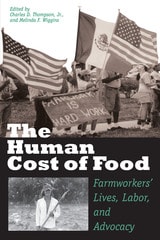
The Human Cost of Food
Farmworkers' Lives, Labor, and AdvocacyEdited by Charles D. Thompson, Jr., and Melinda F. Wiggins
University of Texas Press, 2002
Finding fresh fruits and vegetables is as easy as going to the grocery store for most Americans—which makes it all too easy to forget that our food is cultivated, harvested, and packaged by farmworkers who labor for less pay, fewer benefits, and under more dangerous conditions than workers in almost any other sector of the U.S. economy. Seeking to end the public's ignorance and improve workers' living and working conditions, this book addresses the major factors that affect farmworkers' lives while offering practical strategies for action on farmworker issues.
The contributors to this book are all farmworker advocates—student and community activists and farmworkers themselves. Focusing on workers in the Southeast United States, a previously understudied region, they cover a range of issues, from labor organizing, to the rise of agribusiness, to current health, educational, and legal challenges faced by farmworkers. The authors blend coverage of each issue with practical suggestions for working with farmworkers and other advocates to achieve justice in our food system both regionally and nationally.
Thriving as a Mid-Career Librarian
Identity, Advocacy, and PathwaysBrandon West
Assoc of College & Research Libraries, 2023
In four sections, Thriving as a Mid-Career Librarian collects the experiences of mid-career librarians as they grapple with these questions and the roles that marginalized perspectives, intersectionality, and privilege have played in their careers:
- Section 1: Staying Engaged in Your Career
- Section 2: The Role of Identity in Shaping Mid-career Librarianship
- Section 3: Being Your Own Advocate
- Section 4: To Lead or Not to Lead?
It can feel like everything gets harder, more political, and further under-resourced with each passing year. Thriving as a Mid-Career Librarian offers strategies of community, support, and advocacy that can help make it possible for us to thrive and help others to thrive. At mid-career, we may not have the same bright-eyed enthusiasm we possessed as new information professionals, but we have other things: the contributions we make to our communities and the wealth of experience we have built up since those days.