Results by title

22 books match the query 'African American feminists'
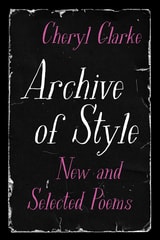
cover of Archive of Style: New and Selected Poems

Archive of Style

New and Selected Poems

Cheryl Clarke

Northwestern University Press, 2024

A new retrospective of a titan of LGBTQ literature, activism, and Black feminism

Award-winning poet and essayist Cheryl Clarke’s illustrious career has spanned more than four decades and culminates in Archive of Style: New and Selected Poems, a long-awaited retrospective of the indelible work of a Black feminist, community and LGBTQ activist, and educator. This collection features carefully curated poems from Narratives: Poems in the Tradition of Black Women (1982), Living as a Lesbian (1986), The Days of Good Looks: Prose and Poetry 1980-2005 (2006), By My Precise Haircut (2016), and Targets (2019). Together these works show a brilliant thinker who has profoundly impacted generations of writers and activists.

Clarke’s poetry and essays, centered around the Black, lesbian, feminist experience, have attracted an audience around the world. Her essays, “Lesbianism: an Act of Resistance” and “The Failure to Transform: Homophobia in the Black Community” revolutionized the thinking about lesbians of color and the struggle against homophobia. Her poetry and non-fiction have been reprinted in numerous anthologies and assigned in women and sexuality courses globally. Having published since 1977, Clarke and her work have become a foundational part of LGBTQ literature and activism. Archive of Style is a celebration and homage to one of American literature’s Black Women literary warriors.
 
[more]
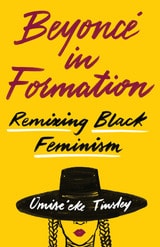
cover of Beyoncé in Formation: Remixing Black Feminism

Beyoncé in Formation

Remixing Black Feminism

By Omise'eke Tinsley

University of Texas Press, 2018

Making headlines when it was launched in 2015, Omise’eke Tinsley’s undergraduate course “Beyoncé Feminism, Rihanna Womanism” has inspired students from all walks of life. In Beyoncé in Formation, Tinsley now takes her rich observations beyond the classroom, using the blockbuster album and video Lemonade as a soundtrack for vital new-millennium narratives.

Woven with candid observations about her life as a feminist scholar of African studies and a cisgender femme married to a trans spouse, Tinsley’s “Femme-onade” mixtape explores myriad facets of black women’s sexuality and gender. Turning to Beyoncé’s “Don’t Hurt Yourself,” Tinsley assesses black feminist critiques of marriage and then considers the models of motherhood offered in “Daddy Lessons,” interspersing these passages with memories from Tinsley’s multiracial family history. Her chapters on nontraditional bonds culminate in a discussion of contemporary LGBT politics through the lens of the internet-breaking video “Formation,” underscoring why Beyoncé’s black femme-inism isn’t only for ciswomen. From pleasure politics and the struggle for black women’s reproductive justice to the subtext of blues and country music traditions, the landscape in this tour is populated by activists and artists (including Loretta Lynn) and infused with vibrant interpretations of Queen Bey’s provocative, peerless imagery and lyrics.

In the tradition of Roxanne Gay’s Bad Feminist and Jill Lepore’s best-selling cultural histories, Beyoncé in Formation is the work of a daring intellectual who is poised to spark a new conversation about freedom and identity in America.
[more]
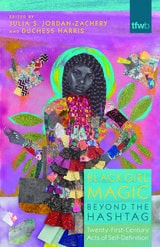
cover of Black Girl Magic Beyond the Hashtag: Twenty-First-Century Acts of Self-Definition

Black Girl Magic Beyond the Hashtag

Twenty-First-Century Acts of Self-Definition

Edited by Julia S. Jordan-Zachery and Duchess Harris; Foreword by Janell Hobson; Afterword by Tammy Owens

University of Arizona Press, 2019

Hashtag or trademark, personal or collective expression, #BlackGirlMagic is an articulation of the resolve of Black women and girls to triumph in the face of structural oppressions. The online life of #BlackGirlMagic insists on the visibility of Black women and girls as aspirational figures. But while the notion of Black girl magic spreads in cyberspace, the question remains: how is Black girl magic experienced offline?

The essays in this volume move us beyond social media. They offer critical analyses and representations of the multiplicities of Black femmes’, girls’, and women’s lived experiences. Together the chapters demonstrate how Black girl magic is embodied by four elements enacted both on- and offline: building community, challenging dehumanizing representations, increasing visibility, and offering restorative justice for violence.

Black Girl Magic Beyond the Hashtag shows how Black girls and women foster community, counter invisibility, engage in restorative acts, and create spaces for freedom. Intersectional and interdisciplinary, the contributions in this volume bridge generations and collectively push the boundaries of Black feminist thought.
[more]
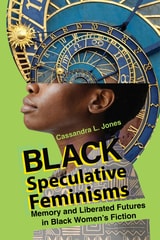
cover of Black Speculative Feminisms: Memory and Liberated Futures in Black Women's Fiction

Black Speculative Feminisms

Memory and Liberated Futures in Black Women's Fiction

Cassandra L. Jones

The Ohio State University Press, 2024
How do Black women writing speculative fiction explore the use of memory as a potential strategy for liberation? In Black Speculative Feminisms, Cassandra L. Jones looks at the writings of Octavia E. Butler, Tananarive Due, Nalo Hopkinson, Rasheedah Phillips, and Nnedi Okorafor to chart those moments where characters harness, or fail to harness, the power of memory. These instances transform memory—individual and collective, bodily and archival—from passive recollection into direct or indirect social action. Taking a Black feminist approach, Jones addresses several emancipatory themes within Afrofuturism: the decolonization of time that can be found in fiction employing non-Western and non-linear expressions of time, exploring futurity and the projection of a full range of expressions of Black humanity into anticipated futures, and imagining new worlds and novel approaches to old problems. Drawing on critical fabulation and restorative justice, she forwards restorative fabulation as the mechanism by which speculative fiction offers a healing site for authors and readers to process generational trauma while imagining more equitable futures.
[more]
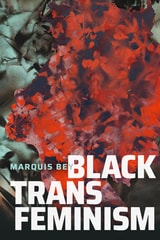
cover of Black Trans Feminism

Black Trans Feminism

Marquis Bey

Duke University Press, 2022

In Black Trans Feminism Marquis Bey offers a meditation on blackness and gender nonnormativity in ways that recalibrate traditional understandings of each. Theorizing black trans feminism from the vantages of abolition and gender radicality, Bey articulates blackness as a mutiny against racializing categorizations; transness as a nonpredetermined, wayward, and deregulated movement that works toward gender’s destruction; and black feminism as an epistemological method to fracture hegemonic modes of racialized gender. In readings of the essays, interviews, and poems of Alexis Pauline Gumbs, jayy dodd, and Venus Di’Khadijah Selenite, Bey turns black trans feminism away from a politics of gendered embodiment and toward a conception of it as a politics grounded in fugitivity and the subversion of power. Together, blackness and transness actualize themselves as on the run from gender. In this way, Bey presents black trans feminism as a mode of enacting the wholesale dismantling of the world we have been given.
[more]
cover of Dear Science and Other Stories

Dear Science and Other Stories

Katherine McKittrick

Duke University Press, 2021
In Dear Science and Other Stories Katherine McKittrick presents a creative and rigorous study of black and anticolonial methodologies. Drawing on black studies, studies of race, cultural geography, and black feminism as well as a mix of methods, citational practices, and theoretical frameworks, she positions black storytelling and stories as strategies of invention and collaboration. She analyzes a number of texts from intellectuals and artists ranging from Sylvia Wynter to the electronica band Drexciya to explore how narratives of imprecision and relationality interrupt knowledge systems that seek to observe, index, know, and discipline blackness. Throughout, McKittrick offers curiosity, wonder, citations, numbers, playlists, friendship, poetry, inquiry, song, grooves, and anticolonial chronologies as interdisciplinary codes that entwine with the academic form. Suggesting that black life and black livingness are, in themselves, rebellious methodologies, McKittrick imagines without totally disclosing the ways in which black intellectuals invent ways of living outside prevailing knowledge systems.
[more]
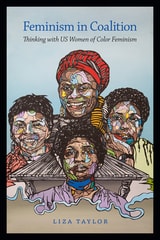
cover of Feminism in Coalition: Thinking with US Women of Color Feminism

Feminism in Coalition

Thinking with US Women of Color Feminism

Liza Taylor

Duke University Press, 2022
In Feminism in Coalition Liza Taylor examines how US women of color feminists’ coalitional politics provides an indispensable resource to contemporary political theory, feminist studies, and intersectional social justice activism. Taylor charts the theorization of coalition in the work of Bernice Johnson Reagon, Audre Lorde, Barbara Smith, the Combahee River Collective, Gloria Anzaldúa, Cherríe Moraga, and others. For these activist-scholars, coalition is a dangerous struggle that emerges from a shared political commitment to undermining oppression and an emphasis on self-transformation. Taylor shows how their coalitional understandings of group politics, identity, consciousness, and scholarship have transformed how activists and theorists build alliances across race, class, gender, sexuality, faith, and ethnicity to tackle systems of domination. Their coalitional politics enrich current discussions surrounding the impetus and longevity of effective activism, present robust theoretical accounts of political subject formation and political consciousness, and demonstrate the promise of collective modes of scholarship. In this way, women of color feminists have been formulating solutions to long-standing problems in political theory. By illustrating coalition’s vitality to a variety of practical and philosophical interdisciplinary discussions, Taylor encourages us to rethink feminist and political theory.
[more]
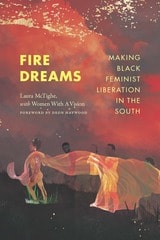
cover of Fire Dreams: Making Black Feminist Liberation in the South

Fire Dreams

Making Black Feminist Liberation in the South

Laura McTighe, with Women With A Vision

Duke University Press, 2024
For thirty-five years, the New Orleans-based Black feminist collective Women With A Vision (WWAV) has fought for the liberation of their communities through reproductive justice, harm reduction, abolition feminism, racial justice, and sex workers' rights. In 2012, shortly after one of WWAV's biggest organizing victories, arsonists firebombed and destroyed their headquarters. Fire Dreams is an innovative collaboration between WWAV and Laura McTighe, who work in community to build a social movement ethnography of the organization’s post-arson rebirth. Rooting WWAV in the geography of the South and the living history of generations of Black feminist thinkers, McTighe and WWAV weave together stories from their founders’ pioneering work during the Black HIV/AIDS crisis in the 1980s and their groundbreaking organizing to end criminalization in the aftermath of Hurricane Katrina---with other movements for liberation as accomplices. Together, the authors refuse the logics of racial capitalism and share WWAV’s own world-building knowledges, as well as their methods for living these Black feminist futures now. Fire Dreams is a vital toolkit for grassroots organizers, activist-scholars, and all those who dream to make the world otherwise.
[more]
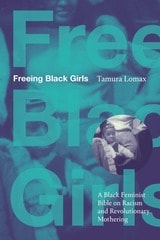
cover of Freeing Black Girls: A Black Feminist Bible on Racism and Revolutionary Mothering

Freeing Black Girls

A Black Feminist Bible on Racism and Revolutionary Mothering

Tamura Lomax

Duke University Press, 2025
In Freeing Black Girls, Tamura Lomax offers an insurgent feminist love letter to Black girls, women, mothers, and othermothers. Exploring what it means to mother Black children in the twenty-first century, Lomax shares her journey from her traditionalist Black girlhood to finding the path to revolutionary Black motherhood. Along the way, she shows how all Black people are endangered by white supremacist capitalist heteropatriarchal dominance and emphasizes the power of looking and talking back. Lomax insists on Black feminist ways of living that value and nourish whole persons, sketching a radical dream that will allow Black women and girls to survive America while being able to love themselves, others, and collective Black freedom. Ultimately, Lomax declares that Black women and girls are emphatically not defective, second-class, or immanent nurturers; they are sacred and revolutionary beings who deserve to live a life free of predation, patriarchy, misrecognition, misogynoir, and violence.
[more]
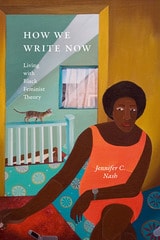
cover of How We Write Now: Living with Black Feminist Theory

How We Write Now

Living with Black Feminist Theory

Jennifer C. Nash

Duke University Press, 2024
In How We Write Now Jennifer C. Nash examines how Black feminists use beautiful writing to allow writers and readers to stay close to the field’s central object and preoccupation: loss. She demonstrates how contemporary Black feminist writers and theorists such as Jesmyn Ward, Elizabeth Alexander, Christina Sharpe, and Natasha Trethewey mobilize their prose to ask readers to feel, undo, and reassemble themselves. These intimate invitations are more than a set of tools for decoding the social world; Black feminist prose becomes a mode of living and feeling, dreaming and being, and a distinctly affective project that treats loss as not only paradigmatic of Black life but also an aesthetic question. Through her own beautiful writing, Nash shows how Black feminism offers itself as a companion to readers to chart their own lives with and in loss, from devastating personal losses to organizing around the movement for Black lives. Charting her own losses, Nash reminds us that even as Black feminist writers get as close to loss as possible, it remains a slippery object that troubles memory and eludes capture.
[more]
cover of In a Field of Static: Missed Encounters with Black Feminist Theorizing

In a Field of Static

Missed Encounters with Black Feminist Theorizing

James Bliss

Duke University Press, 2026
With In a Field of Static, James Bliss examines how the debates at the heart of feminist and queer studies represent missed encounters with Black feminist theorizing. For Bliss, Audre Lorde’s public falling out with Mary Daly, feminist theory’s arguments about intersectionality and assemblage theory, queer theory’s debates over negativity and futurity, and the transnational and diasporic turns in feminist and queer studies each demonstrate how different debates, misunderstandings, and missed encounters have drawn the horizons of our political and conceptual imaginations. Engaging literary and critical works by Hortense Spillers, Audre Lorde, Kimberlé Crenshaw, Saidiya Hartman, Toni Morrison, Barbara Smith, and others, Bliss recontextualizes concepts like relationality, subjectivity, negativity, and belonging through readings across the archive of Black feminism. By revisiting and restaging these conceptual debates, Bliss presents a genealogy of Black feminist theorizing that marks the indeterminacy, the field of static, at the core of Blackness and antiblackness. Insisting on the potential within indeterminacy, this genealogy embraces negativity, abstraction, and speculation as methods for an insurgent conceptual inventiveness—ways of imagining new worlds and new forms of being and relation.
[more]
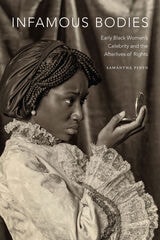
cover of Infamous Bodies: Early Black Women’s Celebrity and the Afterlives of Rights

Infamous Bodies

Early Black Women’s Celebrity and the Afterlives of Rights

Samantha Pinto

Duke University Press, 2020
The countless retellings and reimaginings of the private and public lives of Phillis Wheatley, Sally Hemings, Sarah Baartman, Mary Seacole, and Sarah Forbes Bonetta have transformed them into difficult cultural and black feminist icons. In Infamous Bodies, Samantha Pinto explores how histories of these black women and their ongoing fame generate new ways of imagining black feminist futures. Drawing on a variety of media, cultural, legal, and critical sources, Pinto shows how the narratives surrounding these eighteenth- and nineteenth-century celebrities shape key political concepts such as freedom, consent, contract, citizenship, and sovereignty. Whether analyzing Wheatley's fame in relation to conceptions of race and freedom, notions of consent in Hemings's relationship with Thomas Jefferson, or Baartman's ability to enter into legal contracts, Pinto reveals the centrality of race, gender, and sexuality in the formation of political rights. In so doing, she contends that feminist theories of black women's vulnerable embodiment can be the starting point for future progressive political projects.
[more]
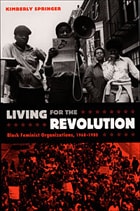
cover of Living for the Revolution: Black Feminist Organizations, 1968–1980

Living for the Revolution

Black Feminist Organizations, 1968–1980

Kimberly Springer

Duke University Press, 2005

The first in-depth analysis of the black feminist movement, Living for the Revolution fills in a crucial but overlooked chapter in African American, women’s, and social movement history. Through original oral history interviews with key activists and analysis of previously unexamined organizational records, Kimberly Springer traces the emergence, life, and decline of several black feminist organizations: the Third World Women’s Alliance, Black Women Organized for Action, the National Black Feminist Organization, the National Alliance of Black Feminists, and the Combahee River Collective. The first of these to form was founded in 1968; all five were defunct by 1980. Springer demonstrates that these organizations led the way in articulating an activist vision formed by the intersections of race, gender, class, and sexuality.

The organizations that Springer examines were the first to explicitly use feminist theory to further the work of previous black women’s organizations. As she describes, they emerged in response to marginalization in the civil rights and women’s movements, stereotyping in popular culture, and misrepresentation in public policy. Springer compares the organizations’ ideologies, goals, activities, memberships, leadership styles, finances, and communication strategies. Reflecting on the conflicts, lack of resources, and burnout that led to the demise of these groups, she considers the future of black feminist organizing, particularly at the national level. Living for the Revolution is an essential reference: it provides the history of a movement that influenced black feminist theory and civil rights activism for decades to come.
[more]
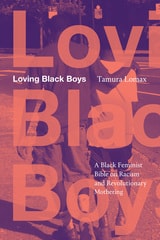
cover of Loving Black Boys: A Black Feminist Bible on Racism and Revolutionary Mothering

Loving Black Boys

A Black Feminist Bible on Racism and Revolutionary Mothering

Tamura Lomax

Duke University Press, 2026
Loving Black Boys is not just a love letter to Tamura Lomax’s own sons, but to all Black boys, men, fathers, and brothers. With understanding and urgency, Lomax writes honestly about Black endangerment and what it means to endure living in what James Baldwin called the “burning house” of white supremacist capitalist heteropatriarchal America. Seeing the full humanity of Black boys and men, and the liberation of all Black people, Lomax writes, requires a Black feminist lens. A companion piece to Freeing Black Girls, this book connects the everyday and extraordinary moments of Black mothering: phenomena as varied as “the talk” about police brutality, physical and emotional violence, Christian nationalism, miseducation, emotional health, sports, and more, which produce not only shared vulnerabilities but also tensions among Black folks. To her sons and to all Black men, Lomax insists that Black feminism, which emphasizes mutuality, protection, ethical autonomy, and healing, is vital to forging a safer future for individual and collective survival.
[more]
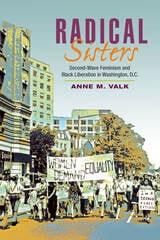
cover of Radical Sisters: Second-Wave Feminism and Black Liberation in Washington, D.C.

Radical Sisters

Second-Wave Feminism and Black Liberation in Washington, D.C.

Anne M. Valk

University of Illinois Press, 2010
Radical Sisters offers a fresh exploration of the ways that 1960s political movements shaped local, grassroots feminism in Washington, D.C. Rejecting notions of a universal sisterhood, Anne M. Valk argues that activists periodically worked to bridge differences for the sake of alleviating women's plight, even while maintaining distinct political bases. While most historiography on the subject tends to portray the feminist movement as deeply divided over issues of race, Valk presents a more nuanced account, showing feminists of various backgrounds both coming together to promote a notion of "sisterhood" and being deeply divided along the lines of class, race, and sexuality.
[more]
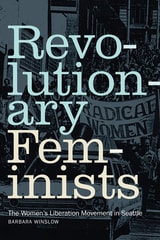
cover of Revolutionary Feminists: The Women's Liberation Movement in Seattle

Revolutionary Feminists

The Women's Liberation Movement in Seattle

Barbara Winslow

Duke University Press, 2023
Revolutionary Feminists tells the story of the radical women’s liberation movement in Seattle in the 1960s and 1970s from the perspective of a founding member, Barbara Winslow. Drawing on her collection of letters, pamphlets, and photographs as well as newspaper accounts, autobiographies, and interviews, Winslow emphasizes the vital role that Black women played in the women’s liberation movement to create meaningful intersectional coalitions in an overwhelmingly White city. Winslow brings the voices and visions of those she calls the movement’s “ecstatic utopians” to life. She charts their short-term successes and lasting achievements, from organizing women at work and campaigning for subsidized childcare to creating women-centered rape crisis centers, health clinics, and self-defense programs. The Seattle movement was essential to winning the first popular vote in the United States to liberalize abortion laws. Despite these achievements, Winslow critiques the failure of the movement's White members to listen to Black, Latina, Indigenous, and Asian American and Pacific Islander feminist activists. Reflecting on the Seattle movement’s accomplishments and shortcomings, Winslow offers a model for contemporary feminist activism.
[more]
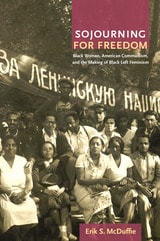
cover of Sojourning for Freedom: Black Women, American Communism, and the Making of Black Left Feminism

Sojourning for Freedom

Black Women, American Communism, and the Making of Black Left Feminism

Erik S. McDuffie

Duke University Press, 2011
Sojourning for Freedom portrays pioneering black women activists from the early twentieth century through the 1970s, focusing on their participation in the U.S. Communist Party (CPUSA) between 1919 and 1956. Erik S. McDuffie considers how women from diverse locales and backgrounds became radicalized, joined the CPUSA, and advocated a pathbreaking politics committed to black liberation, women’s rights, decolonization, economic justice, peace, and international solidarity. McDuffie explores the lives of black left feminists, including the bohemian world traveler Louise Thompson Patterson, who wrote about the “triple exploitation” of race, gender, and class; Esther Cooper Jackson, an Alabama-based civil rights activist who chronicled the experiences of black female domestic workers; and Claudia Jones, the Trinidad-born activist who emerged as one of the Communist Party’s leading theorists of black women’s exploitation. Drawing on more than forty oral histories collected from veteran black women radicals and their family members, McDuffie examines how these women negotiated race, gender, class, sexuality, and politics within the CPUSA. In Sojourning for Freedom, he depicts a community of radical black women activist intellectuals who helped to lay the foundation for a transnational modern black feminism.
[more]
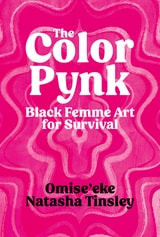
cover of The Color Pynk: Black Femme Art for Survival

The Color Pynk

Black Femme Art for Survival

Omise'eke Natasha Tinsley

University of Texas Press, 2022

2023 John Leo & Dana Heller Award for Best Single Work, Anthology, Multi-Authored, or Edited Book in LGBTQ Studies, Popular and American Culture Association (PACA) / Popular Culture Association (PCA)

2023 Honorable Mention, Harry Shaw and Katrina Hazzard-Donald Award for Outstanding Work in African-American Popular Culture Studies, Popular and American Culture Association (PACA) / Popular Culture Association (PCA)

2024 MPCA/ACA Best Single Work by One or More Authors, Midwest Popular Culture Association / Midwest American Culture Association (MPCA/ACA)


A celebration of the distinctive and politically defiant art of Black queer, cis-, and transfemmes, from the work of Janelle Monáe and Janet Mock to that of Indya Moore and Kelsey Lu.

The Color Pynk is a passionate exploration of Black femme poetics of survival. Sidelined by liberal feminists and invisible to mainstream civil rights movements, Black femmes spent the Trump years doing what they so often do best: creating politically engaged art, entertainment, and ideas. In the first full-length study of Black queer, cis-, and trans-femininity, Omise’eke Natasha Tinsley argues that this creative work offers a distinctive challenge to power structures that limit how we color, gender, and explore freedom.

Tinsley engages 2017–2020 Black femme cultural production that colorfully and provocatively imagines freedom in the stark white face of its impossibility. Looking to the music of Janelle Monáe and Kelsey Lu, Janet Mock’s writing for the television show Pose, the fashion of Indya Moore and (F)empower, and the films of Tourmaline and Juliana Huxtable, as well as poetry and novels, The Color Pynk conceptualizes Black femme as a set of consciously, continually rescripted cultural and aesthetic practices that disrupts conventional meanings of race, gender, and sexuality. There is an exuberant defiance in queer Black femininity, Tinsley finds—so that Black femmes continue to love themselves wildly in a world that resists their joy.
[more]
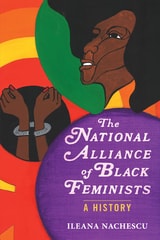
cover of The National Alliance of Black Feminists: A History

The National Alliance of Black Feminists

A History

Ileana Nachescu

University of Illinois Press, 2025

Founded in 1975, the non-partisan National Alliance of Black Feminists (NABF) played a critical role in the Black women’s liberation movement and the fight for the Equal Rights Amendment. The Chicago-based organization’s Black humanist feminism powered a singular dedication to building coalitions while influencing its historic set of comprehensive political, economic, and cultural demands.

Ileana Nachescu places the NABF’s history as the bridge between Black women’s social activism in the 1970s and the intellectual activism of the 1980s. Her account details the NABF’s work and how it reflected the group’s strong humanist belief in the transformation of all human beings. Nachescu also shows that the NABF’s post-Eighties erasure from movement histories is consistent with how many white feminists marginalized women of color and rejected their leadership. From there, Nachescu examines Black lesbians’ vibrant support of the NABF and shows how respectability politics pressured the group to support its lesbian membership in private but maintain a public silence on the issue.

A rare in-depth look at an overlooked organization, The National Alliance of Black Feminists tells an untold story of Black women’s liberation in the Midwest.
[more]
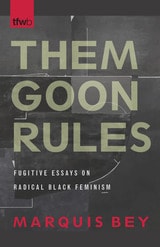
cover of Them Goon Rules: Fugitive Essays on Radical Black Feminism

Them Goon Rules

Fugitive Essays on Radical Black Feminism

Marquis Bey

University of Arizona Press, 2019

Marquis Bey’s debut collection, Them Goon Rules, is an un-rulebook, a long-form essayistic sermon that meditates on how Blackness and nonnormative gender impact and remix everything we claim to know.

A series of essays that reads like a critical memoir, this work queries the function and implications of politicized Blackness, Black feminism, and queerness. Bey binds together his personal experiences with social justice work at the New York–based Audre Lorde Project, growing up in Philly, and rigorous explorations of the iconoclasm of theorists of Black studies and Black feminism. Bey’s voice recalibrates itself playfully on a dime, creating a collection that tarries in both academic and nonacademic realms.

Fashioning fugitive Blackness and feminism around a line from Lil’ Wayne’s “A Millie,” Them Goon Rules is a work of “auto-theory” that insists on radical modes of thought and being as a refrain and a hook that is unapologetic, rigorously thoughtful, and uncompromising.
[more]
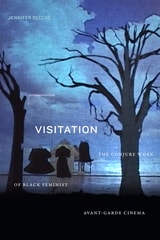
cover of Visitation: The Conjure Work of Black Feminist Avant-Garde Cinema

Visitation

The Conjure Work of Black Feminist Avant-Garde Cinema

Jennifer DeClue

Duke University Press, 2022

In Visitation, Jennifer DeClue shows how Black feminist avant-garde filmmakers draw from historical archives in order to visualize and reckon with violence suffered by Black women in the United States. DeClue argues that these filmmakers—including Kara Walker, Kara Lynch, Tourmaline, and Ja’Tovia Gary—create spaces of mourning and reckoning rather than voyeurism and pornotropy. Through their use of editing, performance, and cinematic experimentation, these filmmakers intervene in the production of Blackness and activate new ways of seeing Black women and telling their stories. Theorizing these films as a form of conjure work, DeClue shows how these filmmakers raise the specters of Black women from the past and invite them to reveal history from their point of view. In so doing, Black feminist avant-garde filmmakers channel spirits that haunt archives and create cinematic arenas for witnessing Black women battling for survival during pivotal and exceedingly violent moments in US history.

Duke University Press Scholars of Color First Book Award recipient
[more]
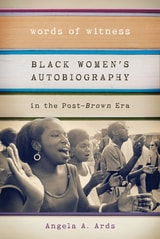
cover of Words of Witness: Black Women's Autobiography in the Post-<i>Brown</i> Era

Words of Witness

Black Women's Autobiography in the Post-<i>Brown</i> Era

Angela A. Ards

University of Wisconsin Press, 2015

A literary and political genealogy of the last half-century, Words of Witness explores black feminist autobiographical narratives in the context of activism and history since the landmark 1954 segregation case, Brown v. Board of Education. Angela A. Ards examines how activist writers, especially five whose memoirs were published in the 1990s and 2000s, crafted these life stories to engage and shape progressive, post-Brown politics.
            Exploring works by the critically acclaimed June Jordan and Edwidge Danticat, as well as by popular and emerging authors such as Melba Beals, Rosemary Bray, and Eisa Davis, Ards demonstrates how each text asserts countermemories to official—and often nostalgic—understandings of the civil rights and Black Power movements. She situates each writer as activist-citizen, adopting and remaking particular roles—warrior, “the least of these,” immigrant, hip-hop head—to crystallize a range of black feminist responses to urgent but unresolved political issues.
[more]