Results by title
4 books match the query 'African American social reformers'
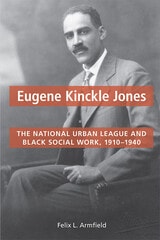
Eugene Kinckle Jones
The National Urban League and Black Social Work, 1910-1940Felix L. Armfield
University of Illinois Press, 2014
Drawing on interviews with Jones's colleagues and associates, as well as recently opened family and Urban League archives, Felix L. Armfield blends biography with an in-depth discussion of the roles of black institutions and organizations. The result is a work that offers new details on the growth of African American communities, the evolution of African American life, and the role of black social workers in the years before the civil rights era.

Glorying in Tribulation
The Lifework of Sojourner TruthErlene Stetson
Michigan State University Press, 1994
In Glorying in Tribulation, Stetson presents a new dimension of Sojourner Truth's character. Much of the information regarding this oft-quoted African American woman is either the stuff of legend or is in dispute. This important new biography takes both legend and fact and sets them into a larger historical context. The authors utilize archival sources, and other forms of direct and indirect evidence to create a better understanding of Truth. We see her victories as well as her defeats--we see her as a real person. Truth comes alive in the pages of this book through her poignant, prophetic words and we realize that what she spoke of in the nineteenth century is just as relevant to us today.
Glorying in Tribulation offers students, scholars, and teachers of American history and culture studies a comprehensive look and a new perspective on Truth's contribution to American history. It is a long-overdue, exciting interpretation of the meaning of Sojourner Truth's life.
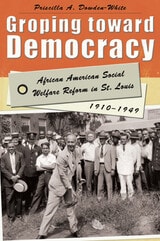
Groping toward Democracy
African American Social Welfare Reform in St. Louis, 1910-1949Priscilla A. Dowden-White
University of Missouri Press, 2011
In Groping toward Democracy: African American Social Welfare Reform in St. Louis, 1910–1949, historian Priscilla A. Dowden-White presents an on-the-ground view of local institution building and community organizing campaigns initiated by African American social welfare reformers. Through extensive research, the author places African American social welfare reform efforts within the vanguard of interwar community and neighborhood organization, reaching beyond the “racial uplift” and “behavior” models of the studies preceding hers. She explores one of the era’s chief organizing principles, the “community as a whole” idea, and deliberates on its relationship to segregation and the St. Louis black community’s methods of reform. Groping toward Democracy depicts the dilemmas organizers faced in this segregated time, explaining how they pursued the goal of full, uncontested black citizenship while still seeking to maximize the benefits available to African Americans in segregated institutions. The book’s nuanced mapping of the terrain of social welfare offers an unparalleled view of the progress brought forth by the early-twentieth-century crusade for democracy and equality.
By delving into interrelated developments in health care, education, labor, and city planning, Dowden-White deftly examines St. Louis’s African American interwar history. Her in-depth archival research fills a void in the scholarship of St. Louis’s social development, and her compelling arguments will be of great interest to scholars and teachers of American urban studies and social welfare history.
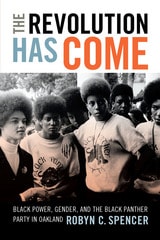
The Revolution Has Come
Black Power, Gender, and the Black Panther Party in OaklandRobyn C. Spencer
Duke University Press, 2016