Results by title
15 books match the query 'African American soldiers'
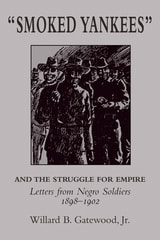
"Smoked Yankees" and the Struggle for Empire
Letters from Negro Soldiers, 1898–1902Willard Gatewood
University of Arkansas Press, 1987
Called upon for the first time to render military service outside the States, Negro soldiers (called Smoked Yankees by the Spaniards) were eager to improve their status at home by fighting for the white man in the Spanish-American War. Their story is told through countless letters sent to black U.S. newspapers that lacked resources to field their own reporters. The collection constitutes a remarkably complete and otherwise undisclosed amount of the black man’s role in—and attitude toward—America’s struggle for empire.
In first-hand reports of battles in the Philippine Islands and Cuba, Negro soldiers wrote from the perspective of dispossessed citizens struggling to obtain a larger share of the rights and privileges of Americans.
These letters provide a fuller understanding of the exploits of black troops through their reports of military activities and accounts of foreign peoples and its cultures.
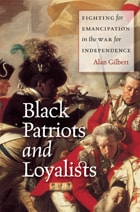
Black Patriots and Loyalists
Fighting for Emancipation in the War for IndependenceAlan Gilbert
University of Chicago Press, 2012
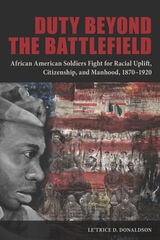
Duty beyond the Battlefield
African American Soldiers Fight for Racial Uplift, Citizenship, and Manhood, 1870–1920Le'Trice D. Donaldson
Southern Illinois University Press, 2020
Through extensive research, Donaldson not only illuminates this evolution but also interrogates the association between masculinity and citizenship and the ways in which performing manhood through military service influenced how these men struggled for racial uplift. Following the Buffalo soldier units and two regular army infantry units from the frontier and the Mexican border to Mexico, Cuba, and the Philippines, Donaldson investigates how these locations and the wars therein provide windows into how the soldiers’ struggles influenced black life and status within the United States.
Continuing to probe the idea of what it meant to be a military race man—a man concerned with the uplift of the black race who followed the philosophy of progress—Donaldson contrasts the histories of officers Henry Flipper and Charles Young, two soldiers who saw their roles and responsibilities as black military officers very differently.
Duty beyond the Battlefield demonstrates that from the 1870s to 1920s military race men laid the foundation for the “New Negro” movement and the rise of Black Nationalism that influenced the future leaders of the twentieth century Civil Rights movement.
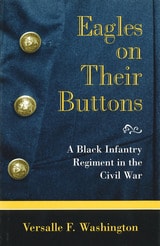
Eagles on Their Buttons
A Black Infantry Regiment in the Civil WarVersalle F. Washington
University of Missouri Press, 1999
Eagles on Their Buttons is a fascinating examination of the Fifth Regiment of Infantry, United States Colored Troops—the Union Army's first black regiment from Ohio. Although the Fifth USCT was one of more than 150 regiments of black troops making up more than 10 percent of the Union Army at the end of the war, it was unique. The majority of USCT regiments were made up of freed men who viewed the army as an escape from slavery and a chance to take up arms against their former masters. The men serving in the 5th USCT, however, were freemen who were raised in a northern state and saw serving in the army both as a way to gain equal rights under the law and as an opportunity to prove their worth as men.
Because historians have written little on this subject, many Americans believe that African Americans simply received their freedom with the Emancipation Proclamation. They know nothing about the struggles these courageous people endured to gain their independence. Now, by incorporating personal documents, letters, diaries, and official records, Eagles on Their Buttons sheds important new light on this unfamiliar aspect of the Civil War. Versalle Washington shows what caused the soldiers in the Fifth USCT to join their regiment, what sort of men they were, and how they fought and lived as African American soldiers under white officers. He discusses the regiment's service, addressing its role in the siege of Petersburg, the battle of Chapin's Farm, and the capture of Fort Fisher and the port of Wilmington. Washington also looks at what effects the soldiers' service had in terms of societal changes following the Civil War.
Eagles on Their Buttons is a fresh contribution to Civil War scholarship and will be welcomed by professional historians and amateur Civil War buffs alike.
This book is part of the University of Missouri Press' Shades of Blue and Gray series.
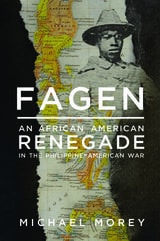
Fagen
An African American Renegade in the Philippine-American WarMichael Morey
University of Wisconsin Press, 2019
The outlines of Fagen's legend have been known for more than a century, but the details of his military achievements, his personal history, and his ultimate fate have remained a mystery—until now. Michael Morey tracks Fagen's life from his youth in Tampa as a laborer in a phosphate camp through his troubled sixteen months in the army, and, most importantly, over his long-obscured career as a guerrilla officer. Morey places this history in its larger military, political, and social context to tell the story of the young renegade whose courage and defiance challenged the supremacist assumptions of the time.
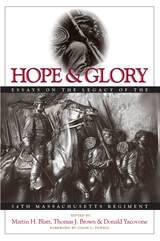
Hope and Glory
Essays on the Legacy of the 54th Massachusetts RegimentMartin H. Blatt
University of Massachusetts Press, 2009
The monument by Augustus Saint-Gaudens to Robert Gould Shaw and the 54th Massachusetts Regiment, located on Boston Common, stands at a symbolic crossroads of American history. A reminder of the nation's ongoing struggle over race, it captures the Civil War's higher purpose—the end of slavery—and memorializes those black soldiers and white officers who made common cause in the service of freedom. The monument and the saga of the 54 th Massachusetts remain powerful touchstones, inspiring enduring meditations such as Robert Lowell's poem “For the Union Dead” and the popular film Glory.
This volume brings together the best scholarship on the history of the 54th, the formation of collective memory and identity, and the ways Americans have responded to the story of the regiment and the Saint-Gaudens monument. Contributors use the historical record and popular remembrance of the 54th as a lens for examining race and community in the United States. The essays range in time from the mid-nineteenth century to the present and encompass history, literature, art, music, and popular culture.
In addition to the editors and Colin Powell, who writes about the memory and example of the 54th in his own career, contributors include Stephen Belyea, David W. Blight, Thomas Cripps, Kathryn Greenthal, James Oliver Horton, Edwin S. Redkey, Marilyn Richardson, Kirk Savage, James Smethurst, Cathy Stanton, Helen Vendler, Denise Von Glahn, and Joan Waugh.
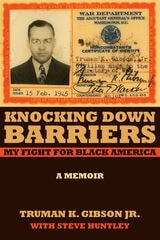
Knocking Down Barriers
My Fight for Black AmericaTruman K. Gibson Jr. with Steve Huntley
Northwestern University Press, 2005
Recipient, 2007 Hyde Park Historical Society Paul Cornell Award
Sixty years ago, when Truman Gibson reported for duty at the War Department, Washington, D.C. was a southern city in its unbending segregation as well as in its steamy summers. Gibson had no illusions, but as someone who'd enjoyed the best of the vibrant black culture of prewar America, he was shocked to find the worst of the Jim Crow South in the nation's capital. What Gibson accomplished as an advocate for African American soldiers-first as a lawyer working for the Secretary of War, then as a member of President Truman's "Black Cabinet"--is a large part of the history of the struggle for civil rights in the American military; and it is a compelling part of the story that Gibson tells in this book, a memoir of a life spent making a difference in the world one step at a time.
A graduate of the University of Chicago Law School, Gibson took his fight for racial justice to the corridors of powers, arguing against restrictive real estate covenants before the U.S. Supreme Court, opposing such iconic figures as Generals Dwight Eisenhower and George C. Marshall in campaigning for the integration of the armed forces, and challenging white control of professional sports by creating a boxing promotion empire that made television history. A firsthand account of the nitty-gritty of twentieth-century race relations in the worlds of law, the military, sports, and entertainment, Gibson's memoir is also an engaging recollection of encounters with the likes of Thurgood Marshall, W. E. B. DuBois, Eleanor Roosevelt, George Patton, Jackie Robinson, and Joe Louis, among others. As a historical record and as an intimate look at a bygone era with all its charms and hardships, the book is an essential chapter in our nation's story.
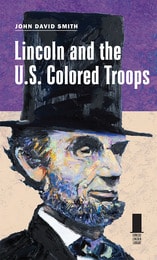
Lincoln and the U.S. Colored Troops
John David Smith
Southern Illinois University Press, 2013
Though scholars have written much on emancipation and the USCT, Smith’s work frames the evolution of Lincoln’s ideas on emancipation and arming blacks within congressional actions, explaining how, when, and why the president seemed to be so halting in his progression to military emancipation. After tracing Lincoln’s evolution from opposing to supporting emancipation as a necessary war measure and to championing the recruitment of black troops for the Union Army, Smith details the creation, mobilization, and diverse military service of the USCT. He assesses the hardships under which the men of the USCT served, including the multiple forms of discrimination from so-called friends and foes alike, and examines the broad meaning of Lincoln’s military emancipation project and its place in African American historical memory.
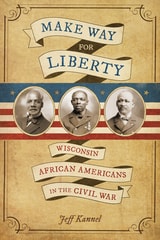
Make Way for Liberty
Wisconsin African Americans in the Civil WarJeff Kannel
Wisconsin Historical Society Press, 2020
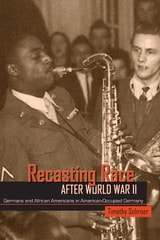
Recasting Race after World War II
Germans and African Americans in American-Occupied GermanyTimothy L. Schroer
University Press of Colorado, 2007
The segregation of U.S. Army forces fed a growing debate in America about whether a Jim Crow army could truly be a democratizing force in postwar Germany. Schroer follows the evolution of that debate and examines the ways in which postwar conditions necessitated reexamination of race relations. He reveals how anxiety about interracial relationships between African American men and German women united white American soldiers and the German populace. He also traces the importation and influence of African American jazz music in Germany, illuminating the subtle ways in which occupied Germany represented a crucible in which to recast the meaning of race in a post-Holocaust world.
Recasting Race after World War II will appeal to historians and scholars of American, African American, and German studies.

Scouting with the Buffalo Soldiers
John P. Langellier
University of North Texas Press, 2020
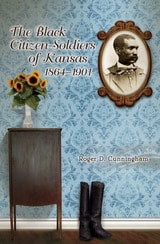
The Black Citizen-Soldiers of Kansas, 1864-1901
Roger D. Cunningham
University of Missouri Press, 2008
Roger Cunningham examines a lost history to show that, in addition to black regulars, hundreds of other black militiamen and volunteers from the Sunflower State provided military service from the Civil War until the dawn of the twentieth century. He tells how African Americans initially filled segregated companies hurriedly organized to defend the state from the threat of Confederate invasion, with some units ordered into battle around Kansas City. Then after the state constitution was amended to admit blacks into the Kansas National Guard, but its generals still refused to integrate, blacks served in reserve militia and independent companies and in all-black regiments that were raised for the Spanish-American and Philippine wars.
Cunningham has researched service records, African American newspapers, and official correspondence to give voice to these citizen-soldiers. He shares stories of real people like William D. Matthews, a captain in the First Kansas Colored Infantry who was refused a commission when his regiment was mustered into the Union army; Charles Grinsted, who commanded the first black militia company after the Civil War; and other unsung heroes.
More than a military history, Cunningham’s account records the quest of black men, many of them former slaves, for inclusion in American society. Many came from the bottom of the socioeconomic order and found that as militiamen they could gain respect within their communities. And by marching in public ceremonies and organizing fund-raising activities to compensate for lack of financial support from the state, they also strengthened the ties that bound African American communities together.
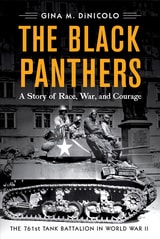
The Black Panthers
A Story of Race, War, and Courage—the 761st Tank Battalion in World War IIGina M. DiNicolo
Westholme Publishing, 2014
Known primarily for being the first African American armored unit to see combat in World War II and as future baseball star Jackie Robinson’s onetime outfit, the 761st Tank Battalion was forged in a devil’s cauldron of heat and prejudice at Camp Claiborne, Louisiana. Here, most viewed the tankers as tokens in a racial experiment, rather than as fellow American soldiers who would actually be deployed to fight a common enemy. Led by a small cadre of white and black officers, the 761st trained to the pinnacle of its craft. The Black Panthers, as they soon were called, proved their battle prowess against other units bound for combat on the parched Texas training fields. For this, they earned a coveted assignment to fight under General George S. Patton and go head-to-head with the best of Hitler’s arsenal. Moving to the front in November 1944, trial by fire soon shook the unit to its core. Ambushed by a veteran German force, the 761st suffered heavy casualties in the confusion as they cut their way out of the trap. But the men rallied to overcome self-doubt and vindicate their losses. Quickly battle hardened, the tankers saw intense combat through November and when Germany launched its last-ditch offensive through the Ardennes in December, the 761st fought side-by-side with Patton’s Third Army. Moving swiftly, the unit helped check the German advance, cut resupply routes to the forces surrounding beleaguered Bastogne, and drove the enemy back, recapturing towns crucial to the final defeat of Germany.
In The Black Panthers: A Story of Race, War, and Courage—the 761st Tank Battalion in World War II, historian Gina M. DiNicolo tells the full and unvarnished history of this important American fighting force. Relying on extensive archival research, including documents that had not been consulted in previous accounts, and interviews with surviving soldiers and family members, the author describes the unit’s training, deployment, combat, and individuals, such as Sgt. Ruben Rivers, one of only seven African American men awarded the Medal of Honor for World War II heroism. The professionalism, dedication, and courage of the 761st and other non-white units made clear that the strength of the American army in the future lay with integration—one of the enduring accomplishments of these servicemen.
The Interpreter
Alice Kaplan
University of Chicago Press, 2007
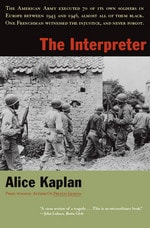
No story of World War II is more triumphant than the liberation of France, made famous in countless photos of Parisians waving American flags and kissing GIs as columns of troops paraded down the Champs Élysées. But one of the least-known stories from that era is also one of the ugliest chapters in the history of Jim Crow. In The Interpreter, celebrated author Alice Kaplan recovers this story both as eyewitnesses first saw it, and as it still haunts us today.
The American Army executed 70 of its own soldiers between 1943 and 1946—almost all of them black, in an army that was overwhelmingly white. Through the French interpreter Louis Guilloux’s eyes, Kaplan narrates two different trials: one of a white officer, one of a black soldier, both accused of murder. Both were court-martialed in the same room, yet the outcomes could not have been more different.
Kaplan’s insight into character and setting creates an indelible portrait of war, race relations, and the dangers of capital punishment.
“A nuanced historical account that resonates with today’s controversies over race and capital punishment.” Publishers Weekly
“American racism could become deadly for black soldiers on the front. The Interpreter reminds us of this sad component of a heroic chapter in American military history.” Los Angeles Times
“With elegance and lucidity, Kaplan revisits these two trials and reveals an appallingly separate and unequal wartime U.S. military justice system.” Minneapolis Star Tribune
“Kaplan has produced a compelling look at the racial disparities as they were played out…She explores both cases in considerable and vivid detail.” Sacramento Bee
The Negro in the American Rebellion
His Heroism and His FidelityWilliam Wells Brown
Ohio University Press, 1997
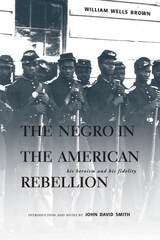
In 1863, as the Civil War raged, the escaped slave, abolitionist, and novelist William Wells Brown identified two groups most harmful to his race. “The first and most relentless,” he explained, “are those who have done them the greatest injury, by being instrumental in their enslavement and consequent degradation. They delight to descant upon the ‘natural inferiority’ of the blacks, and claim that we were destined only for a servile condition, entitled neither to liberty nor the legitimate pursuit of happiness.”
“The second class,” Brown concluded, “are those who are ignorant of the characteristics of the race, and are the mere echoes of the first.” Four years later, Brown wrote the first military history of African Americans, The Negro in the American Rebellion. This text assailed those whose hatred and ignorance inclined them to keep blacks oppressed after Appomattox.
This critical edition of The Negro in the American Rebellion, one of Brown’s least-analyzed texts, is the first to appear in more than three decades. In his introduction, historian John David Smith identifies the text’s Anglo-American abolitionist roots, sets it in the context of Brown’s other writings, appraises it as military history, analyzes its interpretation of black masculinity and honor, and focuses closely on Brown’s assessment of contemporary racial tensions.
Largely ignored by scholars, The Negro in the American Rebellion, Smith argues, is a powerful transitional text, one that confronted squarely the neo-slavery of the Reconstruction era.
“Whites,” Brown wrote, “appear determined to reduce the blacks to a state of serfdom if they cannot have them as slaves.” His important text was a call to arms in the ongoing race struggle. Smith’s analysis, framed within recent scholarship on slavery, emancipation, and African American participation in the U.S. army, is long overdue.