Results by title
9 books match the query 'African Americans in mass media'
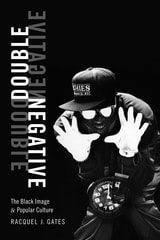
Double Negative
The Black Image and Popular CultureRacquel J. Gates
Duke University Press, 2018
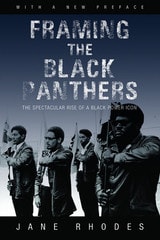
Framing the Black Panthers
The Spectacular Rise of a Black Power IconJane Rhodes
University of Illinois Press, 2017
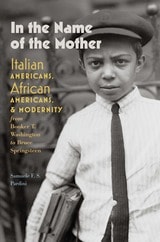
In the Name of the Mother
Italian Americans, African Americans, and Modernity from Booker T. Washington to Bruce SpringsteenSamuele F. S. Pardini
Dartmouth College Press, 2017

Laughing to Keep from Dying
African American Satire in the Twenty-First CenturyDanielle Fuentes Morgan
University of Illinois Press, 2020
Adventurous and perceptive, Laughing to Keep from Dying reveals how African American satirists unmask the illusions and anxieties surrounding race in the twenty-first century.
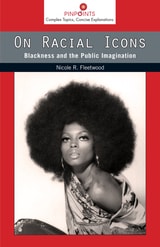
On Racial Icons
Blackness and the Public ImaginationFleetwood, Nicole R
Rutgers University Press, 2015
Nicole R. Fleetwood’s answers to these questions will change the way you think about the next photograph that you see depicting a racial event, black celebrity, or public figure. In On Racial Icons, Fleetwood focuses a sustained look on photography in documenting black public life, exploring the ways in which iconic images function as celebrations of national and racial progress at times or as a gauge of collective racial wounds in moments of crisis.
Offering an overview of photography’s ability to capture shifting race relations, Fleetwood spotlights in each chapter a different set of iconic images in key sectors of public life. She considers flash points of racialized violence in photographs of Trayvon Martin and Emmett Till; the political, aesthetic, and cultural shifts marked by the rise of pop stars such as Diana Ross; and the power and precarity of such black sports icons as Serena Williams and LeBron James; and she does not miss Barack Obama and his family along the way. On Racial Icons is an eye-opener in every sense of the phrase.
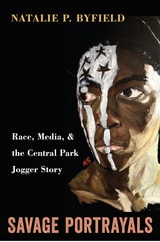
Savage Portrayals
Race, Media and the Central Park Jogger StoryNatalie Byfield
Temple University Press, 2014
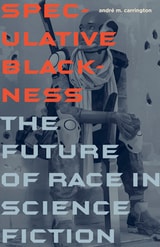
Speculative Blackness
The Future of Race in Science FictionAndré M. Carrington
University of Minnesota Press, 2016
In Speculative Blackness, André M. Carrington analyzes the highly racialized genre of speculative fiction—including science fiction, fantasy, and utopian works, along with their fan cultures—to illustrate the relationship between genre conventions in media and the meanings ascribed to blackness in the popular imagination.
Carrington’s argument about authorship, fandom, and race in a genre that has been both marginalized and celebrated offers a black perspective on iconic works of science fiction. He examines the career of actor Nichelle Nichols, who portrayed the character Uhura in the original Star Trek television series and later became a recruiter for NASA, and the spin-off series Star Trek: Deep Space Nine, set on a space station commanded by a black captain. He recovers a pivotal but overlooked moment in 1950s science fiction fandom in which readers and writers of fanzines confronted issues of race by dealing with a fictitious black fan writer and questioning the relevance of race to his ostensible contributions to the 'zines. Carrington mines the productions of Marvel comics and the black-owned comics publisher Milestone Media, particularly the representations of black sexuality in its flagship title, Icon. He also interrogates online fan fiction about black British women in Buffy the Vampire Slayer and the Harry Potter series.
Throughout this nuanced analysis, Carrington theorizes the relationship between race and genre in cultural production, revealing new understandings of the significance of blackness in twentieth-century American literature and culture.
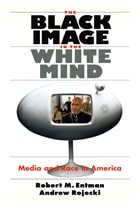
The Black Image in the White Mind
Media and Race in AmericaRobert M. Entman and Andrew Rojecki
University of Chicago Press, 2001
Using the media, and especially television, as barometers of race relations, Robert Entman and Andrew Rojecki explore but then go beyond the treatment of African Americans on network and local news to incisively uncover the messages sent about race by the entertainment industry-from prime-time dramas and sitcoms to commercials and Hollywood movies. While the authors find very little in the media that intentionally promotes racism, they find even less that advances racial harmony. They reveal instead a subtle pattern of images that, while making room for Blacks, implies a racial hierarchy with Whites on top and promotes a sense of difference and conflict. Commercials, for example, feature plenty of Black characters. But unlike Whites, they rarely speak to or touch one another. In prime time, the few Blacks who escape sitcom buffoonery rarely enjoy informal, friendly contact with White colleagues—perhaps reinforcing social distance in real life.
Entman and Rojecki interweave such astute observations with candid interviews of White Americans that make clear how these images of racial difference insinuate themselves into Whites' thinking.
Despite its disturbing readings of television and film, the book's cogent analyses and proposed policy guidelines offer hope that America's powerful mediated racial separation can be successfully bridged.
"Entman and Rojecki look at how television news focuses on black poverty and crime out of proportion to the material reality of black lives, how black 'experts' are only interviewed for 'black-themed' issues and how 'black politics' are distorted in the news, and conclude that, while there are more images of African-Americans on television now than there were years ago, these images often don't reflect a commitment to 'racial comity' or community-building between the races. Thoroughly researched and convincingly argued."—Publishers Weekly
"Drawing on their own research and that of a wide array of other scholars, Entman and Rojecki present a great deal of provocative data showing a general tendency to devalue blacks or force them into stock categories."—Ben Yagoda, New Leader
Winner of the Frank Luther Mott Award for best book in Mass Communication and the Robert E. Lane Award for best book in political psychology.

The Palestinian Idea
Film, Media, and the Radical ImaginationGreg Burris
Temple University Press, 2019
Is there a link between the colonization of Palestinian lands and the enclosing of Palestinian minds? The Palestinian Idea argues that it is precisely through film and media that hope can occasionally emerge amidst hopelessness, emancipation amidst oppression, freedom amidst apartheid. Greg Burris employs the work of Edward W. Said, Jacques Rancière, and Cedric J. Robinson in order to locate Palestinian utopia in the heart of the Zionist present.
He analyzes the films of prominent directors Annemarie Jacir (Salt of This Sea, When I Saw You) and Hany Abu-Assad (Paradise Now) to investigate the emergence and formation of Palestinian identity. Looking at Mais Darwazah’s documentary My Love Awaits Me By the Sea, Burris considers the counterhistories that make up the Palestinian experience—stories and memories that have otherwise been obscured or denied. He also examines Palestinian (in)visibility in the global media landscape, and how issues of Black-Palestinian transnational solidarity are illustrated through social media, staged news spectacles, and hip hop music.