Results by title

12 books match the query 'African diaspora in art'
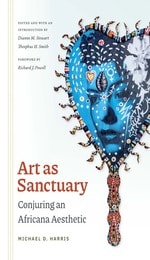
cover of Art as Sanctuary: Conjuring an Africana Aesthetic

Art as Sanctuary

Conjuring an Africana Aesthetic

Michael D. Harris. Edited and with an introduction by Dianne M. Stewart and Theophus H. Smith. Foreword by Richard J. Powell.

Duke University Press, 2026
In Art as Sanctuary, Michael D. Harris considers literal and metaphorical uses of sanctuary in the black experience and African diaspora art, including locales of spiritual expression, self-renewal, and cultural celebration. Harris offers an alternative framework to the Duboisian philosophy of double consciousness, pushing the boundaries of Africana aesthetic analysis by exploring the cultural signifiers embedded consciously or unconsciously in African diaspora art. Within these works, he reveals how these cultural cues speak to the vibrancy of African American life. While acknowledging the presence of the white observer’s gaze, Harris wishes to relieve the black interior from the panoptic assumptions of that gaze and its disciplines. Art as Sanctuary provides innovative pathways to understand African American visual culture and music as autobiographies of cultural identity and experience.
[more]
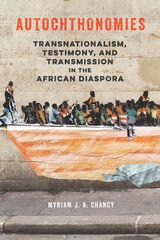
cover of Autochthonomies: Transnationalism, Testimony, and Transmission in the African Diaspora

Autochthonomies

Transnationalism, Testimony, and Transmission in the African Diaspora

Myriam J. A. Chancy

University of Illinois Press, 2020

In Autochthonomies, Myriam J. A. Chancy engages readers in an interpretive journey. She lays out a radical new process that invites readers to see creations by artists of African descent as legible within the context of African diasporic historical and cultural debates. By invoking a transnational African/diasporic lens and negotiating it through a lakou or ”yard space,” we can see such identities transfigured, recognized, and exchanged. Chancy demonstrates how the process can examine the salient features of texts and art that underscore African/diasporic sensibilities and render them legible. What emerges is a potential for richer readings of African diasporic works that also ruptures the Manichean binary dynamics that have dominated previous interpretations of the material. The result: an enriching interpretive mode focused on the transnational connections between subjects of African descent as the central pole for reader investigation.

A bold challenge to established scholarship, Autochthonomies ranges from Africa to Europe and the Americas to provide powerful new tools for charting the transnational interactions between African cultural producers and sites.
[more]
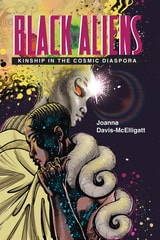
cover of Black Aliens: Kinship in the Cosmic Diaspora

Black Aliens

Kinship in the Cosmic Diaspora

Joanna Davis-McElligatt

The Ohio State University Press, 2026

In Black Aliens, Joanna Davis-McElligatt examines extraterrestrial and interdimensional aliens in Black speculative media and culture, reading them as figural representations of a cosmic diasporic experience and charged metaphors for Black fugitivity and escape. As figures of the enslaved and their descendants, ghosts, time travelers, interstellar voyagers, immortals, and abductees, Black aliens are inherently disruptive figures. In her analysis, Davis-McElligatt foregrounds alien entanglements with terrestrial beings that generate new networks of kinship and relation—genealogical, reproductive, transspecies. As Black extraterrestrials form chosen kin-community with Black Earthlings, they extend the Black Atlantic beyond earthly boundaries.

Analyzing prose, poetry, film, record albums, comic books, illustrations, art installations, and exhibition catalogues, Davis-McElligatt traces how Octavia E. Butler, Maisy Card, Sun Ra, and Dwayne McDuffie and M. D. Bright visualize aliens whose bodies and beings are subject to interpellation as Black on Earth. She argues that these creators intentionally locate the Black alien as a subject whose galactic bonds are constructed in and as narrative form itself, made manifest in plot, characterization, and narrativization. In recasting narrative spacetime, they reimagine Black entanglements, kinship systems, and histories as a cosmic diaspora.

[more]
cover of Black Bodies, White Gold: Art, Cotton, and Commerce in the Atlantic World

Black Bodies, White Gold

Art, Cotton, and Commerce in the Atlantic World

Anna Arabindan-Kesson

Duke University Press, 2021

In Black Bodies, White Gold Anna Arabindan-Kesson uses cotton, a commodity central to the slave trade and colonialism, as a focus for new interpretations of the way art, commerce, and colonialism were intertwined in the nineteenth-century Atlantic world. In doing so, Arabindan-Kesson models an art historical approach that makes the histories of the Black diaspora central to nineteenth-century cultural production. She traces the emergence of a speculative vision that informs perceptions of Blackness in which artistic renderings of cotton—as both commodity and material—became inexorably tied to the monetary value of Black bodies. From the production and representation of “negro cloth”—the textile worn by enslaved plantation workers—to depictions of Black sharecroppers in photographs and paintings, Arabindan-Kesson demonstrates that visuality was the mechanism through which Blackness and cotton became equated as resources for extraction. In addition to interrogating the work of nineteenth-century artists, she engages with contemporary artists such as Hank Willis Thomas, Lubaina Himid, and Yinka Shonibare CBE RA, who contend with the commercial and imperial processes shaping constructions of Blackness and meanings of labor.
[more]
cover of Black Panther

Black Panther

Scott Bukatman

University of Texas Press, 2022

Black Panther was the first Black superhero in mainstream American comics. Black Panther was a cultural phenomenon that broke box office records. Yet it wasn’t just a movie led by and starring Black artists. It grappled with ideas and conflicts central to Black life in America and helped redress the racial dynamics of the Hollywood blockbuster.

Scott Bukatman, one of the foremost scholars of superheroes and cinematic spectacle, brings his impeccable pedigree to this lively and accessible study, finding in the utopianism of Black Panther a way of re-envisioning what a superhero movie can and should be while centering the Black creators, performers, and issues behind it. He considers the superheroic Black body; the Pan-African fantasy, feminism, and Afrofuturism of Wakanda; the African American relationship to Africa; the political influence of director Ryan Coogler’s earlier movies; and the entwined performances of Chadwick Boseman’s T’Challa and Michael B. Jordan’s Killmonger. Bukatman argues that Black Panther is escapism of the best kind, offering a fantasy of liberation and social justice while demonstrating the power of popular culture to articulate ideals and raise vital questions.
[more]
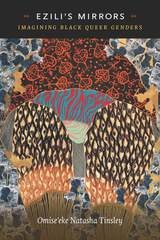
cover of Ezili's Mirrors: Imagining Black Queer Genders

Ezili's Mirrors

Imagining Black Queer Genders

Omise'eke Natasha Tinsley

Duke University Press, 2018

From the dagger mistress Ezili Je Wouj and the gender-bending mermaid Lasiren to the beautiful femme queen Ezili Freda, the Ezili pantheon of Vodoun spirits represents the divine forces of love, sexuality, prosperity, pleasure, maternity, creativity, and fertility. And just as Ezili appears in different guises and characters, so too does Omise’eke Natasha Tinsley in her voice- and genre-shifting, exploratory book Ezili's Mirrors. Drawing on her background as a literary critic as well as her quest to learn the lessons of her spiritual ancestors, Tinsley theorizes black Atlantic sexuality by tracing how contemporary queer Caribbean and African American writers and performers evoke Ezili. Tinsley shows how Ezili is manifest in the work and personal lives of singers Whitney Houston and Azealia Banks, novelists Nalo Hopkinson and Ana Lara, performers MilDred Gerestant and Sharon Bridgforth, and filmmakers Anne Lescot and Laurence Magloire—none of whom identify as Vodou practitioners. In so doing, Tinsley offers a model of queer black feminist theory that creates new possibilities for decolonizing queer studies.
[more]
cover of Immaterial Archives: An African Diaspora Poetics of Loss

Immaterial Archives

An African Diaspora Poetics of Loss

Jenny Sharpe

Northwestern University Press, 2020
In this innovative study, Jenny Sharpe moves beyond the idea of art and literature as an alternative archive to the historical records of slavery and its aftermath. Immaterial Archives explores instead the intangible phenomena of affects, spirits, and dreams that Caribbean artists and writers introduce into existing archives. Through the works of Frantz Zéphirin, Edouard Duval-Carrié, M. NourbeSe Philip, Erna Brodber, and Kamau Brathwaite, Immaterial Archives examines silences as black female spaces, Afro-Creole sacred worlds as diasporic cartographies, and the imaginative conjoining of spirits with industrial technologies as disruptions of enlightened modernity.
[more]
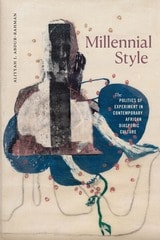
cover of Millennial Style: The Politics of Experiment in Contemporary African Diasporic Culture

Millennial Style

The Politics of Experiment in Contemporary African Diasporic Culture

Aliyyah I. Abdur-Rahman

Duke University Press, 2024

In Millennial Style, Aliyyah I. Abdur-Rahman looks at recent experiments in black expressive culture that begin in the place of ruin. By ruin, Abdur-Rahman means the political terror and social abjection that constitute the ongoing peril of black lives. Whereas earlier black writers and artists have employed realist modes of expression to represent racial harm and to imaginatively remediate it, the black avant-garde of today displays more experimental methods. Abdur-Rahman outlines four widely employed modes in contemporary African diasporic cultural production: Black Grotesquerie, Hollowed Blackness, Black Cacophony, and the Black Ecstatic. Mobilizing black feminist and black radical thought, she considers work by such cultural practitioners as Wangechi Mutu, Marci Blackman, Alexandria Smith, Colson Whitehead, Toni Morrison, Harmony Holiday, and Essex Hemphill. Writerly and experimental, Millennial Style theorizes contemporary black art as the holding (or hoarding) of black mortal and material resources against the injuries of social death, as the fashioning of relational ethics, and as exuberant black world-building in ruinous times.
[more]
cover of Selected Writings, Volume 1: Toward a New African Art Discourse

Selected Writings, Volume 1

Toward a New African Art Discourse

Okwui Enwezor. Edited by Terry Smith.

Duke University Press, 2025

Okwui Enwezor is widely regarded as a leader among the brilliant curators who emerged in the 1990s to set agendas for understanding the global expansiveness of contemporary art. Among his pathfinding exhibitions were the second Johannesburg Biennale (1997), the paradigm-shifting Documenta11 (2002), Archive Fever (2008), and Postwar (2016). In addition to breaking ground as a curator, Enwezor was also a prolific critic, essayist, and theorist. Selected Writings—a landmark two-volume set—brings together Enwezor’s most influential and foundational works. Spanning a quarter-century, these selections reflect the depth and breadth of Enwezor’s writing and its role in his tireless efforts to decolonize the art world. Volume 1, Toward a New African Art Discourse, includes fifteen essays written between 1994 and 2006. Drawn from exhibition catalogs, art journals, interviews with artists, art reviews, curatorial statements, historical studies, and book chapters, these texts show him striving to fulfil the first main ambition that drove his career: to found and sustain what he called a “New African Art Discourse.” Demonstrating that his writing helped fulfill this goal, this collection reaffirms Enwezor’s status as a transformational figure in the global contemporary art world.
[more]
cover of Selected Writings, Volume 2: Curating the Postcolonial Condition, Volume 2

Selected Writings, Volume 2

Curating the Postcolonial Condition, Volume 2

Okwui Enwezor. Edited by Terry Smith.

Duke University Press, 2025
Okwui Enwezor is widely regarded as a leader among the brilliant curators who emerged in the 1990s to set agendas for understanding the global expansiveness of contemporary art. Among his pathfinding exhibitions were the second Johannesburg Biennale (1997), the paradigm-shifting Documenta 11 (2002), Archive Fever (2008), and Postwar (2016). In addition to breaking ground as a curator, Enwezor was also a prolific critic, essayist, and theorist. Selected Writings—a landmark two-volume set—brings together Enwezor’s most influential and foundational works. Spanning a quarter-century, these selections reflect the depth and breadth of Enwezor’s writing and its role in his tireless efforts to decolonize the art world. Volume 2, Curating the Postcolonial Condition, includes seventeen essays written between 2006 and 2019. Drawn from exhibition catalogs, art journals, interviews with artists, art reviews, curatorial statements, historical studies, and book chapters, these texts show him striving to fulfil the second main ambition that drove his career: enabling a critical, diasporic imagining of postcoloniality that would become pervasive within global art discourse. Demonstrating that his writing helped fulfill this goal, this collection reaffirms Enwezor’s status as a transformational figure in the global contemporary art world.
[more]
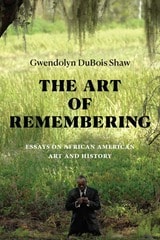
cover of The Art of Remembering: Essays on African American Art and History

The Art of Remembering

Essays on African American Art and History

Gwendolyn DuBois Shaw

Duke University Press, 2024

In The Art of Remembering art historian and curator Gwendolyn DuBois Shaw explores African American art and representation from the height of the British colonial period to the present. She engages in the process of "rememory"—the recovery of facts and narratives of African American creativity and self-representation that have been purposefully set aside, actively ignored, and disremembered. In analyses of the work of artists ranging from Scipio Moorhead, Moses Williams, and Aaron Douglas to Barbara Chase-Riboud, Kara Walker, Kehinde Wiley, and Deana Lawson, Shaw demonstrates that African American art and history may be remembered and understood anew through a process of intensive close looking, cultural and historical contextualization, and biographic recuperation or consideration. Shaw shows how embracing rememory expands the possibilities of history by acknowledging the existence of multiple forms of knowledge and ways of understanding an event or interpreting an object. In so doing, Shaw thinks beyond canonical interpretations of art and material and visual culture to imagine “what if,” asking what else did we once know that has been lost.
[more]
cover of Travel & See: Black Diaspora Art Practices since the 1980s

Travel & See

Black Diaspora Art Practices since the 1980s

Kobena Mercer

Duke University Press, 2016

Over the years, Kobena Mercer has critically illuminated the visual innovations of African American and black British artists. In Travel & See he presents a diasporic model of criticism that gives close attention to aesthetic strategies while tracing the shifting political and cultural contexts in which black visual art circulates. In eighteen essays, which cover the period from 1992 to 2012 and discuss such leading artists as Isaac Julien, Renée Green, Kerry James Marshall, and Yinka Shonibare, Mercer provides nothing less than a counternarrative of global contemporary art that reveals how the “dialogical principle” of cross-cultural interaction not only has transformed commonplace perceptions of blackness today but challenges us to rethink the entangled history of modernism as well.
 
 
[more]