Results by title
3 books match the query 'Afterimages'

Afterimages of Gilles Deleuze’s Film Philosophy
D. N. Rodowick
University of Minnesota Press, 2009
The French philosopher Gilles Deleuze was one of the most innovative and revolutionary thinkers of the twentieth century. Author of more than twenty books on literature, music, and the visual arts, Deleuze published the first volume of his two-volume study of film, Cinema 1: The Movement-Image, in 1983 and the second volume, Cinema 2: The Time-Image, in 1985. Since their publication, these books have had a profound impact on the study of film and philosophy. Film, media, and cultural studies scholars still grapple today with how they can most productively incorporate Deleuze's thought.
The first new collection of critical studies on Deleuze's cinema writings in nearly a decade, Afterimages of Gilles Deleuze's Film Philosophy provides original essays that evaluate the continuing significance of Deleuze's film theories, accounting systematically for the ways in which they have influenced the investigation of contemporary visual culture and offering new directions for research.
Contributors: Raymond Bellour, Centre Nationale de Recherches Scientifiques; Ronald Bogue, U of Georgia; Giuliana Bruno, Harvard U; Ian Buchanan, Cardiff U; James K. Chandler, U of Chicago; Tom Conley, Harvard U; Amy Herzog, CUNY; András Bálint Kovács, Eötvös Loránd U; Patricia MacCormack, Anglia Ruskin U; Timothy Murray, Cornell U; Dorothea Olkowski, U of Colorado; John Rajchman, Columbia U; Marie-Claire Ropars-Wuilleumier, U Paris VIII; Garrett Stewart, U of Iowa; Damian Sutton, Glasgow School of Art; Melinda Szaloky, UC Santa Barbara.
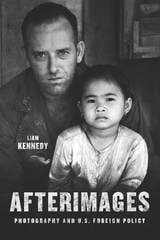
Afterimages
Photography and U.S. Foreign PolicyLiam Kennedy
University of Chicago Press, 2016
Liam Kennedy here maps the evolving relations between the American way of war and photographic coverage of it. Organized in its first section around key US military actions over the last fifty years, the book then moves on to examine how photographers engaged with these conflicts on wider ethical and political grounds, and finally on to the genre of photojournalism itself. Illustrated throughout with examples of the photographs being considered, Afterimages argues that photographs are important means for critical reflection on war, violence, and human rights. It goes on to analyze the high ethical, sociopolitical, and legalistic value we place on the still image’s ability to bear witness and stimulate action.
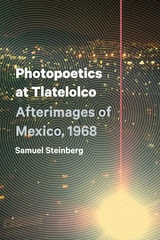
Photopoetics at Tlatelolco
Afterimages of Mexico, 1968By Samuel Steinberg
University of Texas Press, 2016
In the months leading up to the 1968 Olympic games in Mexico City, students took to the streets, calling for greater democratization and decrying crackdowns on political resistance by the ruling PRI party. During a mass meeting held at the Plaza of the Three Cultures in the Tlatelolco neighborhood, paramilitary forces opened fire on the gathering. The death toll from the massacre remains a contested number, ranging from an official count in the dozens to estimates in the hundreds by journalists and scholars. Rereading the legacy of this tragedy through diverse artistic-political interventions across the decades, Photopoetics at Tlatelolco explores the state’s dual repression—both the massacre’s crushing effects on the movement and the manipulation of cultural discourse and political thought in the aftermath.
Examining artifacts ranging from documentary photography and testimony to poetry, essays, chronicles, cinema, literary texts, video, and performance, Samuel Steinberg considers the broad photographic and photopoetic nature of modern witnessing as well as the specific elements of light (gunfire, flares, camera flashes) that ultimately defined the massacre. Steinberg also demonstrates the ways in which the labels of “massacre” and “sacrifice” inform contemporary perceptions of the state’s blatant and violent repression of unrest. With implications for similar processes throughout the rest of Latin America from the 1960s to the present day, Photopoetics at Tlatelolco provides a powerful new model for understanding the intersection of political history and cultural memory.