Results by title
3 books match the query 'Agent (Philosophy) in literature'
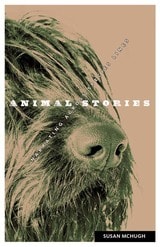
Animal Stories
Narrating across Species LinesSusan McHugh
University of Minnesota Press, 2010
Beginning with a historical account of why animal stories pose endemic critical challenges to literary and cultural theory, Animal Stories argues that key creative developments in narrative form became inseparable from shifts in animal politics and science in the past century. Susan McHugh traces representational patterns specific to modern and contemporary fictions of cross-species companionship through a variety of media—including novels, films, fine art, television shows, and digital games—to show how nothing less than the futures of all species life is at stake in narrative forms.
McHugh’s investigations into fictions of people relying on animals in civic and professional life—most obviously those of service animal users and female professional horse riders—showcase distinctly modern and human–animal forms of intersubjectivity. But increasingly graphic violence directed at these figures indicates their ambivalent significance to changing configurations of species.
Reading these developments with narrative adaptations of traditional companion species relations during this period— queer pet memoirs and farm animal fictions—McHugh clarifies the intercorporeal intimacies—the perforations of species boundaries now proliferating in genetic and genomic science—and embeds the representation of animals within biopolitical frameworks.
[more]
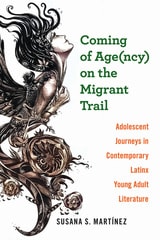
Coming of Age(ncy) on the Migrant Trail
Adolescent Journeys in Contemporary Latinx Young Adult LiteratureSusana S. Martínez
The Ohio State University Press, 2025
Susana S. Martínez’s Coming of Age(ncy) on the Migrant Trail maps the contours of agency in young adult literature involving Latine/x migrant youth—a project that could not be timelier given anti-immigrant hostility, LGBTQ+ book bans, and intense scrutiny of how we teach about race. Martínez leads readers chronologically and geographically from the 1980s Central American civil wars north through Mexico during the war on drugs to the recent experiences of those living undocumented in the United States, showing that YA is an ideal medium through which to tease out those stories of Central American migration that are often subsumed within Latine/x studies and to combat stereotypes of young migrants. Viewed through the lenses of intersectionality and racialized capitalism’s politics of disposability, the novels in question contribute to timely antiracist pedagogical discussions where youth emerge as catalysts for social change. By including non-Latinx authors who wrote about the Guatemalan and Salvadoran civil conflicts alongside authors from the Central American diaspora—Marcia Argueta Mickelson, Jennifer De Leon, and Bessie Flores Zaldívar among them—Martínez invites us to reflect on solidarity in contentious times.
[more]
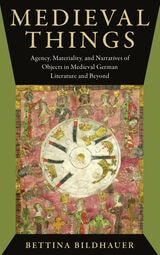
Medieval Things
Agency, Materiality, and Narratives of Objects in Medieval German Literature and BeyondBettina Bildhauer
The Ohio State University Press, 2020
What does medieval literature look like from the point of view not of knights and ladies, but of treasure, and rings, nets and the grail? How does medieval literature imagine the agency of material things, and what exactly distinguishes human subjects from inanimate objects? Medieval Things: Agency, Materiality, and Narratives of Objects in Medieval German Literature and Beyond brings together a theoretically informed and politically engaged new materialist approach with a study of how everyday objects are understood in medieval literature. Bettina Bildhauer argues that medieval narratives can inspire current critical theory on agency and materiality. She focuses on famous and forgotten German narratives from the twelfth to the sixteenth centuries, including Wolfram of Eschenbach’s Parzival and the epic Song of the Nibelungs, and sets them in their global context. Many such tales can be reconceptualized as “thing biographies”—stories that follow the trajectory not of a human hero but of a coin, a gown, a treasure, or a ring. Many also use nets and networks to conceptualize dangerous structures of knowledge. Shine, glamour, and charisma emerge as particularly powerful ways in which material things exert a kind of agency that is neither pseudo-human nor fetishistic. In analyzing details like these from medieval literature, Bildhauer thus contributes in new ways to current theory on agency and materiality.
[more]