Results by title
2 books match the query 'Agricultural systems'
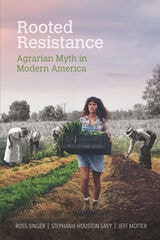
Rooted Resistance
Agrarian Myth in Modern AmericaNorie R. Singer
University of Arkansas Press, 2020
From farm-to-table restaurants and farmers markets, to support for fair trade and food sovereignty, movements for food-system change hold the promise for deeper transformations. Yet Americans continue to live the paradox of caring passionately about healthy eating while demanding the convenience of fast food. Rooted Resistance explores this fraught but promising food scene. More than a retelling of the origin story of a democracy born from an intimate connection with the land, this book wagers that socially responsible agrarian mythmaking should be a vital part of a food ethic of resistance if we are to rectify the destructive tendencies in our contemporary food system.
Through a careful examination of several case studies, Rooted Resistance traverses the ground of agrarian myth in modern America. The authors investigate key figures and movements in the history of modern agrarianism, including the World War I victory garden efforts, the postwar Country Life movement for the vindication of farmers’ rights, the Southern Agrarian critique of industrialism, and the practical and spiritual prophecy of organic farming put forth by J. I. Rodale. This critical history is then brought up to date with recent examples such as the contested South Central Farm in urban Los Angeles and the spectacular rise and fall of the Chipotle “Food with Integrity” branding campaign.
By examining a range of case studies, Singer, Grey, and Motter aim for a deeper critical understanding of the many applications of agrarian myth and reveal why it can help provide a pathway for positive systemic change in the food system.
[more]
The Wet and the Dry
Irrigation and Agricultural Intensification in PolynesiaPatrick Vinton Kirch
University of Chicago Press, 1994
Scholars and researchers have long believed that the ability to irrigate is crucial to the development of civilizations. In this book, archaeologist Patrick Kirch challenges this "hydraulic hypothesis" and provides a more accurate and detailed account of the role of "wet" and "dry" cultivation systems in the development of complex sociopolitical structures.
Examining research on cultural adaptation and ecology in Western Polynesia and utilizing extensive data from a variety of important South Pacific sites, Kirch not only reveals how particular systems of production developed within the constraints imposed by environmental conditions, but also explores the tension that arises between contrasting productive systems with differential abilities to produce surplus. He shows that the near total neglect of short-fallow dryland cultivation, as well as arboriculture, or tree-cropping, has seriously distorted the picture that archaeologists and anthropologists have of agricultural intensification and its relation to complex social structure.
This work, likely to become a classic, will be central to all future discussions of the ecology and politics of agricultural intensification.
[more]