Results by title
173 books match the query 'Origins' and 9 start with a
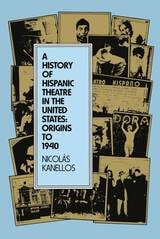
A History of Hispanic Theatre in the United States
Origins to 1940By Nicolás Kanellos
University of Texas Press, 1990
Hispanic theatre flourished in the United States from the mid-nineteenth century until the beginning of the Second World War—a fact that few theatre historians know. A History of Hispanic Theatre in the United States: Origins to 1940 is the very first study of this rich tradition, filled with details about plays, authors, artists, companies, houses, directors, and theatrical circuits.
Sixteen years of research in public and private archives in the United States, Mexico, Spain, and Puerto Rico inform this study. In addition, Kanellos located former performers and playwrights, forgotten scripts, and old photographs to bring the life and vitality of live theatre to his text. He organizes the book around the cities where Hispanic theatre was particularly active, including Los Angeles, San Antonio, New York, and Tampa, as well as cities on the touring circuit, such as Laredo, El Paso, Tucson, and San Francisco.
Kanellos charts the major achievements of Hispanic theatre in each city—playwriting in Los Angeles, vaudeville and tent theatre in San Antonio, Cuban/Spanish theatre in Tampa, and pan-Hispanism in New York—as well as the individual careers of several actors, writers, and directors. And he uncovers many gaps in the record—reminders that despite its popularity, Hispanic theatre was often undervalued and unrecorded.

A Prelude to the Welfare State
The Origins of Workers' CompensationPrice V. Fishback and Shawn Everett Kantor
University of Chicago Press, 2000
In this highly original and persuasive work, Price V. Fishback and Shawn Everett Kantor challenge widespread historical perceptions, arguing that, rather than being an early progressive victory, workers' compensation succeeded because all relevant parties—labor and management, insurance companies, lawyers, and legislators—benefited from the legislation. Thorough, rigorous, and convincing, A Prelude to the Welfare State: The Origins of Workers' Compensation is a major reappraisal of the causes and consequences of a movement that ultimately transformed the nature of social insurance and the American workplace.
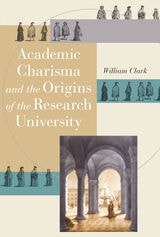
Academic Charisma and the Origins of the Research University
William Clark
University of Chicago Press, 2005
William Clark argues that the research university—which originated in German Protestant lands and spread globally in the nineteenth and twentieth centuries—developed in response to market forces and bureaucracy, producing a new kind of academic whose goal was to establish originality and achieve fame through publication. With an astonishing wealth of research, Academic Charisma and the Origins of the Research University investigates the origins and evolving fixtures of academic life: the lecture catalogue, the library catalog, the grading system, the conduct of oral and written exams, the roles of conversation and the writing of research papers in seminars, the writing and oral defense of the doctoral dissertation, the ethos of "lecturing with applause" and "publish or perish," and the role of reviews and rumor. This is a grand, ambitious book that should be required reading for every academic.
Access to Origins
Affines, Ancestors, and AristocratsBy Mary W. Helms
University of Texas Press, 1998
In many non-industrial, non-Western societies, power and prestige are closely linked to the extent of an individual's or group's perceived connection to the supernatural realm, which also explains and validates tangible activities such as economic success, victories in war, or control over lucrative trade. Affines (in-laws), ancestors, and aristocrats, in particular, are connected to the realm of creative cosmological origins (i.e., to Genesis), which accords them distinctive, supernatural powers and gives them a natural and legitimate right to worldly authority.
This is the hypothesis that Mary W. Helms pursues in this broadly cross-cultural study of aristocracy in chiefly societies. She begins with basic ideas about the dead, ancestors, affines, and concepts of cosmological origins. This leads her to a discussion of cosmologically defined hierarchies, the qualities that characterize aristocracy, and the political and ideological roles of aristocrats as wife-givers and wife-takers (that is, as in-laws). She concludes by considering various models that explain how societies may develop or define aristocracies.

Albrecht Altdorfer and the Origins of Landscape
Christopher S. Wood
University of Chicago Press, 1993
Altruistically Inclined?
The Behavioral Sciences, Evolutionary Theory, and the Origins of ReciprocityAlexander J. Field
University of Michigan Press, 2004
Altruistically Inclined? examines the implications of recent research in the natural sciences for two important social scientific approaches to individual behavior: the economic/rational choice approach and the sociological/anthropological. It considers jointly two controversial and related ideas: the operation of group selection within early human evolutionary processes and the likelihood of modularity—domain-specific adaptations in our cognitive mechanisms and behavioral predispositions.
Experimental research shows that people will often cooperate in one-shot prisoner's dilemma (PD) games and reject positive offers in ultimatum games, contradicting commonly accepted notions of rationality. Upon first appearance, predispositions to behave in this fashion could not have been favored by natural selection operating only at the level of the individual organism.
Emphasizing universal and variable features of human culture, developing research on how the brain functions, and refinements of thinking about levels of selection in evolutionary processes, Alexander J. Field argues that humans are born with the rudiments of a PD solution module—and differentially prepared to learn norms supportive of it. His emphasis on failure to harm, as opposed to the provision of affirmative assistance, as the empirically dominant form of altruistic behavior is also novel.
The point of departure and principal point of reference is economics. But Altruistically Inclined? will interest a broad range of scholars in the social and behavioral sciences, natural scientists concerned with the implications of research and debates within their fields for the conduct of work elsewhere, and educated lay readers curious about essential features of human nature.
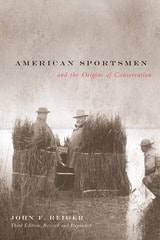
American Sportsmen and the Origins of Conservation, 3rd Ed
John F. Reiger
Oregon State University Press, 2001
Beginning in the 1870s, sportsmen across America formed hundreds of organizations that not only fostered responsibility for game habitats but also spearheaded the creation of national parks, forests, and wildlife refuges. Reiger tells how these "gentlemen" hunters and anglers, outdoor journals like Forest and Stream, and organizations such as the Boone and Crockett Club—founded by Theodore Roosevelt, George Bird Grinnell, and other prominent sportsmen—lobbied for laws regulating the taking of wildlife, and helped to arouse public interest in wilderness preservation.
In this new edition, Reiger traces the antecedents of the sportsmen's conservation movement to the years before the Civil War. He extends his coverage into the present by demonstrating how the nineteenth-century sportsman's code—with its demand for taking responsibility for the total environment—continues to be the cornerstone of the sporting ethic. A new Epilogue depicts leading environmental thinker Aldo Leopold as the best-known exponent of this hunter-conservationist ideal.
Praised as "one of the seminal works in conservation history" by historian Hal Rothman, Reiger's book continues to be essential reading for all concerned with how earlier Americans regarded the land, demonstrating even to those who oppose hunting that they share with sportsmen and sportswomen an awareness and appreciation of our fragile environment.
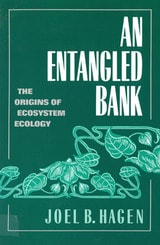
An Entangled Bank
The Origins of Ecosystem EcologyJoel B. Hagen
Rutgers University Press, 1992
His breadth of knowledge, his discerning inclusiveness, his clarity of thought, all make _An Entangled Bank_ a stimulating read. Very often in science courses we are presented only with the canonical "state of the science," having to swallow its agglomerated whole free of context. Hagen reveals the wisdom of understanding intellectual foundations. Through study of the origins and development of a science, we may better grasp the received tenets of current scientific understanding. As a young science, ecosystem ecology has a historical context that is relatively accessible to us, if less romantic than a tale of the origins of astronomy might be.
A peek into the labs and offices of botanists, limnologists, and biogeochemists might not seem like the acme of excitement. Hagen inspires us with his insights. He makes his subject meaningful to us. Though it is not pleasure reading by any stretch, its clear-sighted intellectual vigor makes _An Entangled Bank_ pure enjoyment.

Arab-American Faces and Voices
The Origins of an Immigrant CommunityBy Elizabeth Boosahda
University of Texas Press, 2003
As Arab Americans seek to claim their communal identity and rightful place in American society at a time of heightened tension between the United States and the Middle East, an understanding look back at more than one hundred years of the Arab-American community is especially timely. In this book, Elizabeth Boosahda, a third-generation Arab American, draws on over two hundred personal interviews, as well as photographs and historical documents that are contemporaneous with the first generation of Arab Americans (Syrians, Lebanese, Palestinians), both Christians and Muslims, who immigrated to the Americas between 1880 and 1915, and their descendants.
Boosahda focuses on the Arab-American community in Worcester, Massachusetts, a major northeastern center for Arab immigration, and Worcester's links to and similarities with Arab-American communities throughout North and South America. Using the voices of Arab immigrants and their families, she explores their entire experience, from emigration at the turn of the twentieth century to the present-day lives of their descendants. This rich documentation sheds light on many aspects of Arab-American life, including the Arab entrepreneurial motivation and success, family life, education, religious and community organizations, and the role of women in initiating immigration and the economic success they achieved.