Results by title
16 books match the query 'Alchemy'
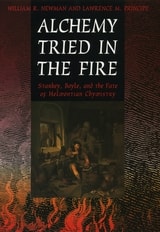
Alchemy Tried in the Fire
Starkey, Boyle, and the Fate of Helmontian ChymistryWilliam R. Newman and Lawrence M. Principe
University of Chicago Press, 2002
What actually took place in the private laboratory of a mid-seventeenth century alchemist? How did he direct his quest after the secrets of Nature? What instruments and theoretical principles did he employ?
Using, as their guide, the previously misunderstood interactions between Robert Boyle, widely known as "the father of chemistry," and George Starkey, an alchemist and the most prominent American scientific writer before Benjamin Franklin as their guide, Newman and Principe reveal the hitherto hidden laboratory operations of a famous alchemist and argue that many of the principles and practices characteristic of modern chemistry derive from alchemy. By analyzing Starkey's extraordinary laboratory notebooks, the authors show how this American "chymist" translated the wildly figurative writings of traditional alchemy into quantitative, carefully reasoned laboratory practice—and then encoded his own work in allegorical, secretive treatises under the name of Eirenaeus Philalethes. The intriguing "mystic" Joan Baptista Van Helmont—a favorite of Starkey, Boyle, and even of Lavoisier—emerges from this study as a surprisingly central figure in seventeenth-century "chymistry." A common emphasis on quantification, material production, and analysis/synthesis, the authors argue, illustrates a continuity of goals and practices from late medieval alchemy down to and beyond the Chemical Revolution.
For anyone who wants to understand how alchemy was actually practiced during the Scientific Revolution and what it contributed to the development of modern chemistry, Alchemy Tried in the Fire will be a veritable philosopher's stone.
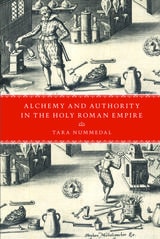
Alchemy and Authority in the Holy Roman Empire
Tara Nummedal
University of Chicago Press, 2007
Drawing on criminal trial records, contracts, laboratory inventories, satires, and vernacular alchemical treatises, Alchemy and Authority in the Holy Roman Empire situates the everyday alchemists, largely invisible to modern scholars until now, at the center of the development of early modern science and commerce. Reconstructing the workaday world of entrepreneurial alchemists, Tara Nummedal shows how allegations of fraud shaped their practices and prospects. These debates not only reveal enormously diverse understandings of what the “real” alchemy was and who could practice it; they also connect a set of little-known practitioners to the largest questions about commerce, trust, and intellectual authority in early modern Europe.

Alchemy in the Rain Forest
Politics, Ecology, and Resilience in a New Guinea Mining AreaJerry K. Jacka
Duke University Press, 2015
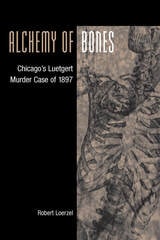
Alchemy of Bones
Chicago's Luetgert Murder Case of 1897Robert Loerzel
University of Illinois Press, 2002
On May 1, 1897, Louise Luetgert disappeared. Although no body was found, Chicago police arrested her husband, Adolph, the owner of a large sausage factory, and charged him with murder. The eyes of the world were still on Chicago following the success of the World's Columbian Exposition, and the Luetgert case, with its missing victim, once-prosperous suspect, and all manner of gruesome theories regarding the disposal of the corpse, turned into one of the first media-fueled celebrity trials in American history.
Newspapers fought one another for scoops, people across the country claimed to have seen the missing woman alive, and each new clue led to fresh rounds of speculation about the crime. Meanwhile, sausage sales plummeted nationwide as rumors circulated that Luetgert had destroyed his wife's body in one of his factory's meat grinders.
Weaving in strange-but-true subplots involving hypnotists, palmreaders, English con artists, bullied witnesses, and insane-asylum bodysnatchers, Alchemy of Bones is more than just a true crime narrative; it is a grand, sprawling portrait of 1890s Chicago--and a nation--getting an early taste of the dark, chaotic twentieth century.
Atoms and Alchemy
Chymistry and the Experimental Origins of the Scientific RevolutionWilliam R. Newman
University of Chicago Press, 2006
Tracing the alchemical roots of Robert Boyle’s famous mechanical philosophy, Newman shows that alchemy contributed to the mechanization of nature, a movement that lay at the very heart of scientific discovery. Boyle and his predecessors—figures like the mysterious medieval Geber or the Lutheran professor Daniel Sennert—provided convincing experimental proof that matter is made up of enduring particles at the microlevel. At the same time, Newman argues that alchemists created the operational criterion of an “atomic” element as the last point of analysis, thereby contributing a key feature to the development of later chemistry. Atomsand Alchemy thus provokes a refreshing debate about the origins of modern science and will be welcomed—and deliberated—by all who are interested in the development of scientific theory and practice.
Doris Lessing
The Alchemy of SurvivalCarey Kaplan
Ohio University Press, 1988
Long neglected by the academic world because of her rejection of belletristic values and resistance to convenient literary taxonomy, Doris Lessing has nonetheless built an international following of serious, dedicated readers. Acknowledging the difficulties posed by the multiple dimensions of Lessing’s work, Kaplan and Rose have gathered eleven essays that address her artistic, philosophical, political, and psychological complexity, and so provide a welcome introduction to the extraordinary depth and diversity of this important contemporary novelist.
Lessing has been described as an “alchemical” writer, in that her work is directed toward changing people’s lives and perceptions rather than simply recording experience. Accordingly, the contributors examine her various postures and tactics for the purpose of discovering how the alchemical elements inform her various personae. Frederick C. Stern discusses Lessing’s commitment to radical humanist thought, while Carey Kaplan examines how Lessing’s imperialist past has shaped her futuristic fiction. Elizabeth Abel offers a feminist interpretation of the pattern of brother-sister incest in Lessing’s work, showing how Lessing has established Antigone as a female alternative to the Oedipal myth of male incest. Particularly insightful is Eve Bertelsen’s report of her interview with Lessing, demonstrating how Lessing’s often evasive style of adversarial dialogue works in concert with her refusal to be conveniently pigeonholed by academic analysis.
For those readers new to her work, Doris Lessing: The Alchemy of Survival will serve as a useful introduction to Lessing’s concerns and techniques. Those who have long admired her writing will find in this collection new keys to understanding Lessing’s philosophical, political, and psychological complexity.
Gehennical Fire
The Lives of George Starkey, an American Alchemist in the Scientific RevolutionWilliam R. Newman
University of Chicago Press, 2002
Max Ernst and Alchemy
A Magician in Search of MythBy M. E. Warlick
University of Texas Press, 2001
Surrealist artist Max Ernst defined collage as the "alchemy of the visual image." Students of his work have often dismissed this comment as simply a metaphor for the transformative power of using found images in a new context. Taking a wholly different perspective on Ernst and alchemy, however, M. E. Warlick persuasively demonstrates that the artist had a profound and abiding interest in alchemical philosophy and often used alchemical symbolism in works created throughout his career.
A revival of interest in alchemy swept the artistic, psychoanalytic, historical, and scientific circles of the late nineteenth and early twentieth centuries, and Warlick sets Ernst's work squarely within this movement. Looking at both his art (many of the works she discusses are reproduced in the book) and his writings, she reveals how thoroughly alchemical philosophy and symbolism pervade his early Dadaist experiments, his foundational work in surrealism, and his many collages and paintings of women and landscapes, whose images exemplify the alchemical fusing of opposites. This pioneering research adds an essential key to understanding the multilayered complexity of Ernst's works, as it affirms his standing as one of Germany's most significant artists of the twentieth century.
Promethean Ambitions
Alchemy and the Quest to Perfect NatureWilliam R. Newman
University of Chicago Press, 2004
In Promethean Ambitions, William R. Newman ambitiously uses alchemy to investigate the thinning boundary between the natural and the artificial. Focusing primarily on the period between 1200 and 1700, Newman examines the labors of pioneering alchemists and the impassioned—and often negative—responses to their efforts. By the thirteenth century, Newman argues, alchemy had become a benchmark for determining the abilities of both men and demons, representing the epitome of creative power in the natural world. Newman frames the art-nature debate by contrasting the supposed transmutational power of alchemy with the merely representational abilities of the pictorial and plastic arts—a dispute which found artists such as Leonardo da Vinci and Bernard Palissy attacking alchemy as an irreligious fraud. The later assertion by the Paracelsian school that one could make an artificial human being—the homunculus—led to further disparagement of alchemy, but as Newman shows, the immense power over nature promised by the field contributed directly to the technological apologetics of Francis Bacon and his followers. By the mid-seventeenth century, the famous "father of modern chemistry," Robert Boyle, was employing the arguments of medieval alchemists to support the identity of naturally occurring substances with those manufactured by "chymical" means.
In using history to highlight the art-nature debate, Newman here shows that alchemy was not an unformed and capricious precursor to chemistry; it was an art founded on coherent philosophical and empirical principles, with vocal supporters and even louder critics, that attracted individuals of first-rate intellect. The historical relationship that Newman charts between human creation and nature has innumerable implications today, and he ably links contemporary issues to alchemical debates on the natural versus the artificial.
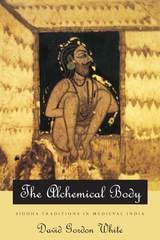
The Alchemical Body
Siddha Traditions in Medieval IndiaDavid Gordon White
University of Chicago Press, 1996
"White proves a skillful guide in disentangling historical and theoretical complexities that have thus far bedeviled the study of these influential aspects of medieval Indian culture."—Yoga World
"Anyone seriously interested in finding out more about authentic tantra, original hatha yoga, embodied liberation . . . sacred sexuality, paranormal abilities, healing, and of course alchemy will find White's extraordinary book as fascinating as any Tom Clancy thriller."—Georg Feuerstein, Yoga Journal

The Alchemy of English
The Spread, Functions, and Models of Non-native EnglishesBraj Kachru
University of Illinois Press, 1990
of an entire field, rather than merely the fruitful exploration of a topic.
. . . [Kachru] is to be congratulated for having taken us as far as he
already has and for doing so in so stimulating and so productive a fashion."
-- World Englishes
"A potent addition to theoretical, sociolinguistic, attitudinal
and methodological explorations vis-à-vis the spread and functions
of, and innovations in, English from the viewpoint of a non-Western scholar."
-- The Language Teacher
Winner of the Joint First Prize, Duke of Edinburgh English Language
Book Competition of the English-Speaking Union of the Commonwealth, 1987
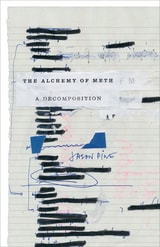
The Alchemy of Meth
A DecompositionJason Pine
University of Minnesota Press, 2019
Meth cooks practice late industrial alchemy—transforming base materials, like lithium batteries and camping fuel, into gold
Meth alchemists all over the United States tap the occulted potencies of industrial chemical and big pharma products to try to cure the ills of precarious living: underemployment, insecurity, and the feeling of idleness. Meth fires up your attention and makes repetitive tasks pleasurable, whether it’s factory work or tinkering at home. Users are awake for days and feel exuberant and invincible. In one person’s words, they “get more life.”
The Alchemy of Meth is a nonfiction storybook about St. Jude County, Missouri, a place in decomposition, where the toxic inheritance of deindustrialization meets the violent hope of this drug-making cottage industry. Jason Pine bases the book on fieldwork among meth cooks, recovery professionals, pastors, public defenders, narcotics agents, and pharmaceutical executives. Here, St. Jude is not reduced to its meth problem but Pine looks at meth through materials, landscapes, and institutions: the sprawling context that makes methlabs possible. The Alchemy of Meth connects DIY methlabs to big pharma’s superlabs, illicit speed to the legalized speed sold as ADHD medication, uniquely implicating the author’s own story in the narrative.
By the end of the book, the backdrop of St. Jude becomes the foreground. It could be a story about life and work anywhere in the United States, where it seems no one is truly clean and all are complicit in the exploitation of their precious resources in exchange for a livable present—or even the hope of a future.
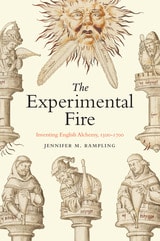
The Experimental Fire
Inventing English Alchemy, 1300–1700Jennifer M. Rampling
University of Chicago Press, 2020
In medieval and early modern Europe, the practice of alchemy promised extraordinary physical transformations. Who would not be amazed to see base metals turned into silver and gold, hard iron into soft water, and deadly poison into elixirs that could heal the human body? To defend such claims, alchemists turned to the past, scouring ancient books for evidence of a lost alchemical heritage and seeking to translate their secret language and obscure imagery into replicable, practical effects.
Tracing the development of alchemy in England over four hundred years, from the beginning of the fourteenth century to the end of the seventeenth, Jennifer M. Rampling illuminates the role of alchemical reading and experimental practice in the broader context of national and scientific history. Using new manuscript sources, she shows how practitioners like George Ripley, John Dee, and Edward Kelley, as well as many previously unknown alchemists, devised new practical approaches to alchemy while seeking the support of English monarchs. By reconstructing their alchemical ideas, practices, and disputes, Rampling reveals how English alchemy was continually reinvented over the space of four centuries, resulting in changes to the science itself. In so doing, The Experimental Fire bridges the intellectual history of chemistry and the wider worlds of early modern patronage, medicine, and science.
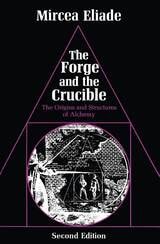
The Forge and the Crucible
The Origins and Structure of AlchemyMircea Eliade
University of Chicago Press, 1979
The new edition of The Forge and the Crucible contains an updated appendix, in which Eliade lists works on Chinese alchemy published in the past few years. He also discusses the importance of alchemy in Newton's scientific evolution.
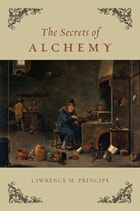
The Secrets of Alchemy
Lawrence M. Principe
University of Chicago Press, 2012
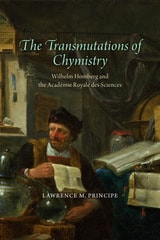
The Transmutations of Chymistry
Wilhelm Homberg and the Académie Royale des SciencesLawrence M. Principe
University of Chicago Press, 2020
Principe, the leading authority on the subject, recounts how Homberg’s radical vision promoted chymistry as the most powerful and reliable means of understanding the natural world. Homberg’s work at the Académie and in collaboration with the future regent, Philippe II d’Orléans, as revealed by a wealth of newly uncovered documents, provides surprising new insights into the broader changes chymistry underwent during, and immediately after, Homberg. A human, disciplinary, and institutional biography, The Transmutations of Chymistry significantly revises what was previously known about the contours of chymistry and scientific institutions in the early eighteenth century.