Results by title
6 books match the query 'Alien labor'

Color Lines
Affirmative Action, Immigration, and Civil Rights Options for AmericaJohn David Skrentny
University of Chicago Press, 2001
Contributors:
Erik Bleich
Lawrence D. Bobo
Frank Dobbin
John Aubrey Douglass
Hugh Davis Graham
Kyra R. Greene
Erin Kelly
George R. La Noue
Jennifer Lee
Michael Lichter
Deborah C. Malamud
Sunita Parikh
John C. Sullivan
Thomas J. Sugrue
Carol M. Swain
Steven M. Teles
Roger Waldinger
Christine Min Wotipka
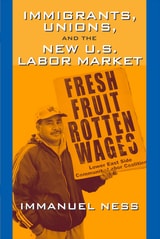
Immigrants Unions & The New Us Labor Mkt
Immanuel Ness
Temple University Press, 2005
Immigration and the Work Force
Economic Consequences for the United States and Source AreasEdited by George J. Borjas and Richard B. Freeman
University of Chicago Press, 1992
This timely study is unique in presenting new data sets on the labor force, wage rates, and demographic conditions of both the U.S. and source-area economies through the 1980s. The contributors analyze the economic effects of immigration on the United States and selected source areas, with a focus on Puerto Rico and El Salvador. They examine the education and job performance of foreign-born workers; assimilation, fertility, and wage rates; and the impact of remittances by immigrants to family members on the overall gross domestic product of source areas.
A revealing and original examination of a topic of growing importance, this book will stand as a guide for further research on immigration and on the economies of developing countries.
Immigration, Trade, and the Labor Market
Edited by John M. Abowd and Richard B. Freeman
University of Chicago Press, 1991
Prompted by the growing internationalization of the U.S. labor market since the 1970s, contributors to Immigration, Trade, and the Labor Market provide an innovative and comprehensive analysis of the labor market impact of the international movements of people, goods, and capital. Their provocative findings are brought into perspective by studies of two other major immigrant-recipient countries, Canada and Australia. The differing experiences of each nation stress the degree to which labor market institutions and economic policies can condition the effect of immigration and trade on economic outcomes
Contributors trace the flow of immigrants by comparing the labor market and migration behavior of individual immigrants, explore the effects of immigration on wages and employment by comparing the composition of the work force in local labor markets, and analyze the impact of trade on labor markets in different industries. A unique data set was developed especially for this study—ranging from an effort to link exports/imports with wages and employment in manufacturing industries, to a survey of illegal Mexican immigrants in the San Diego area—which will prove enormously valuable for future research.
Limits of Citizenship
Migrants and Postnational Membership in EuropeYasemin Nuhoglu Soysal
University of Chicago Press, 1994
Soysal focuses on postwar international migration, paying particular attention to "guestworkers." Taking an in-depth look at France, Germany, the Netherlands, Sweden, Switzerland, and the United Kingdom, she identifies three major patterns that reflect the varying emphasis particular states place on individual versus corporate groups as the basis for incorporation. She finds that the global expansion and intensification of human rights discourse puts nation-states under increasing outside pressure to extend membership rights to aliens, resulting in an increasingly blurred line between citizen and noncitizen. Finally, she suggests a possible accommodation to these shifts: specifically, a model of post-national membership that derives its legitimacy from universal personhood, rather than national belonging.
This fresh approach to the study of citizenship, rights, and immigration will be invaluable to anyone involved in issues of human rights, international migration, and transnational cultural interactions, as well as to those who study the contemporary transformation of the nation-state, nationalism, and globalization.
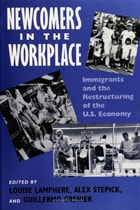
Newcomers In Workplace
Immigrants and the Restructing of the U.S. Economyedited by Louise Lamphere, Alex Stepick and Guillermo Grenier
Temple University Press, 1994
Newcomers in the Workplace documents and dramatizes the changing face of the American workplace, transformed in the 1980s by immigrant workers in all sectors. This collection of excellent ethnographies captures the stench of meatpacking plants, the clatter of sewing machines, the sweat of construction sites, and the strain of management-employee relations in hotels and grocery stores as immigrant workers carve out crucial roles in a struggling economy.
Case studies focus on three geographical regions—Philadelphia, Miami, and Garden City, Kansas—where the active workforce includes increasing numbers of Cubans, Haitians, Koreans, Puerto Ricans, Laotians, Vietnamese, and other new immigrants. The portraits show these newcomers reaching across ethnic boundaries in their determination to retain individualism and to insure their economic survival.
In the series Labor and Social Change, edited by Paula Rayman and Carmen Sirianni.