Results by title
6 books match the query 'Allied occupation, 1945-1952'
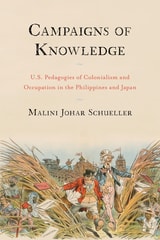
Campaigns of Knowledge
U.S. Pedagogies of Colonialism and Occupation in the Philippines and JapanMalini Johar Schueller
Temple University Press, 2019
The creation of a new school system in the Philippines in 1898 and educational reforms in occupied Japan, both with stated goals of democratization, speaks to a singular vision of America as savior, following its politics of violence with benevolent recuperation. The pedagogy of recovery—in which schooling was central and natives were forced to accept empire through education—might have shown how Americans could be good occupiers, but it also created projects of Orientalist racial management: Filipinos had to be educated and civilized, while the Japanese had to be reeducated and “de-civilized.”
In Campaigns of Knowledge, Malini Schueller contrapuntally reads state-sanctioned proclamations, educational agendas, and school textbooks alongside political cartoons, novels, short stories, and films to demonstrate how the U.S. tutelary project was rerouted, appropriated, reinterpreted, and resisted. In doing so, she highlights how schooling was conceived as a process of subjectification, creating particular modes of thought, behaviors, aspirations, and desires that would render the natives docile subjects amenable to American-style colonialism in the Philippines and occupation in Japan.
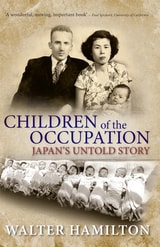
Children of the Occupation
Japan's Untold StoryHamilton, Walter
Rutgers University Press, 2013
Based on interviews with or research on 150 konketsuji—a now-taboo word for "mixed-blood" Japanese—journalist Walter Hamilton presents vivid first-person accounts of these adults as they remember their experiences of childhood loss. Using archival material from organizations dedicated to assisting the children, he combines moving personal tales with historical and political analyses of international race relations and immigration policy, particularly in North America and Australia.
Not only were attitudes and behaviors of the Japanese biased against the mixed-race children, but so were the restrictive and prejudicial immigration policies of the fathers’ native countries. Japan’s racial intolerance was fully matched in the nations it fought against. Hamilton examines how attitudes about race relations have evolved and traces the impact of racial ideology on national policy and cultural identity in Australia, Japan, and the United States.
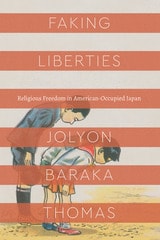
Faking Liberties
Religious Freedom in American-Occupied JapanJolyon Baraka Thomas
University of Chicago Press, 2019
Through a fresh analysis of pre-war Japanese law, Jolyon Baraka Thomas demonstrates that the occupiers’ triumphant narrative obscured salient Japanese political debates about religious freedom. Indeed, Thomas reveals that American occupiers also vehemently disagreed about the topic. By reconstructing these vibrant debates, Faking Liberties unsettles any notion of American authorship and imposition of religious freedom. Instead, Thomas shows that, during the Occupation, a dialogue about freedom of religion ensued that constructed a new global set of political norms that continue to form policies today.
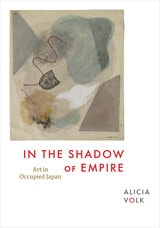
In the Shadow of Empire
Art in Occupied JapanAlicia Volk
University of Chicago Press, 2025
Alicia Volk brings to light a significant body of postwar Japanese art, exploring how it accommodated and resisted the workings of the American empire during the early Cold War. Volk’s groundbreaking account presents the points of view of Japanese artists and their audiences under American occupation and amid the ruins of war. Each chapter reveals how artists embraced new roles for art in the public sphere—at times by enacting radical critiques of established institutions, values, and practices—and situates a range of compelling art objects in their intersecting artistic and political worlds.
Centering on the diverse and divisive terrain of Japanese art between 1945 and 1952, In the Shadow of Empire creates a fluid map of relationality that brings multiple Cold War spheres into dialogue, stretching beyond US-occupied Japan to art from China, Europe, the Soviet Union, and the United States, and demonstrates the rich potential of this transnational site of artmaking for rethinking the history of Japanese and global postwar art.
Pedagogy of Democracy
Feminism and the Cold War in the U.S. Occupation of JapanMire Koikari
Temple University Press, 2009
Pedagogy of Democracy re-interprets the U.S. occupation of Japan from 1945 to 1952 as a problematic instance of Cold War feminist mobilization rather than a successful democratization of Japanese women as previously argued. By combining three fields of research—occupation, Cold War, and postcolonial feminist studies—and examining occupation records and other archival sources, Koikari argues that postwar gender reform was one of the Cold War containment strategies that undermined rather than promoted women’s political and economic rights.
The Community of Nuchi Du Takara ("Life Is the Ultimate Treasure") in Postwar Okinawa
Local Subjectivity within and against EmpireMasamichi (Marro) Inoue
University of Michigan Press, 2025