Results by title
12 books match the query 'Alphabets & Writing Systems'
Figures of Speech
Six Histories of Language and Identity in the Age of RevolutionsTim Cassedy
University of Iowa Press, 2018
Tim Cassedy’s fascinating study examines the role that language played at the turn of the nineteenth century as a marker of one’s identity. During this time of revolution (U.S., French, and Haitian) and globalization, language served as a way to categorize people within a world that appeared more diverse than ever. Linguistic differences, especially among English-speakers, seemed to validate the emerging national, racial, local, and regional identity categories that took shape in this new world order.
Focusing on six eccentric characters of the time—from the woman known as “Princess Caraboo” to wordsmith Noah Webster—Cassedy shows how each put language at the center of their identities and lived out the possibilities of their era’s linguistic ideas. The result is a highly entertaining and equally informative look at how perceptions about who spoke what language—and how they spoke it—determined the shape of communities in the British American colonies and beyond.
This engagingly written story is sure to appeal to historians of literature, culture, and communication; to linguists and book historians; and to general readers interested in how ideas about English developed in the early United States and throughout the English-speaking world.
Formalities
Seeing Script in Art of the Early Modern Spanish WorldAaron M. Hyman
University of Chicago Press, 0
Examines the visual qualities of written words in works of art created from 1540 to 1700 across the transatlantic Spanish Empire.
Pieces of text are found across paintings produced in the early modern Spanish Empire, but their role as aesthetic elements has long been overlooked. With Formalities, Aaron M. Hyman argues that these words were important, not only because of their literal content but also because of their forms, which artists and their audiences across the Spanish world understood in terms of meanings beyond semantic content.
The widespread phenomenon of writing in or on works of art is one of the most distinctive features of art in the early modern Spanish world, yet it has received little art historical attention. Hyman focuses on this feature, demonstrating how artists mobilized particular scripts and carefully integrated the pictorial qualities of the written word. He explores how letterforms of the era were strictly codified, with different forms being particular to different genres and contexts. Chapters look at painted, embroidered, and incised words alongside texts in archival documents, books, and prints, showing how the visual arts drew on sources including calligraphy manuals, notarial documents, merchant account books, liturgical texts, and pictograms. Artists relied on their audiences’ understanding of the contexts in which such objects were used and connotations that texts thus produced, using visual languages to make meaning in addition to—or in spite of—what the words themselves actually said.
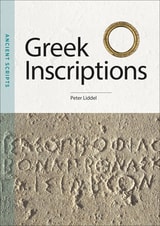
Greek Inscriptions
Ancient ScriptsPeter Liddel
J. Paul Getty Trust, The, 2025
Ancient Greek inscriptions are crucially important in understanding the cultures of Greece and the Mediterranean in antiquity. They provide glimpses of the behavior of the people of the time, including clues about their mindsets and aspirations. These public records combine word and image in a multitude of ways and are rich in the insights they offer.
The inscriptions examined in this volume come from a range of objects on metal or stone that include laws, decrees, accounts and inventories, honorific texts, dedications to deities, and funerary epitaphs. They give a broad view of interstate relations, historical narratives, and the political administration of various city-states while also providing new perspectives on concepts such as democracy, citizenship, gender, ethnicity, religion, and the supernatural. Peter Liddel emphasizes the physical form of the texts alongside their importance in understanding ancient Greek culture. Accessible and insightful, Greek Inscriptions both highlights the significance and history of these artifacts and examines their reception in the modern world.
Inventing Writing
Prophets, Shamans, and the Transmission of Ritual Discourse in North American Indigenous Cultures, 1600–1900Pierre Déléage
HAU, 2026
Why have humans repeatedly devoted immense intellectual energy to inventing writing? In world history, writing was independently created four times—by the Sumerians, Egyptians, Chinese, and Mayans. These traditions developed universal scripts, systems of symbols theoretically capable of recording any utterance in the spoken language. On this basis, a long-standing scholarly view has held that the origins of writing are inseparable from the rise of states and bureaucracies.
However, this book turns our attention to another trajectory. Between 1700 and 1900, prophets and shamans in Native American societies devised “bounded” forms of writing. Unlike universal scripts, these were not intended to capture the entirety of speech. Instead, they served a precise function: to ensure the faithful transmission of ritual discourses within ceremonial frameworks. Their principles of notation differed profoundly from those of the great phonographic traditions.
Pierre Déléage’s analysis not only illuminates these overlooked episodes in the history of writing but also advances a methodological shift: rather than treating selective scripts as “failed” or “incomplete,” he interprets them on their own terms. In doing so, he opens up a broader framework for understanding writing as a diverse cultural practice, one that can emerge outside of state power, bureaucracy, or universal phonographic systems.
Now published in English translation, Inventing Writing makes the work of a leading French scholar available to new readers. It offers a groundbreaking perspective: writing does not emerge only as a universal technology of language, but also as a bounded tool shaped by ritual, institution, and culture.
Inventing the Alphabet
The Origins of Letters from Antiquity to the PresentJohanna Drucker
University of Chicago Press, 2022
Inventing the Alphabet provides the first account of two-and-a-half millennia of scholarship on the alphabet. Drawing on decades of research, Johanna Drucker dives into sometimes obscure and esoteric references, dispelling myths and identifying a pantheon of little-known scholars who contributed to our modern understandings of the alphabet, one of the most important inventions in human history.
Beginning with Biblical tales and accounts from antiquity, Drucker traces the transmission of ancient Greek thinking about the alphabet’s origin and debates about how Moses learned to read. The book moves through the centuries, finishing with contemporary concepts of the letters in alpha-numeric code used for global communication systems. Along the way, we learn about magical and angelic alphabets, antique inscriptions on coins and artifacts, and the comparative tables of scripts that continue through the development of modern fields of archaeology and paleography.
This is the first book to chronicle the story of the intellectual history through which the alphabet has been “invented” as an object of scholarship.
Iron Age Hieroglyphic Luwian Inscriptions
Annick Payne
SBL Press, 2012

Language of Tomorrow
Towards a Transcultural Visual Communication System in a Posthuman ConditionHaytham Nawar
Intellect Books, 2020
Language of Tomorrow is a comprehensive guide to the history, evolution, and current forms of pictographic communication, charting its course from ancient Egyptian writing systems to modern-day emojis. The book is a culmination of research combining visual communication, semiotic theory, cultural studies, linguistics, artificial intelligence, and new media.
Haytham Nawar presents a cohesive and comprehensive historical framework—covering pictographic, logographic, and ideographic writing systems and scripts—through which we can discuss the future of communication. In his analysis, he explores the possibility of developing a standardized universal pictographic communication system that fosters mutual understanding and bridges diverse cultures. Weaving practice and theory across disciplines and bringing together language, culture, art, and design, Language of Tomorrow aims to locate the direction for the research and development of a transcultural visual communication system for the posthuman era.
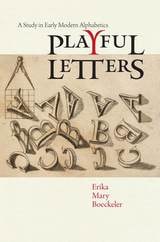
Playful Letters
A Study in Early Modern AlphabeticsErika Mary Boeckeler
University of Iowa Press, 2017
Drawing on Shakespeare, anthropomorphic typography, figured letters, and Cyrillic pedagogy and politics, this book explores the ways in which alphabetic thinking and writing inform literature and the visual arts, and it develops reading strategies for the “letterature” that underwrites such cultural production. Playful Letters begins with early modern engagements with the alphabet and the human body—an intersection where letterature emerges with startling force. The linking of letters and typography with bodies produced a new kind of literacy. In turn, educational habits that shaped letter learning and writing permeated the interrelated practices of typography, orthography, and poetry. These mutually informing processes render visible the persistent crumbling of words into letters and their reconstitution into narrative, poetry, and image.
In addition to providing a rich history of literary and artistic alphabetic interrogation in early modern Western Europe and Russia, Playful Letters contributes to the continuous story of how people use new technologies and media to reflect on older forms, including the alphabet itself.
Politics, Language, and Thought
The Somali ExperienceDavid D. Laitin
University of Chicago Press, 1977
Twelve years after independence, a military government was able to settle the acrimonious controversy by announcing that Somali would be the official language and Latin the basic script. It was hoped that this choice would foster political equality and strengthen the national culture. Politics, Language, and Thought is an exploration of how language and politics interrelate in the Somali Republic. Using both historical and experimental evidence, David D. Laitin demonstrates that the choice of an official language may significantly affect the course of a country's political development.
Part I of Laitin's study is an attempt to explain why the parliamentary government was incapable of reaching agreement on a national script and to assess the social and political consequences of the years of nondecision. Laitin shows how the imposition of nonindigenous languages produced inequalities which eroded the country's natural social basis of democracy.
Part 2 attempts to relate language to political thought and political culture. Analyzing interviews and role-playing sessions among Somali bilingual students, Laitin demonstrates that the impact of certain political concepts is quite different when expressed in different languages. He concludes that the implications of choosing a language are far more complex than previously thought, because to change the language of a people is to change the ways they think and act politically.
The History and Power of Writing
Henri-Jean Martin
University of Chicago Press, 1994
Traversing four millennia, Martin offers a chronicle of writing as a cultural system, a means of communication, and a history of technologies. He shows how the written word originated, how it spread, and how it figured in the evolution of civilization. Using as his center the role of printing in making the written way of thinking dominant, Martin examines the interactions of individuals and cultures to produce new forms of "writing" in the many senses of authorship, language rendition, and script.
Martin looks at how much the development of writing owed to practical necessity, and how much to religious and social systems of symbols. He describes the precursors to writing and reveals their place in early civilization as mnemonic devices in service of the spoken word. The tenacity of the oral tradition plays a surprisingly important part in this story, Martin notes, and even as late as the eighteenth century educated individuals were trained in classical rhetoric and preferred to rely on the arts of memory. Finally, Martin discusses the changes to writing wrought by the electronic revolution, offering invaluable insights into the influence these new technologies have had on children born into the computer age.
The Power of Babel
Language and Governance in the African ExperienceAli A. Mazrui and Alamin M. Mazrui
University of Chicago Press, 1998
The Power of Babel is one of the first comprehensive studies of the complex linguistic constellations of Africa. It draws on Ali Mazrui's earlier work in its examination of the "triple heritage" of African culture, in which indigenous, Islamic, and Western traditions compete for influence. In bringing the idea of the triple heritage to language, the Mazruis unravel issues of power, culture, and modernity as they are embedded in African linguistic life.
The first section of the book takes a global perspective, exploring such issues as the Eurocentrism of much linguistic scholarship on Africa; part two takes an African perspective on a variety of issues from the linguistically disadvantaged position of women in Africa to the relation of language policy and democratic development; the third section presents a set of regional studies, centering on the Swahili language's exemplification of the triple heritage.The Power of Babel unites empirical information with theories of nationalism and pluralism—among others—to offer the richest contextual account of African languages to date.
The Violence of the Letter
Toward a Theory of WritingMelanie McMahon
University of Michigan Press, 2023
Co-Winner of the 2024 ACLA Renè Wellek Prize for Monograph
The emergence of the alphabet in ancient Greece, usually heralded as the first step in the inexorable march toward reason and progress, in fact signaled the introduction of a chance technology that hijacked the future, with devastating consequences for humanity. By investigating an array of cultural artifacts, ranging from Kubrick's 2001: A Space Odyssey to the Oracle at Delphi to Luther's challenge to the Church, this book demonstrates how the apparently benign emergence of writing made possible far-ranging systems of organized domination and unprecedented levels of violence. The Violence of the Letter considers how a twenty-six-letter code changed the face of the world, and not always for the better.