Results by title
6 books match the query 'Altar'
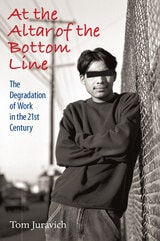
At the Altar of the Bottom Line
The Degradation of Work in the 21st CenturyThomas Juravich
University of Massachusetts Press, 2009
Tom Juravich combines oral history with social and economic analysis to provide a vivid account of the multiple challenges presented in today's workplaces.
Based on extensive interviews with workers in four different industries, this book takes us behind the statistics of the economic collapse and into the lives of Americans who are struggling to make ends meet and support their families.
At a Verizon call center in Andover, Massachusetts, customer service reps find themselves overwhelmed by the pace of work and the constant monitoring. They describe a daily routine marked by regimentation, intense pressure to sell, and unrelenting stress. In New Bedford, undocumented Guatemalans in the fish-processing industry are fired if they don't work fast enough, cheated out of wages, and mistreated by supervisors. Juravich describes a brutal immigration raid by U.S. Immigration and Customs Enforcement that divided families and forced workers further underground.
Juravich then takes us inside the operating rooms at the Boston Medical Center, where hospital consolidation has brought a new “bottom line” philosophy that has fundamentally altered the way patient care is delivered. Surgery takes place almost non-stop, driving some nurses from their chosen profession and leaving those who remain exhausted.
The final case study looks at the shuttering of the Jones Beloit plant, an internationally known manufacturer of machinery for the paper industry. Despite the best efforts of highly skilled and productive workers to save their plant, it was abruptly closed and they were abandoned after their CEO recklessly became involved in a shaky foreign investment.
Juravich argues that workers face a series of paradoxes in the contemporary American workplace. They can no longer assume that large established firms create good jobs. The new working conditions often resemble what was traditionally associated with marginal and low-wage employers. He concludes that we must bring a discussion about the quality of jobs back into the public discourse and that a “good jobs” strategy is a fundamental building block to economic recovery.
Workers' voices are front and center in this highly readable book. It includes striking photographs by Paul Shoul and a CD that presents a series of audio documentaries with excerpts from the interviews, as well as four original songs written and performed by Juravich.
Lamb at the Altar
The Story of a DanceDeborah Hay
Duke University Press, 1994
Her movements are uncharacteristic, her words subversive, her dances unlike anything done before—and this is the story of how it all works. A founding member of the famed Judson Dance Theater and a past performer in the Merce Cunningham Dance Company, Deborah Hay is well known for choreographing works using large groups of trained and untrained dancers whose surprising combinations test the limits of the art. Lamb at the Altar is Hay’s account of a four-month seminar on movement and performance held in Austin, Texas, in 1991. There, forty-four trained and untrained dancers became the human laboratory for Hay’s creation of the dance Lamb, lamb, lamb . . . , a work that she later distilled into an evening-length solo piece, Lamb at the Altar. In her book, in part a reflection on her life as a dancer and choreographer, Hay tells how this dance came to be. She includes a movement libretto (a prose dance score) and numerous photographs by Phyllis Liedeker documenting the dance’s four-month emergence.
In an original style that has marked her teaching and writing, Hay describes her thoughts as the dance progresses, commenting on the process and on the work itself, and ultimately creating a remarkable document on the movements—precise and mysterious, mental and physical—that go into the making of a dance. Having replaced traditional movement technique with a form she calls a performance meditation practice, Hay describes how dance is enlivened, as is each living moment, by the perception of dying and then involves a freeing of this perception from emotional, psychological, clinical, and cultural attitudes into movement. Lamb at the Altar tells the story of this process as specifically practiced in the creation of a single piece.
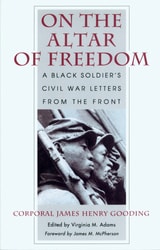
On the Altar of Freedom
A Black Soldier’s Civil War Letters from the FrontJames Henry Gooding
University of Massachusetts Press, 1991
From basic training at Camp Meigs in Readville, Massachusetts, through campaigns in Georgia, South Carolina, and Florida, Gooding faithfully records the activities of the 54th, including the legendary storming of Fort Wagner. He also voices the injustice felt by soldiers of his regiment over the issue of unequal pay, the refusal to promote deserving black enlistees to officer rank, and the deeply ingrained racism of whites in both the North and South.
Wounded and captured during the battle of Olustee, Florida, in February 1864, Gooding died later that year in Andersonville Prison.
In her introduction, Virginia M. Adams provides biographical details on Gooding's life and examines the antebellum history of New Bedford's large and articulate community of free blacks.
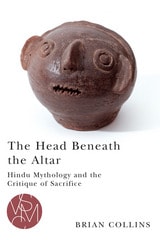
The Head Beneath the Altar
Hindu Mythology and the Critique of SacrificeBrian Collins
Michigan State University Press, 2014

The Melting Pot and the Altar
Marital Assimilation in Early Twentieth-Century WisconsinRichard M. Bernard
University of Minnesota Press, 1981
The Melting Pot and the Altar was first published in 1981. Minnesota Archive Editions uses digital technology to make long-unavailable books once again accessible, and are published unaltered from the original University of Minnesota Press editions.
Recent studies of assimilation in nineteenth-century America have focused on the ways in which immigrant groups maintained separate identities rather than on their absorption in American society. In The Melting Pot and the Altar Richard M. Bernard puts to test the theory of the melting pot. He concludes that although cultural and structural pluralism deserves attention so does interaction between the host society and the immigrants
Through extensive quantitative analysis of census reports and marriage records Bernard studies the pattern of intergroup marriage - the ultimate test of assimilation - during a period of massive migration to this country. His research on eleven immigrant groups and the native-born population in Wisconsin suggests that there was considerable intergroup mixing. Moreover, once allowance is made for differing times of arrival, immigration generations, and rural or urban residences, the assimilative patterns of Western and Eastern European groups were remarkably similar. An examination of several factors, such as occupation, age, location, and birthplace of parents, shows that certain demographic and social characteristics rather than any particular ethnic identification increased the likelihood that an individual would marry outside his or her group.
The Melting Pot and the Altar is the first multiple variable analysis of marital assimilation in an entire state whose immigration patterns is similar to that of the nation. Both historians and sociologist will find this work of interest as an example of quantitative methodology and for its new evidence on an important subject.
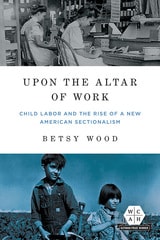
Upon the Altar of Work
Child Labor and the Rise of a New American SectionalismBetsy Wood
University of Illinois Press, 2020
Betsy Wood examines the evolution of ideas about child labor and the on-the-ground politics of the issue against the backdrop of broad developments related to slavery and emancipation, industrial capitalism, moral and social reform, and American politics and religion. Wood explains how the decades-long battle over child labor created enduring political and ideological divisions within capitalist society that divided the gatekeepers of modernity from the cultural warriors who opposed them. Tracing the ideological origins and the politics of the child labor battle over the course of eighty years, this book tells the story of how child labor debates bequeathed an enduring legacy of sectionalist conflict to modern American capitalist society.