Results by title
12 books match the query 'Alternative medicine'
Alternative Health Care
Michael S. Goldstein
Temple University Press, 1999
Michael S. Goldstein's Alternative Health Care is the first comprehensive account of the growing presence of alternative medicine in American society. Beginning with the basic premises of alternative medicine, Goldstein's book examines the clinical, economic, and political realities of the broad range of alternative care options and practices in the United States and explains why alternative medicine has become a viable choice for so many people who are ill or who seek to remain healthy.
Bringing history, policy, practice, personal experience, and in-depth sociological analysis together into one comprehensive volume, Goldstein -- one of the first recipients of funding from the National Institute of Health for research on alternative medicine -- also studies the complexities of the relationship between spirituality and alternative medicine and the changing role of alternative medicine in the larger context of American health care. Probing such issues as the corporatization of medicine, the role of alternative medicine in health care, and the dynamic relationship between conventional and alternative treatments, Goldstein's Alternative Health Care is more than the long-awaited introduction to the many forms of alternative medicine. It is also the measure of the implications of such care for practitioners, businesses, policymakers, and patients alike.
Alternative Health Care is the definitive guide for the millions of Americans interested in alternative medicine and treatment, American health care, the sociology of medicine, and American social issues.
Alternative Medicine
Rafael Campo
Duke University Press, 2013
Beyond Complementary Medicine
Legal and Ethical Perspectives on Health Care and Human EvolutionMichael H. Cohen
University of Michigan Press, 2000
Integration of divergent philosophies, paradigms, and practices requires responsible investigation, informed judgment, and open-minded yet critical study and analysis of various systems of healing. Michael H. Cohen offers providers and policymakers vitally important information by addressing questions such as credentialing, malpractice, informed consent, and liability for referrals. He describes both practical strategies for minimizing liability, as well as the necessary future evolution of the legal and regulatory structure.
Cohen also probes uncharted ethical and bioethical issues in complementary medicine and integrative health care. He further explores the connection between law, medicine, and spirituality and the role of this connection in human evolution. The book's range mirrors the integrative process itself, a process of grappling with, and meaningfully assimilating, disparate traditions and unfamiliar ways of thinking about the significance of health, body, and being.
Beyond Complementary Medicine is required reading for anyone involved in health care, including executives, insurers, managed care organizations, attorneys, ethicists, and lawmakers; physicians integrating complementary and alternative therapies; complementary and alternative medicine practitioners; medical schools, law schools, and educational institutions offering programs in health care, public health, and complementary therapies; companies manufacturing herbs and dietary supplements; and most of all, patients and their families.
Michael H. Cohen is President of the Institute for Integrative and Energy Medicine, a nonprofit organization in health care policy, ethics, and legal and regulatory affairs, and an attorney with an international practice in integrative health care.
Biomedicine and Alternative Healing Systems in America
Issues of Class, Race, and GenderHans A. Baer
University of Wisconsin Press, 2001
Examining medical pluralism in the United States from the Revolutionary War period through the end of the twentieth century, Hans Baer brings together in one convenient reference a vast array of information on healing systems as diverse as Christian Science, osteopathy, acupuncture, Santeria, southern Appalachian herbalism, evangelical faith healing, and Navajo healing.
In a country where the dominant paradigm of biomedicine (medical schools, research hospitals, clinics staffed by M.D.s and R.N.s) has been long established and supported by laws and regulations, the continuing appeal of other medical systems and subsystems bears careful consideration. Distinctions of class, Baer emphasizes, as well as differences in race, ethnicity, and gender, are fundamental to the diversity of beliefs, techniques, and social organizations represented in the phenomenon of medical pluralism.
Baer traces the simultaneous emergence in the nineteenth century of formalized biomedicine and of homeopathy, botanic medicine, hydropathy, Christian Science, osteopathy, and chiropractic. He examines present-day osteopathic medicine as a system parallel to biomedicine with an emphasis on primary care; chiropractic, naturopathy, and acupuncture as professionalized heterodox medical systems; homeopathy, herbalism, bodywork, and lay midwifery in the context of the holistic health movement; Anglo-American religious healing; and folk medical systems, particularly among racial and ethnic minorities. In closing he focuses on the persistence of folk medical systems among working-class Americans and considers the growing interest of biomedical physicians, pharmaceutical and healthcare corporations, and government in the holistic health movement
Bounding Biomedicine
Evidence and Rhetoric in the New Science of Alternative MedicineColleen Derkatch
University of Chicago Press, 2016
Bounding Biomedicine centers on this boundary-changing era, looking at how consumer demand shook the health care hierarchy. Drawing on scholarship in rhetoric and science and technology studies, the book examines how the medical profession scrambled to maintain its position of privilege and prestige, even as its foothold appeared to be crumbling. Colleen Derkatch analyzes CAM-themed medical journals and related discourse to illustrate how members of the medical establishment applied Western standards of evaluation and peer review to test health practices that did not fit easily (or at all) within standard frameworks of medical research. And she shows that, despite many practitioners’ efforts to eliminate the boundaries between “regular” and “alternative,” this research on CAM and the forms of communication that surrounded it ultimately ended up creating an even greater division between what counts as safe, effective health care and what does not.
At a time when debates over treatment choices have flared up again, Bounding Biomedicine gives us a possible blueprint for understanding how the medical establishment will react to this new era of therapeutic change.
Disgustatory!
A Gothic Rhetoric of ConsumptionJeremy Tirrell and Kate Maddalena
University of Alabama Press, 2026
A critical exploration of how Gothic tropes infiltrate wellness discourse, revealing the rhetorical forces behind our cultural obsession with food, health, and bodily control.
Disgustatory! A Gothic Rhetoric of Consumption unearths the darkness behind modern obsessions with food, health, and bodily optimization. In this provocative and richly interdisciplinary work, Jeremy Tirrell and Kate Maddalena argue that contemporary discourses around food, medicine, and the body are steeped in Gothic rhetoric—where the promise of purity and control is shadowed by monstrosity, abjection, and the uncanny.
From Soylent and nootropics to probiotics and lab-grown meat, Tirrell and Maddalena show how wellness discourse is haunted by Gothic tropes: body horror, hybridity, and existential dread. Wellness culture, they argue, is not merely pseudoscience or fraud but a complex, persuasive rhetoric that blurs science and myth, purity and decay, medicine and mysticism.
Disgustatory! offers a fresh framework: a “Gothic rhetoric of consumption” that explains why we are drawn to weird diets, digital detoxes, and miracle cures. Through case studies of strange substances and stranger practices—Reddit fasting rituals, magic dirt supplements, fecal transplants— Tirrell and Maddalena reveal how fear, fascination, and the fantasy of bodily control animate our health choices. Each chapter explores a rhetorical element—quantification, hybridity, abjection, optimization, and regulation—to show how food becomes a site of cultural anxiety and existential longing. This book will appeal to rhetoricians, scholars of science and technology studies, cultural theorists, and anyone interested in the strange intersections of health, horror, and persuasion.
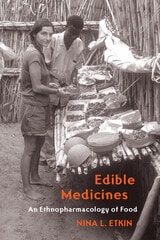
Edible Medicines
An Ethnopharmacology of FoodNina L. Etkin
University of Arizona Press, 2006
This book investigates the health implications of foods from the cuisines of peoples around the world to describe the place of food in health maintenance. In this wide-ranging book, Nina Etkin reveals the pharmacologic potential of foods in the specific cultural contexts in which they are used. Incorporating co-evolution with a biocultural perspective, she addresses some of the physiological effects of foods across cultures and through history while taking into account both the complex dynamics of food choice and the blurred distinctions between food and medicine. Showing that food choice is more closely linked to health than is commonly thought, she helps us to understand the health implications of people’s food-centered actions in the context of real-life circumstances.
Drawing on an extensive literature that transects food and culture, the history of medicine, ethnopharmacology, food history, nutrition, and human evolution, Edible Medicines demonstrates the intricate relationship between culture and nature. It will appeal to a wide range of scholars and professionals, from anthropologists to nutritionists, as well as general readers seeking a greater understanding of the medicinal aspects of food.
Future Medicine
Ethical Dilemmas, Regulatory Challenges, and Therapeutic Pathways to Health Care and Healing in Human TransformationMichael H. Cohen
University of Michigan Press, 2002
Healing Powers
Alternative Medicine, Spiritual Communities, and the StateFred M. Frohock
University of Chicago Press, 1992
"Frohock goes beyond the often irreconcilable differences between scientific biomedicine and alternative care by clarifying the social and legal dilemmas they present. . . . A noteworthy contribution forcing us to rethink what medical care is all about."—Jeffrey Michael Clare, Journal of the American Medical Association
"The book does more and better than simply provide a social-scientific proposal. It also gives not only a hearing but a voice to those who follow alternative therapies. . . . Frohock's accounts of their stories—along with the stories of the medical professionals—are eloquent and fascinating."—Allen Verhey, Medical Humanities Review
"Contains a storehouse of valuable information about the historical, philosophical, and psychological bases of alternative approaches to healing."—Marshall B. Kapp, New England Journal of Medicine
"Frohock introduces us to the scientific naturopaths and to physicians who believe in the mind's power to heal, to charismatics who believe in but cannot explain their powers, to those who test God and those who merely accept. He writes so well that I felt I had met these people."—Arthur W. Frank, Christian Century
Other-Worldly
Making Chinese Medicine through Transnational FramesMei Zhan
Duke University Press, 2009
Whether discussing the presentation of Chinese medicine at a health fair sponsored by a Silicon Valley corporation, or how the inclusion of a traditional Chinese medicine clinic authenticates the “California” appeal of an upscale residential neighborhood in Shanghai, Zhan emphasizes that unexpected encounters and interactions are not anomalies in the structure of Chinese medicine. Instead, they are constitutive of its irreducibly complex and open-ended worlds. Zhan proposes an ethnography of “worlding” as an analytic for engaging and illuminating emergent cultural processes such as those she describes. Rather than taking “cultural difference” as the starting point for anthropological inquiries, this analytic reveals how various terms of difference—for example, “traditional,” “Chinese,” and “medicine”—are invented, negotiated, and deployed translocally. Other-Worldly is a theoretically innovative and ethnographically rich account of the worlding of Chinese medicine.
Ritual Healing in Surburban America
McGuire, Meredith
Rutgers University Press, 1988

The Medical Library Association Guide to Finding Out about Complementary and Alternative Medicine
The Best Print and Electronic ResourcesAmerican Library Association, 2010