Results by title
20 books match the query 'Altruism'
Africa
A Practical Guide for Global Health WorkersEdited by Laurel A. Spielberg and Lisa V. Adams
Dartmouth College Press, 2011
Altruism, Morality, and Economic Theory
Edmund S. Phelps
Russell Sage Foundation, 1975
Altruistically Inclined?
The Behavioral Sciences, Evolutionary Theory, and the Origins of ReciprocityAlexander J. Field
University of Michigan Press, 2004
Altruistically Inclined? examines the implications of recent research in the natural sciences for two important social scientific approaches to individual behavior: the economic/rational choice approach and the sociological/anthropological. It considers jointly two controversial and related ideas: the operation of group selection within early human evolutionary processes and the likelihood of modularity—domain-specific adaptations in our cognitive mechanisms and behavioral predispositions.
Experimental research shows that people will often cooperate in one-shot prisoner's dilemma (PD) games and reject positive offers in ultimatum games, contradicting commonly accepted notions of rationality. Upon first appearance, predispositions to behave in this fashion could not have been favored by natural selection operating only at the level of the individual organism.
Emphasizing universal and variable features of human culture, developing research on how the brain functions, and refinements of thinking about levels of selection in evolutionary processes, Alexander J. Field argues that humans are born with the rudiments of a PD solution module—and differentially prepared to learn norms supportive of it. His emphasis on failure to harm, as opposed to the provision of affirmative assistance, as the empirically dominant form of altruistic behavior is also novel.
The point of departure and principal point of reference is economics. But Altruistically Inclined? will interest a broad range of scholars in the social and behavioral sciences, natural scientists concerned with the implications of research and debates within their fields for the conduct of work elsewhere, and educated lay readers curious about essential features of human nature.
Beyond Self-Interest
Edited by Jane J. Mansbridge
University of Chicago Press, 1990
In Beyond Self-Interest, leading social scientists argue for a view of individuals behavior and social organization that takes into account the powerful motivations of duty, love, and malevolence. Economists who go beyond "economic man," psychologists who go beyond stimulus-response, evolutionary biologists who go beyond the "selfish gene," and political scientists who go beyond the quest for power come together in this provocative and important manifesto.
The essays trace, from the ancient Greeks to the present, the use of self-interest to explain political life. They investigate the differences between self-interest and the motivations of duty and love, showing how these motivations affect behavior in "prisoners' dilemma" interactions. They generate evolutionary models that explain how altruistic motivations escape extinction.
They suggest ways to model within one individual the separate motivations of public spirit and self-interest, investigate public spirit and self-interest, investigate public spirit in citizen and legislative behavior, and demonstrate that the view of democracy in existing Constitutional interpretations is not based on self-interest. They advance both human evil and mothering as alternatives to self-interest, this last in a penetrating feminist critique of the "contract" model of human interaction.
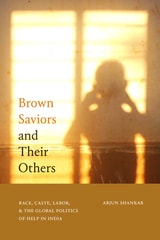
Brown Saviors and Their Others
Race, Caste, Labor, and the Global Politics of Help in IndiaArjun Shankar
Duke University Press, 2023
Historicity of Nature
Essays on Science and TheologyWolfhart Pannenberg
Templeton Press, 2008
Known as one of the most outstanding theologians of the twentieth century, Wolfhart Pannenberg is also considered a great interdisciplinary thinker. Now, essays and articles on science and theology that are central to understanding Pannenberg's theories have been collected into one volume.
Niels Henrik Gregersen, a former student of Pannenberg and now professor of systematic theology at Copenhagen University, has compiled the writings in four sections: Methodology, Creation and Nature's Historicity, Religion and Anthropology, and Meaning and Metaphysics. Included in this volume are:
•Translations of Pannenberg's principled argument for the consonance between science and religion, including contingency and laws of nature, field theories and space-time, and divine action•Translations of Pannenberg's theory of theology as a rational hypothetical science, including his discussions with leading British and American scholars such as A. N. Whitehead, John Cobb, and Langdon Gilkey
•Previously unpublished articles on the problems between science and theology in the course of modern history, explaining why chance may be more important for theology than design
•Translations of seminal articles that articulate Pannenberg's understanding of the role of religion in human nature
•One of the few theological articles on aggression as a psychological and social phenomenon
With this collection, the essays of this important contemporary theologian and his illuminating views are presented in one convenient volume.

Last Best Gifts
Altruism and the Market for Human Blood and OrgansKieran Healy
University of Chicago Press, 2006
Last Best Gifts offers a fresh perspective on this ethical dilemma by examining the social organization of blood and organ donation in Europe and the United States. Gifts of blood and organs are not given everywhere in the same way or to the same extent—contrasts that allow Kieran Healy to uncover the pivotal role that institutions play in fashioning the contexts for donations. Procurement organizations, he shows, sustain altruism by providing opportunities to give and by producing public accounts of what giving means. In the end, Healy suggests, successful systems rest on the fairness of the exchange, rather than the purity of a donor’s altruism or the size of a financial incentive.

Laughing Saints and Righteous Heroes
Emotional Rhythms in Social Movement GroupsErika Summers Effler
University of Chicago Press, 2010
To explore these questions, Erika Summers Effler undertook three years of ethnographic fieldwork with two groups: anti–death penalty activists STOP and the Catholic Workers, who strive to alleviate poverty. In both communities, members must contend with problems that range from the broad to the intimately personal. Adverse political conditions, internal conflict, and fluctuations in financial resources create a backdrop of daily frustration—but watching an addict relapse or an inmate’s execution are much more devastating setbacks. Summers Effler finds that overcoming these obstacles, recovering from failure, and maintaining the integrity of the group require a constant process of emotional fine-tuning, and she demonstrates how activists do this through thoughtful analysis and a lucid rendering of their deeply affecting stories.
Research On Altruism & Love
An Annotated Bibliography of Major Studies in Psychology, Sociology, Evolutionary Biology, and TheologyStephen Post
Templeton Press, 2003
Research on Altruism and Love is a compendium of annotated bibliographies reviewing literature and research studies on the nature of love. An essay introduces each of the annotated bibliographies.
A variety of literature directly related to science-and-love issues or supporting those issues is covered in the Religious Love Interfaces with Science section. This annotated bibliography is unique in that it approaches the field from a decidedly religious perspective. It includes classical expositions of love that continue to influence contemporary scholars, including Platos' work on eros, the work and words of Jesus, Aristotle, Augustine of Hippo, Martin Luther, Kierkegaard, and Ghandi, among others. The contemporary discussion includes Anders Nygren's theological arguments in his classic, Agape and Eros; Pitirim Sorokin; and others. An issue that often emerges in this literature is the question of the nature and definition of love.
A second annotated bibliography features current empirical research in the field of Personality and Altruism, with a focus on social psychology. Among the topics covered are the altruistic personality, altruistic behavior, empathy, helping behavior, social responsibility, and volunteerism. Methodologies are diverse, and studies include experiments, local and national surveys, naturalistic observation, and combinations of these.
The Evolutionary Biology annotated bibliography covers the most significant works on altruism and love in the field of biology and evolutionary psychology.
The fourth and final annotated bibliography in this volume is entitled Sociology of Faith-Based Volunteerism. Here the focus is on literature on the interface of helping behavior and religious organizations, as well as major pieces on voluntary associations.

Saints and Postmodernism
Revisioning Moral PhilosophyEdith Wyschogrod
University of Chicago Press, 1990
"A 'must' for readers interested in the borderlands between philosophy, hagiography, and ethics."—Mark I. Wallace, Religious Studies Review
Selfishness, Altruism, and Rationality
Howard Margolis
University of Chicago Press, 1984
"Howard Margolis's intriguing ideas . . . provide an alternative to the crude models of rational choice that have dominated economics and political science for too long."—Times Literary Supplement
Signaling Goodness
Social Rules and Public ChoicePhillip J. Nelson and Kenneth V. Greene
University of Michigan Press, 2003

Tangled Goods
The Practical Life of Pro Bono AdvertisingIddo Tavory, Sonia Prelat and Shelly Ronen
University of Chicago Press, 2022
The advertising industry may seem like one of the most craven manifestations of capitalism, turning consumption into a virtue. In Tangled Goods, authors Iddo Tavory, Sonia Prelat, and Shelly Ronen consider an important dimension of the advertising industry that appears to depart from the industry’s consumerist foundations: pro bono ad campaigns. Why is an industry known for biting cynicism and cutthroat competition also an industry in which people dedicate time and effort to “doing good”?
Interviewing over seventy advertising professionals and managers, the authors trace the complicated meanings of the good in these pro bono projects. Doing something altruistic, they show, often helps employees feel more at ease working for big pharma or corporate banks. Often these projects afford them greater creative leeway than they normally have, as well as the potential for greater recognition. While the authors uncover different motivations behind pro bono work, they are more interested in considering how various notions of the good shift, with different motivations and benefits rising to the surface at different moments. This book sheds new light on how goodness and prestige interact with personal and altruistic motivations to produce value for individuals and institutions and produces a novel theory of the relationship among goods: one of the most fraught questions in sociological theory.
The Altruism Reader
Selections from Writings on Love, Religion, and ScienceThomas Oord
Templeton Press, 2007
This anthology brings together, for the first time, leading essays and book chapters from theologians, philosophers, and scientists on their research on ethics, altruism, and love. Because the general consensus today is that scholarship in moral theory requires empirical research, the arguments of the leading scholars presented in this book will be fundamental to those examining issues in love, ethics, religion, and science.
The first half of The Altruism Reader offers essential selections from religious texts, leading contemporary scholars, and cutting-edge ethicists. Buddhism, Christianity, Hinduism, Islam, and Judaism are represented. Among the highly respected writers are Thomas Aquinas, the Dalai Lama, Thich Nhat Hanh, John Polkinghorne, Stephen Pope, Louis Fischer, Amira Shamma Abdin, Katharine Doob Sakenfeld, and Daniel Day Williams.
The book’s second half features primary readings on love and altruism from the sciences. Here the focus is on anthropology, psychology, sociology, biology, and neurology, with material written by Daniel C. Batson, David Sloan Wilson, Robert Wright, Stephen G. Post, Robert Axelrod, Richard Dawkins, Holmes Rolston III, and other renowned scientists and philosophers.
“Virtually all people act—and often talk—as if they have some clue about love. We speak about loving food, falling in love, loving God, feeling loved, and loving a type of music. We say that love hurts, love waits, love stinks, and love means never having to say you’re sorry. We use the word and its derivatives in a wide variety of ways . . . . My definition of love is this: To love is to act intentionally, in sympathetic response to others (including God), to promote well-being.” —Thomas Jay Oord
The Altruistic Species
Scientific, Philosophical, and Religious Perspectives of Human BenevolenceAndrew Michael Flescher
Templeton Press, 2008
What motivates altruism? How essential is the phenomenon of altruism to the human experience? Is altruism readily accessible to the ordinary person? In The Altruistic Species, Andrew Michael Flescher and Daniel L. Worthen explore these questions through the lenses of four disciplinary perspectives—biology, psychology, philosophy, and religion. In their investigation, they make an extended argument for the existence of altruism against competing theories that construe all ostensible cases of benevolence as self-interest in disguise. The authors consider theories of egoism; the role of genetics and evolutionary biology; the psychological that induce altruistic behavior; philosophical theories of altruism in normative ethics such as Kantian, utilitarian, and Aristotelian models of moral action; and accounts of love of the neighbor in Christianity and Buddhism. Additionally, they offer a new, comprehensive definition of altruism that includes the insights of each of these perspectives.
The Altruistic Species reinvigorates the debate over the prevalence of selfless motivation in human behavior—whether it is a rare or ubiquitous phenomenon—something considered exceptional or a capacity that members of any community could potentially develop. This noteworthy interdisciplinary examination of altruism balances science, virtue theory, and theology. It is ideal for ethics, human behavior, and evolutionary biology courses as an educational resource for other multidisciplinary studies and interested lay readers.
Tissue Economies
Blood, Organs, and Cell Lines in Late CapitalismCatherine Waldby and Robert Mitchell
Duke University Press, 2006
Waldby and Mitchell pull together a prodigious amount of research—involving policy reports and scientific papers, operating manuals, legal decisions, interviews, journalism, and Congressional testimony—to offer a series of case studies based on particular forms of tissue exchange. They examine the effect of threats of contamination—from HIV and other pathogens—on blood banks’ understandings of the gift/commodity relationship; the growth of autologous economies, in which individuals bank their tissues for their own use; the creation of the United Kingdom’s Stem Cell bank, which facilitates the donation of embryos for stem cell development; and the legal and financial repercussions of designating some tissues “hospital waste.” They also consider the impact of different models of biotechnology patents on tissue economies and the relationship between experimental therapies to regenerate damaged or degenerated tissues and calls for a legal, for-profit market in organs. Ultimately, Waldby and Mitchell conclude that scientific technologies, the globalization of tissue exchange, and recent anthropological, sociological, and legal thinking have blurred any strict line separating donations from the incursion of market values into tissue economies.
Toward a Phenomenological Rhetoric
Writing, Profession, and AltruismBarbara Couture
Southern Illinois University Press, 1998
Current rhetorical and critical theory for the most part separates writing from consciousness and presumes relative truth to be the only possible expressive goal for rhetoric. These presumptions are reflected in our tradition of persuasive rhetoric, which values writing that successfully argues one person’s belief at the expense of another’s. Barbara Couture presents a case for a phenomenological rhetoric, one that values and respects consciousness and selfhood and that restores to rhetoric the possibility of seeking an all-embracing truth through pacific and cooperative interaction.
Couture discusses the premises on which current interpretive theory has supported relative truth as the philosophical grounding for rhetoric, premises, she argues, that have led to constraints on our notion of truth that divorce it from human experience. She then shows how phenomenological philosophy might guide the theory and practice of rhetoric, reanimating its role in the human enterprise of seeking a shared truth. She proposes profession and altruism as two guiding metaphors for the phenomenological activity of "truth-seeking through interaction."
Among the contemporary rhetoricians and philosophers who influence Couture are Pierre Teilhard de Chardin, Martin Buber, Charles Altieri, Charles Taylor, Alasdair Maclntyre, and Jürgen Habermas.
Unexpected Grace
Stories of Faith, Science, and AltruismBill Kramer
Templeton Press, 2007
In Unexpected Grace Bill Kramer offers a rare look into the human side of the world of scientific research. He goes behind the scenes of four scientific investigations on diverse aspects of the study of unlimited love and offers uplifting portraits of human beings struggling to understand and improve the complex issues facing them. He explores the dynamics between the researchers, the subjects they study, and the participants in the studies, and eloquently tells their personal stories. The stories touch on vastly different social and human issues, but all are connected by love.
The third study, from Case Western Reserve University in Cleveland, focused on the benefits of religion on mental and physical health, which led its researcher to a greater understanding of forgiveness, humility, and grace. The final powerful story is about a physiology of love study conducted in Iowa City. Here, a functional MRI is the vehicle for measuring empathy and brings the researcher to wonder, "Is there a point at which empathy shuts down and we turn away?" Ultimately she comes to recognize that past experiences influences our ability to respond emphatically.
Unlimited Love
Altruism, Compassion, and ServiceStephen G. Post
Templeton Press, 2003
What if we could prove that love heals mental illness and is vital to successful therapeutic outcomes in all areas of health care? What if we could prove that people who live more for others than for self have greater psychological well-being?
Ways & Power Of Love
Techniques Of Moral TransformationPitirim A. Sorokin
Templeton Press, 2002
The Ways and Power of Love was originally published in 1954 when Pitirim Sorokin was in the twilight of his career and leading the Harvard Research Center in Creative Altruism. His elaborate scientific analysis of love with regard to its higher and lower forms, its causes and effects, its human and cosmic significance, and its core features constitutes the first study on this topic in world literature to date.
Sorokin was the one absolutely essential twentieth-century pioneer in the study of love at the interface of science and religion. Bringing The Ways and Power of Love back into print allows a new generation of readers to appreciate Sorokin's genius and to move forward with his endeavor at a time when civilization itself continues to be threatened by a marked inability to live up to the ideal of love for all humankind. It is certainly right to hope, with Sorokin, that progress in knowledge about love can move humanity forward to a better future. Turning the sciences toward the study of love is no easy task, but it can and must be done.