Results by title
7 books match the query 'Always'
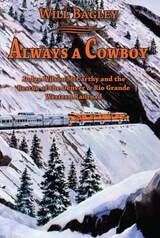
Always a Cowboy
Judge Wilson McCarthy and the Rescue of the Denver & Rio Grande Western RailroadWill Bagley
Utah State University Press, 2008
Cowboy, judge, federal official, then business executive, Wilson McCarthy mirrored change and growth in the twentieth-century West. Leading the Denver & Rio Grande back from the brink saved a vital link in the national transportation system. The D&RGW ran over and through the scenic Rockies, developing mineral resources, fighting corporate wars, and helping build communities. The Depression brought it to its knees. Accepting federal assignment to save the line, McCarthy turned it into a paragon of mid-century railroading, represented by the streamlined, Vista-Domed California Zephyr, although success hauling freight was of more economic importance. Prior to that, McCarthy’s life had taken him from driving livestock in Canada to trying to drive the national economy as a director of the Reconstruction Finance Corporation, the first line of federal attack on the Depression. Always a Cowboy positions McCarthy’s story in a rich historical panorama..
Will Bagley is the author of Blood of the Prophets: Brigham Young and the Massacre at Mountain Meadows
Always an Academic Immigrant
A Collective MemoirDafna Lemish
Rutgers University Press, 2025
Always an Academic Immigrant is a collective memoir that gives voice to eighty-one academics who immigrated from thirty-seven countries for a career in an institution of higher education, in either the United States or one of ten other countries. Through in-depth interviews and observations from her own experiences as an immigrant scholar, Dafna Lemish shares the highs and the lows that academic immigrants feel as they search for both a country and an institution they can call home. She discovers the formative events that led these scholars to pursue careers outside their native lands and details the challenges they faced adapting to unspoken expectations in their new countries and workplaces. Ultimately, this book reveals the strategies that immigrant professors use to bridge their native and adoptive cultures while highlighting the vital contributions they have made to academia as scholars, teachers, and leaders.
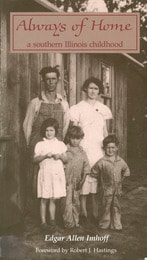
Always of Home
A Southern Illinois ChildhoodEdgar Allen Imhoff. Foreword by Robert J. Hastings
Southern Illinois University Press, 1992
Edgar Allen Imhoff renders a series of touching, colorful vignettes about growing up in southern Illinois during the Great Depression. He writes poignantly of his family and their struggles (including his father’s exhausting but successful effort at self-education) as he revisits his early childhood years in the country and his eventual move to the town of Murphysboro, where he encountered school bullies, outstanding teachers, first love, World War II, and adolescence.
Imhoff contrasts these memories of his youth with events, incidents, and thoughts from his more recent past. While writing a government check with six figures to the left of the decimal, he remembers how his mother once scrounged together thirty cents so Imhoff and his brother and sister could go to the circus with their classmates. Listening to President Carter give a speech in the Rose Garden reminds him of the contrasting elocutionary style of the Reverend William Boatman, the pastor at his country church, which was built by Imhoff’s great-great-grandfather and others.
Through such contrasts, Imhoff not only paints a loving picture of his past, he also comments on the alienation and emptiness that mark many lives in the United States, especially those of modern nomads. Imhoff has himself become a nomad, living far from the land of his birth, enjoying a successful and rewarding career. Yet he is drawn repeatedly to his past, his family, his childhood home, and the intricate combination of events, attitudes, values, and loyalties that influenced and molded him.
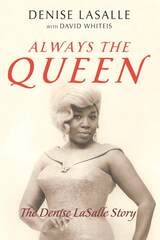
Always the Queen
The Denise LaSalle StoryDenise LaSalle, with David Whiteis
University of Illinois Press, 2020
As honest and no-nonsense as the artist herself, Always the Queen is LaSalle's in-her-own-words story of a lifetime in music. Moving to Chicago as a teen, LaSalle launched a career in gospel and blues that eventually led to the chart-topping 1971 smash ”Trapped by a Thing Called Love” and a string of R&B hits. She reinvented herself as a soul-blues artist as tastes changed and became a headliner on the revitalized southern soul circuit and at festivals nationwide and overseas. Revered for a tireless dedication to her music and fans, LaSalle continued to tour and record until shortly before her death.

Hold Dear, As Always
Jette, a German Immigrant Life in LettersAdolf E. Schroeder and Carla Schulz-Geisberg
University of Missouri Press, 1988
Henriette Geisberg Bruns was twenty-three when she arrived in 1836 at the isolated Westphalia Settlement in central Missouri with her husband, baby son, two brothers, and a maid. Jette, as she was known to her family and friends, had not come to America by inclination, but from duty. Her husband Bernhard, a physician, had fallen victim to the emigration fever sweeping Germany in the 1830s and was convinced that he could provide a better life for his family in the American Free States where land was plentiful, the soil was fertile, and taxes were low. Born into a large, prosperous, closely knit family, Jette had set out for the New World reluctantly; but once in Missouri, she was determined not to give up and go back home, as a neighboring family did.
Although she maintained her resolve, this collection of letters written to her family in Germany shows that her life in America was often beset by deprivation, disease, and loneliness. Jette had been persuaded to emigrate for the sake of her children’s future; however, of the ten born in central Missouri, five died in childhood, three within three weeks in September and October 1841.Despite the family responsibilities and the hardships she faced in Missouri, Jette maintained a lively interest in American political and social life. For fifteen years in Westphalia and almost fifty in Jefferson City and St. Louis, she observed and offered astute—if sometimes acerbic—commentary on the historic as well as the daily events of nineteenth-century life. Left destitute by the death of her husband, who had served as mayor of Jefferson City during the Civil War, she opened a boarding-house in her home across from the state capitol to support her own children and those of her brother. There the German radicals in state government gathered to argue and debate.This rare collection of personal family letters, combined with an autobiographical sketch Jette wrote after the Civil War, illuminates the experience of one immigrant woman in a land that was always foreign to her.
Joe T. Robinson
Always a Loyal DemocratCecil Weller
University of Arkansas Press, 1998
Senate majority leader Joseph Taylor Robinson was undoubtedly one of the most powerful U.S. senators of the early twentieth century. An important political figure in Arkansas from the time he was elected to the state legislature in 1895, Joe T., as he was popularly called became nationally prominent when he ascended to the Democratic leadership of the U.S. Senate in 1923.
Robinson’s career spanned momentous legislative debates in the chambers of the Senate, such as the League of Nations charter, the Teapot Dome Scandal, and FDR’s plan to “pack” the Supreme Court. His run for the vice-presidency in 1928, the first Southerner on a major ticket after the Civil War, and his three terms as chairman of the Democratic National Convention, in 1920, 1928, and 1936, are all covered in this perceptive study.
Never on Time, Always in Time
Narrative Form and the Queer SensoriumKate McCullough
The Ohio State University Press, 2024