Results by title
3 books match the query 'Amadon, Samuel'
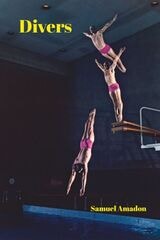
Divers
Samuel Amadon
Omnidawn, 2026
Marking a formal reinvention for the poet, this collection addresses the strangeness of time, blending writers and images from the past with contemporary scenes.
This book-length sequence of turbulent sonnets follows their speaker's impulses and imagination through the seasons of their composition. Written between 2016 and 2022, Divers is a collection shaped by contradiction and marks a new period of lyric experimentation for poet Sam Amadon. These poems are rigorously constrained while also making space for improvisation. They hold to a decasyllabic line while moving in and out of meter. They sing of time, and struggle to understand it. They find words for our moment in the pages of old books. Lines from great writers of the past—including Gerard Manley Hopkins, Thomas Wyatt, and Michael Drayton—echo through Amadon's poems of contemporary menace and wonder. Here we see both the owls lining our fences and the black SUVs rolling down our streets. Out of these conflicts, Amadon’s sonnets step up, lift off, and dive into themselves.
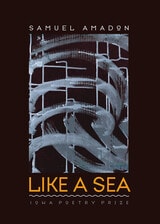
Like a Sea
Samuel Amadon
University of Iowa Press, 2010
Drawing equally from Wallace Stevens, Gertrude Stein, John Berryman, and Robert Frost, Samuel Amadon’s award-winning Like a Sea is a collection of poems where personality is foregrounded and speech is both bizarre and familiar. Central to this weirdly talky work is “Each H,” a sequence of eleven monologues and dialogues wherein an unknown number of speakers examine their collective and singular identities while simultaneously distorting them. From a sequence of pared-down sonnets to a more traditional lyric to a procedural collage inspired by J. D. Salinger, Ezra Pound, Robert Lowell, Walter Benjamin, Jane Kenyon, Joris-Karl Huysmans, Primo Levi, Eugenio Montale, and Edwin Arlington Robinson, Like a Sea is a book of significant variation and originality.
Amadon’s electric collection begins with the line “I could not sound like anyone but me,” and through a wide range of forms and styles and voices he tests the true limits of that statement. The image of a half-abandoned Hartford, Connecticut, remains in the background of these poems, casting a tone of brokenness and haplessness. Ultimately Amadon’s poems present the confusion and fear of the current moment, of Stevens’s “river that flows nowhere, like a sea,” equally alongside its joyful ridiculousness and possibility. Rather than create worlds, they point out what a strange world already exists.
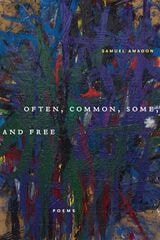
Often, Common, Some, and Free
Samuel Amadon
Omnidawn, 2021
This is a book about transformation. Moving across varied formal and aesthetic terrains, these poems take on the subject of change, considering the construction and demolition of buildings, roaming between cities, and drawing together an image of a world in flux. The speaker is in movement—walking, flying, swimming, and taking the train, while also constantly twisting in his sentences, turning into different versions of himself, and braiding his voice with others. These poems take on subjects that encompass creation and loss from Robert Moses’s career transforming the cityscape of New York to the robbery of works from Boston’s Gardner Museum. But, ultimately, these poems aim to resist destruction, to focus on the particular, and to hold still their world and their ever-shifting speaker.