Results by title
7 books match the query 'American States'
Democratic Laboratories
Policy Diffusion among the American StatesAndrew Karch
University of Michigan Press, 2010
"Observers have long marveled at the spread of ideas and policies from state to state in American democracy. But why and how do politicians, professionals, and citizens in one state take inspiration from national policy debates and imitate, resist, and rework legislative models from other states? For the first time in this important new book, Andrew Karch analyzes in depth the process of policy 'diffusion' across the states, offering a nuanced and powerful framework to explain one of the most important and recurrent features of U.S. politics."
---Theda Skocpol, Victor S. Thomas Professor of Government and Sociology, Harvard University
"Karch does two things with remarkable skill. First, he makes sense of the copious literature on policy diffusion and extends that literature in a very fruitful way. Second, he conducts the most thorough and methodologically sound empirical study of policy diffusion to date, using both qualitative and quantitative analysis. This book is so well written and thoughtful that it will likely stimulate a whole new wave of study of state policy and its diffusion."
---Chris Mooney, editor of State Politics and Policy Quarterly
"Democratic Laboratories goes beyond standard 'diffusion of innovation' approaches to analyze the complex interaction of interstate and intrastate political forces that shapes policy change. The book is a major contribution to the study of American federalism---and a very good read."
---Kent Weaver, Brookings Institution
---Virginia Gray, University of North Carolina, Chapel Hill
"Democratic Laboratories is the seminal work on policy diffusion among the American states. Rigorously designed and well written, it is the new starting place for anyone interested in this important topic. The findings are copious and loaded with insights into the future of this valuable research."
---Harrell Rodgers, Professor and Chair, Department of Political Science, University of Houston
Andrew Karch is Assistant Professor of Government at the University of Texas at Austin.
Dynamic Democracy
Public Opinion, Elections, and Policymaking in the American StatesDevin Caughey and Christopher Warshaw
University of Chicago Press, 2022
Scholars of American politics have long been skeptical of ordinary citizens’ capacity to influence, let alone control, their governments. Drawing on over eight decades of state-level evidence on public opinion, elections, and policymaking, Devin Caughey and Christopher Warshaw pose a powerful challenge to this pessimistic view. Their research reveals that although American democracy cannot be taken for granted, state policymaking is far more responsive to citizens’ demands than skeptics claim.
Although governments respond sluggishly in the short term, over the long term, electoral incentives induce state parties and politicians—and ultimately policymaking—to adapt to voters’ preferences. The authors take an empirical and theoretical approach that allows them to assess democracy as a dynamic process. Their evidence across states and over time gives them new leverage to assess relevant outcomes and trends, including the evolution of mass partisanship, mass ideology, and the relationship between partisanship and ideology since the mid-twentieth century; the nationalization of state-level politics; the mechanisms through which voters hold incumbents accountable; the performance of moderate candidates relative to extreme candidates; and the quality of state-level democracy today relative to state-level democracy in other periods.
Educated by Initiative
The Effects of Direct Democracy on Citizens and Political Organizations in the American StatesDaniel A. Smith and Caroline J. Tolbert
University of Michigan Press, 2004
--Kristina Wilfore, Executive Director, Ballot Initiative Strategy Center and Foundation
Educated by Initiative moves beyond previous evaluations of public policy to emphasize the educational importance of the initiative process itself. Since a majority of ballots ultimately fail or get overturned by the courts, Smith and Tolbert suggest that the educational consequences of initiative voting may be more important than the outcomes of the ballots themselves. The result is a fascinating and thoroughly-researched book about how direct democracy teaches citizens about politics, voting, civic engagement and the influence of special interests and political parties. Designed to be accessible to anyone interested in the future of American democracy, the book includes boxes (titled "What Matters") that succinctly summarize the authors' data into easily readable analyses.
Daniel A. Smith is Associate Professor of Political Science at the University of Florida.
Caroline J. Tolbert is Associate Professor of Political Science at Kent State University.

Monopoly Rule
Party Government in the American StatesJanine A. Parry and Zoe Nemerever
University of Michigan Press, 2027
As the high drama of national elections keeps watchers on the edge of their seats, a different phenomenon altogether characterizes the politics of the American states: long-term one-party monopolies. Widely (and wrongly) assumed to be specific to the South, one-party domination is as ubiquitous as it is consequential. Monopoly Rule documents the startling pervasiveness of state party monopolies since the 1930s.
Even in the “battleground states” of recent presidential elections, Janine A. Parry and Zoe Nemerever make the case that one party or the other usually holds a large and enduring advantage outside the presidential contest. Using a novel State Party Control Index, the authors demonstrate the troubling effects of these partisan juggernauts, including upticks in elite malfeasance, voter complacency, and democratic backsliding. Despite the renewed willingness of contemporary party elites to advance their electoral success by rigging the rules, Monopoly Rule argues that contemporary state and local experiments in ranked choice voting, independent redistricting, and campaign finance reform offer options for reinvigorating the health of American democracy.
State Constitutional Politics
Governing by Amendment in the American StatesJohn Dinan
University of Chicago Press, 2018
With State Constitutional Politics, John Dinan looks at the various occasions in American history when state constitutional amendments have served as instruments of governance. Among other things, amendments have constrained state officials in the way they levy taxes and spend money; enacted policies unattainable through legislation on issues ranging from minimum wage to the regulation of marijuana; and updated understandings of rights, including religious liberty, equal protection, and the right to bear arms. In addition to comprehensively chronicling the ways amendments shape politics in the states, Dinan also assesses the consequences of undertaking changes in governance through amendments rather than legislation or litigation. For various reasons, including the greater stability and legitimacy of changes achieved through the amendment process, he argues that it might be a more desirable way of achieving change.
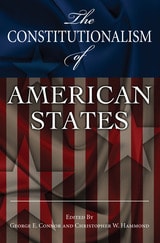
The Constitutionalism of American States
Edited by George E. Connor & Christopher W. Hammons
University of Missouri Press, 2008
This comparative study of American state constitutions offers insightful overviews of the general and specific problems that have confronted America’s constitution writers since the founding. Each chapter reflects the constitutional history and theory of a single state, encompassing each document’s structure, content, and evolution.
The text is grounded in the model presented by constitutional scholar Donald S. Lutz in The Origins of American Constitutionalism so that even when a state has a relatively stable constitutional history, Lutz’s framework can be used to measure the evolving meaning of the document. With contributors drawn from state governments as well as academia, this is the first work to offer a framework by which state constitutions can be analyzed in relation to one another and to the federal Constitution.
The volume begins with chapters on the New England, Mid-Atlantic, Border, and Southern states. While regional similarities within and between the New England and Mid-Atlantic states are noteworthy, the colonial aspect of their history laid the foundation for national constitution-making. And while North and South moved in distinct directions, the Border states wrestled with conflicting constitutional traditions in the same way that they wrestled with their place in the Union.
Southern states that seceded are shown to have had a common set of problems in their constitutions, and the post–Civil War South emerged from that conflict with a constitutionalism that was defined for it by the war’s victors. These chapters reveal that constitutional self-definition, while not evident in all of the former Confederate states, has redeveloped in the South in the intervening 140 years.
Sections devoted to the Midwest, the Plains, the Mountain West, the Southwest, and the West reflect the special circumstances of states that arose from American expansion. Chapters describe how states of the Midwest, united by common roots in the Northwest Ordinance, wrote constitutions that were defined by that act’s parameters while reflecting the unique cultural and political realities of each state. Meanwhile, the Plains states developed a constitutionalism that was historically rooted in progressivism and populism, sometimes in the clash between these two ideologies.
Perhaps more than any other region, the Mountain West was defined by the physical landscape, and these chapters relate how those states were able to define their individual constitutional identities in spite of geography rather than because of it. And although western states borrowed heavily from those with much older constitutional traditions, the contributors reveal that they borrowed differently—and in different proportions—in order to craft constitutions that were uniquely adapted to their historical situation and peoples.
This work demonstrates the diversity of our governmental arrangements and provides a virtual introduction to the political culture of each—many offering stories of constitutional foundings that are rich with meaning. Although these fifty documents are defined in a federal context, state constitutions are necessary to complete the constitutionalism of the United States.

Where Women Run
Gender and Party in the American StatesKira Sanbonmatsu
University of Michigan Press, 2010
“Kira Sanbonmatsu has done a masterful job of linking the representation of women in elective office to the activities of party organizations in the states. She combines qualitative and quantitative data to show how women are navigating the campaign process to become elected leaders and the changing role of party organizations in their recruitment and election. It is a significant contribution to the study of representative democracy.”
--Barbara Burrell, Northern Illinois University
“Sanbonmatsu has produced an excellent study that will invigorate research on the role of political parties and the recruitment of women candidates. Using a variety of methods and data sources, she has crafted a tightly constructed, clearly argued, and exceedingly well-written study. A commendable and convincing job.”
--Gary Moncrief, Boise State University
“Sanbonmatsu offers important insights in two neglected areas of American politics: the role of political parties in recruiting candidates and the continued under-representation of women in elected office. Connecting the two subjects through careful qualitative and statistical methods, insightful interpretation of the literature and interesting findings, the book is a significant new addition to scholarship on parties, gender, and political recruitment.”
--Linda Fowler, Dartmouth College
Kira Sanbonmatsu is Associate Professor of Political Science at Rutgers University and Senior Scholar at the Eagleton Institute of Politics’ Center for American Women and Politics (CAWP). She was previously associate professor at Ohio State University. She is the author of Democrats, Republicans, and the Politics of Women’s Place.