Results by title
10 books match the query 'American wit and humor, Pictorial'
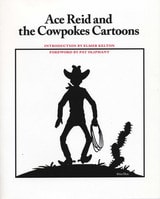
Ace Reid and the Cowpokes Cartoons
By Ace Reid
University of Texas Press, 1999
Winner, Mitchell A. Wilder Award for Publication Design, Texas Association of Museums
Folks across the West know a cowpoke named Jake. A good-hearted guy, he's always up to his eyebrows in debt or drought or prickly pears looking for them dad-blamed ole wild cows. In fact, he's so real a fella that it's hard to believe that Ace Reid made him up.
This book brings together 139 of Ace Reid's popular "Cowpokes" cartoons, reproduced in large format to show the artistry and attention to detail that characterized Reid's work. Grouped around themes such as work, weather, bankers, and friends, they reveal the distinctive "you might as well laugh as cry" sense of humor that ranch folks draw on to get through hard work and hard times.
In the foreword, Washington Post cartoonist Pat Oliphant offers an appreciation of Reid's "Cowpokes" cartoons, noting that "Ace's work has a magic of its own, and it owes nothing to anyone else." Reid's longtime friend Elmer Kelton recounts Ace's life and career in the introduction, describing how a shy boy who grew up on ranch work transformed himself into an artist-entrepreneur who never met a stranger and who made ranch work the subject of his real love, cartooning. This collector's volume belongs on the shelf of everyone who loves the "Cowpokes" cartoons, knows a fella like Jake, or enjoys the dry wit of the American cowboy.
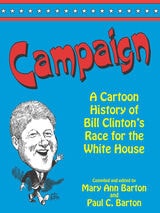
Campaign
A Cartoon History of Bill Clinton's Race for the White HouseMary Ann Barton
University of Arkansas Press, 1993
For many people, in the United States and abroad, the dramas of the campaign created the character of Clinton. From the Gennifer Flowers debacle to Clinton’s
resurrection at the Democratic National Convention and the triumph of the election win, the incisive cartoons in this collection capture Clinton’s emerging image in a way that no written word can. The forty-five contributing artists use these cartoons to depict the breathtaking and colorful events that only a presidential campaign can produce and offer hours of entertainment for any reader.

Freudian Slips
Cartoons on PsychologySidney Harris
Rutgers University Press, 1997
Graphic Opinions
Editorial Cartoonists and Their ArtJack Colldeweih
University of Wisconsin Press, 1998
calling.
The editors examine the current work and opinions of two dozen prominent cartoonists through profiles and essays about political and social issues. Four examples by each cartoonist illustrate this.
Latin America in Caricature
By John J. Johnson
University of Texas Press, 1993
“Not many readers will thank the author as he deserves, for he has told us more about ourselves than we perhaps wish to know,” predicted Latin America in Books of Latin America in Caricature—an exploration of more than one hundred years of hemispheric relations through political cartoons collected from leading U.S. periodicals from the 1860s through 1980.
The cartoons are grouped according to recurring themes in diplomacy and complementing visual imagery. Each one is accompanied by a lengthy explanation of the incident portrayed, relating the drawing to public opinion of the day. Johnson’s thoughtful introduction and the comments that precede the individual chapters provide essential background for understanding U.S. attitudes and policies toward Latin America.
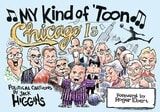
My Kind of 'Toon, Chicago Is
Political CartoonsJack Higgins
Northwestern University Press, 2009
An institution at the Chicago Sun-Times, his home paper for more than twenty–five years, Pulitzer Prize-winning editorial cartoonist Jack Higgins gathers for the first time in My Kind of ’Toon (Chicago Is) approximately 250 editorial and political cartoons. Over the years, he has filed syndicated cartoons from the Soviet Union, Hungary, Ireland, and Cuba. From his front-row seat he has lately focused on the highs and lows of the Chicago and Illinois politics that produced both the first African American president and a string of corrupt gubernatorial administrations.
Philip Guston's Poor Richard
Debra Bricker Balken
University of Chicago Press, 2001
A visual narrative of Nixon's life, the drawings trace Nixon from his childhood, through his ascent to power, to his years in the White House. They incorporate Henry Kissinger (a pair of glasses), Spiro Agnew (a cone-head), and John Mitchell (a dolt smoking a pipe). They depict Nixon and his cohorts in China, plotting strategy in Key Biscayne, and shamelessly pandering to African Americans, hippies, and elderly tourists.
As Balken discusses in her accompanying essay, these drawings also reflect a dramatic transformation in Guston's work. In response to social unrest and the Vietnam War, he began to question the viability of a private art given to self-expression. His betrayal of aesthetic abstraction in favor of imagery imbued with personal and political meaning largely engendered the renewal of figuration in painting in America in the 1970s. These drawings not only represent one of the few instances of an artist in the late twentieth century engaging caricature in his work, they are also a witty, acerbic take on a corrupt figure and a scandalous political regime.
Singular Sensations
A Cultural History of One-Panel Comics in the United StatesMichelle Ann Abate
Rutgers University Press, 2024
Shortlisted for the 2024 Eisner Award for Best Academic/Scholarly Book
What do The Family Circus, Ziggy, and The Far Side have in common? They are all single-panel comics, a seemingly simple form that cartoonists have used in vastly different ways.
Singular Sensations is the first book-length critical study to examine this important but long-neglected mode of cartoon art. Michelle Ann Abate provides an overview of how the American single-panel comic evolved, starting with Thomas Nast’s political cartoons and R.F. Outcault’s groundbreaking Yellow Kid series in the nineteenth century. In subsequent chapters, she explores everything from wry New Yorker cartoons to zany twenty-first-century comics like Bizarro. Offering an important corrective to the canonical definition of comics as “sequential art,” Abate reveals the complexity, artistry, and influence of the single-panel art form.
Engaging with a wide range of historical time periods, sociopolitical subjects, and aesthetic styles, Singular Sensations demonstrates how comics as we know and love them would not be the same without single-panel titles. Abate’s book brings the single-panel comic out of the margins and into the foreground.
The Best of Fisher
28 years of Editorial Cartoons from Faubus to ClintonGeorge Fisher
University of Arkansas Press, 1993
The Last Supper of Chicano Heroes
Selected Works of José Antonio BurciagaJosé Antonio Burciaga; Edited by Mimi R. Goldstein and Daniel Chacón
University of Arizona Press, 2008
Best known for his books Weedee Peepo, Drink Cultura, and Undocumented Love, Burciaga was also a poet, cartoonist, founding member of the comedy troupe Cultura Clash, and a talented muralist whose well-known work The Last Supper of Chicano Heroes became almost more famous than the man. This first and only collection of Burciaga’s work features thirty-eight illustrations and incorporates previously unpublished essays and drawings, including selections from his manuscript “The Temple Gang,” a memoir he was writing at the time of his death. In addition, Gladstein and Chacón address Burciaga’s importance to Chicano letters.
A joy to read, this rich compendium is an important contribution not only to Chicano literature but also to the preservation of the creative, spiritual, and political voice of a talented and passionate man.