Results by title
664 books match the query 'Ancient & Classical' and 92 start with a
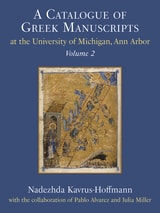
A Catalogue of Greek Manuscripts at the University of Michigan, Ann Arbor, Volume 2
Nadezhda Kavrus-Hoffmann with the collaboration of Pablo Alvarez and Julia Miller
University of Michigan Press, 2026
A Catalogue of Greek Manuscripts at the University of Michigan, Ann Arbor, Volume II unveils the rich diversity and enduring legacy of the Greek manuscript tradition preserved in one of North America's largest collections. Building on the acclaimed first volume, this second and concluding volume offers comprehensive illustrated descriptions of eighty-four manuscripts and fragments housed in the University of Michigan Library's Special Collections Research Center. The discovery of twenty-three previously unknown manuscripts and fragments significantly expands our understanding of Byzantine and post-Byzantine book culture, illuminating the remarkable continuity of Greek scholarly, liturgical, and artistic traditions from the ninth through the nineteenth centuries.
Each entry integrates codicological features, handwriting analysis, textual content, decoration, binding, provenance, and references to earlier scholarship as well as high-quality color plates to illustrate representative pages, script types, and illuminations. Among the exceptional highlights are a fragment of The Great Calculation According to the Indians by Maximos Planoudes, preserving portions of this rare mathematical treatise otherwise lost; an illuminated 1371 copy of The Heavenly Ladder by John Klimax, created by the renowned scribe Joasaph II of the Hodegon Monastery in Constantinople; and a newly identified manuscript containing rare patristic homilies linked to the sixteenth-century Choniates scriptorium in Venice.
A Catalogue of Greek Manuscripts from the Meerman Collection in the Bodleian Library
Annaclara Cataldi Palau
Bodleian Library Publishing, 2011
A Catalogue of Greek Manuscripts from the Meerman Collection in the Bodleian Library
Annaclara Cataldi Palau
Bodleian Library Publishing, 0
A Commentary on Cicero, De Natura Deorum II
Andrew R. Dyck
University of Michigan Press, 2025
A Commentary on Plato's Meno
Jacob Klein
University of Chicago Press, 1989
"A major addition to the literature on the Meno and necessary reading for every student of the dialogue."—Alexander Seasonske, Philosophical Review
"There exists no other commentary on Meno which is so thorough, sound, and enlightening."—Choice
Jacob Klein (1899-1978) was a student of Martin Heidegger and a tutor at St. John's College from 1937 until his death. His other works include Plato's Trilogy: Theaetetus, the Sophist, and the Statesman, also published by the University of Chicago Press.
A Commentary on The Complete Greek Tragedies. Aeschylus
James C. Hogan
University of Chicago Press, 1985
James C. Hogan provides a general introduction to Aeschylean theater and drama, followed by a line-by-line commentary on each of the seven plays. He places Aeschylus in the historical, cultural, and religious context of fifth-century Athens, showing how the action and metaphor of Aeschylean theater can be illuminated by information on Athenian law athletic contests, relations with neighboring states, beliefs about the underworld, and countless other details of Hellenic life. Hogan clarifies terms that might puzzle modern readers, such as place names and mythological references, and gives special attention to textual and linguistic issues: controversial questions of interpretation; difficult or significant Greek words; use of style, rhetoric, and commonplaces in Greek poetry; and Aeschylus's place in the poetic tradition of Homer, Hesiod, and the elegiac poets. Practical information on staging and production is also included, as are maps and illustrations, a bibliography, indexes, and extensive cross-references between the seven plays. Forthcoming volumes will cover the works of Sophocles and Euripides.
A Commentary on the Plays of Sophocles
James C. Hogan
Southern Illinois University Press, 1991
James C. Hogan introduces each play by highlighting specific and interpretive problems relevant to that play before turning to a line-by-line analysis. The line analysis is comprehensive, ranging from the meanings of words and phrases that pertain to a variety of Greek ideas and institutions to metaphor and imagery specific to each play as well as plots and borrowings from earlier poetry, styles, and characterizations.
Along with his examination of the seven extant plays of Sophocles in English translations, Hogan provides a general introduction to the theatre in Sophocles’ time, discussing staging, the conventions of the Greek theatre, the text of the plays, and mythology and religion.
A Companion to Ancient Philosophy
Edited and with an introduction by Sean D. Kirkland and Eric Sanday
Northwestern University Press, 2018
Rather than offering synoptic and summary treatments of preestablished positions and themes, these essays engage with the ancient texts directly, focusing attention on concepts that emerge as urgent in the readings themselves and then clarifying those concepts interpretively. Indeed, this is a companion volume that takes a very serious and considered approach to its designated task—accompanying readers as they move through the most crucial passages of the infinitely rich and compelling texts of the ancients. Each essay provides a tutorial in close reading and careful interpretation.
Because it offers foundational treatments of the most important works of ancient philosophy and because it, precisely by doing so, arrives at numerous original interpretive insights and suggests new directions for research in ancient philosophy, this volume should be of great value both to students just starting off reading the ancients and to established scholars still fascinated by philosophy's deepest abiding questions.
A Companion to Apollonius of Rhodes
Ruth Scodel
University of Michigan Press, 2025
A Companion to Apollonius of Rhodes aims to help contemporary readers appreciate what is most characteristic of Apollonius’ epic—its fascination with ritual and myth, gods who act without the direction of Zeus, frequent distanced narration, the portrayal of characters in situations where there are no good choices. It includes thorough analyses of the poem’s relationship to contemporary art with illustrations and treats familiar topics, such as Jason’s leadership, with nuance. Contributors include Benjamin Acosta-Hughes, Annemarie Ambühl, Anja Bettenworth, Keyne Cheshire, Christopher Chinn, James Clauss, Adele Teresa Cozzoli, Kristopher Fletcher, Alexander Hollmann, Regina Höschele, Niklas Holzberg, Alison Keith, Adolf Köhnken†, Anatole Mori, William H. Race, Norman Sandridge, Selina Stewart, Stefanie Stürner, and Graham Zanker.
A Companion to Greek Tragedy
By John Ferguson
University of Texas Press, 1972
This handbook provides students and scholars with a highly readable yet detailed analysis of all surviving Greek tragedies and satyr plays. John Ferguson places each play in its historical, political, and social context—important for both Athenian and modern audiences—and he displays a keen, discriminating critical competence in dealing with the plays as literature.
Ferguson is sensitive to the meter and sound of Greek tragedy, and, with remarkable success, he manages to involve even the Greekless reader in an actual encounter with the Greek as poetry. He examines language and metrics in relation to each tragedian's dramatic purpose, thus elucidating the crucial dimension of technique that other handbooks, mostly the work of philologists, renounce in order to concentrate on structure and plot. The result is perceptive criticism in which the quality of Ferguson's scholarship vouches for what he sees in the plays.
The book is prefaced with a general introduction to ancient Greek theatrical production, and there is a brief biographical sketch of each tragedian. Footnotes are avoided: the object of this handbook is to introduce readers to the plays as dramatic poetry, not to detail who said what about them. There is an extensive bibliography for scholars and a glossary of Greek words to assist the student with the operative moral and stylistic terms of Greek tragedy.
A Companion to The Iliad of Homer
Malcolm M. Willcock
University of Chicago Press, 1976
Those who are able to read Homer in Greek have ample recourse to commentaries, but the vast majority who read the Iliad in translation have not been so well served—the many available translations contain few, if any, notes. For these readers, Malcolm M. Willcock provides a line-by-line commentary that explains the many factual details, mythological allusions, and Homeric conventions that a student or general reader could not be expected to bring to an initial encounter with the Iliad.
The notes, which always relate to particular lines in the text, have as their prime aim the simple, factual explanation of things the inexperienced reader would be unlikely to have at his or her command (What is a hecatomb? Who is Atreus' son?). Second, they enhance an appreciation of the Iliad by illuminating epic style, Homer's methods of composition, the structure of the work, and the characterization of the major heroes. The "Homeric Question," concerning the origin and authorship of the Iliad, is also discussed.
The book's accessible commentary can be used with any translation of the poem, though it is based on Richmond Lattimore's landmark translation, which is regarded as the outstanding English-language version. This clearly written commentary, which includes an excellent select bibliography, makes of the touchstones of Western culture accessible to a wider audience.
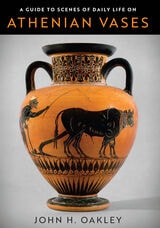
A Guide to Scenes of Daily Life on Athenian Vases
John H. Oakley
University of Wisconsin Press, 2020
John H. Oakley's clear, accessible writing provides sound information with just the right amount of detail. Specialists of Greek art will welcome this book for its text and illustrations. This guide is an essential and much-needed reference for scholars and an ideal sourcebook for classics and art history.
A History of Trust in Ancient Greece
Steven Johnstone
University of Chicago Press, 2011
A Landmark Through Time
On Classifying Greek Art and ArchitectureMilette Gaifman
University of Chicago Press, 0
What representations of a monument across centuries can tell us about how we engage with, study, and understand the past.
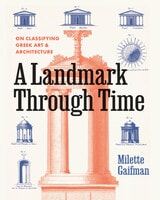
In a square in the heart of Athens, a cylindrical structure rests on a platform made up of large stone blocks. Semi-columns encircle it, and a slanted roof sits on top, with a plantlike feature at its highest point. Focusing on this well-documented remnant of classical Greece, the so-called Choregic Monument of Lysikrates, Milette Gaifman considers the history of engagement with this ancient landmark, looking at how names, scholarly classifications, and illustrations have shaped our understanding of it from the fourth century BCE to the modern era.
Studying the landmark’s representation through centuries of scholarship and illustrations, she examines how modes of engagement with the past often impose their own baggage, interpretive forces, and inaccuracies. By being aware of their histories, advantages, and limitations, Gaifman argues that we should treat them as helpful tools and flexible guidelines rather than as strict or unmoving criteria. A Landmark Through Time reveals how adapting and expanding traditional frameworks of classification and technologies can open fresh vantage points for appreciating the complexity and ingenuity of ancient Greek art and architecture.
A Latin Lover in Ancient Rome
Readings in Propertius and His GenreW. R. Johnson
The Ohio State University Press, 2009
A Life Worthy of the Gods
The Materialist Psychology of EpicurusDavid Konstan
Parmenides Publishing, 2008
A Sanskrit Treasury
A Compendium of Literature from the Clay Sanskrit LibraryCamillo A. Formigatti
Bodleian Library Publishing, 2020
A Short History of Greek Literature
Jacqueline de Romilly
University of Chicago Press, 1985
A Short Introduction to the Ancient Greek Theater
Graham Ley
University of Chicago Press, 1991
Reexamining the surviving plays of the tragic writers Aeschylus, Sophocles, and Euripides and of the comedian Aristophanes, Graham Ley discusses the actor's technique, the power and range of the chorus, the use of theatrical space, and parody in the plays. A series of diagrams relates the theater to the city and political life of ancient Athens, and photographic illustrations of scenes from Greek vases document the visualization of theatrical performance.
An ideal companion to The Complete Greek Tragedies (University of Chicago Press), Ley's work is a valuable user's guide to the critical assessment of modern translations and adaptations of tragedy and comedy. It is designed for all students of Greek drama with an interest in performance, and for theatrical practitioners who require a concise but informative introduction to one of the great periods of world drama.
A Short Introduction to the Ancient Greek Theater
Revised EditionGraham Ley
University of Chicago Press, 2007
Reexamining the surviving plays of Aeschylus, Sophocles, Euripides, and Aristophanes, Graham Ley here discusses acting technique, scenery, the power and range of the chorus, the use of theatrical space, and parody in their plays. In addition to photos of scenes from Greek vases that document theatrical performance, this new edition includes notes on ancient mime and puppetry and how to read Greek playtexts as scripts, as well as an updated bibliography. An ideal companion to The Complete Greek Tragedies, also published by the University of Chicago Press, Ley’s work is a concise and informative introduction to one of the great periods of world drama.
"Anyone faced with Athenian tragedy or comedy for the first time, in or out of the classroom, would do well to start with A Short Introduction to Ancient Greek Theater."—Didaskalia
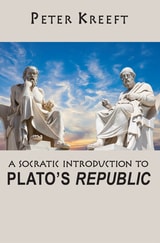
A Socratic Introduction to Plato's Republic
Peter Kreeft
St. Augustine's Press, 2026
- Beginners who want an introduction to philosophy;
- Those who have already had an introduction to philosophy and who would like to see it in action now applied to a great book written by a great philosophy, but who have never read Plato’s Republic, the most famous and influential philosophy book ever written;
- Those who have read Plato’s Republic before but did not understand its deepest significance.
Peter Kreeft has taught philosophy for over 50 years, including one section of a course for beginners every semester. He has tried just about everything possible, and a few new things that are impossible. He has experimented with every one of the many alternative methods available for teaching beginners. (He has A.D.D., so he easily gets bored and likes to try new things all the time.) But he has never found anything nearly as successful as Plato.
Plato is the best writer in the history of philosophy. Most philosophers are dull, undramatic, abstract writers. (There are a few other exceptions besides Plato: Augustine, Pascal, Nietzsche, Kierkegaard.) But Plato wrote dramatic dialogues, in which Socrates, his famous teacher, interacts with a great variety of fools. These dialogues are like intellectual swordfights, and even though you know Socrates is going to win, they are exciting because you see his ideas come alive, like a sword in the handoff a master. Plato is a great dramatist, a great poet, and a great psychologist as well as a great philosopher. Nobody else who ever lived combined those four talents as well as Plato did.
Apprenticeship to a great master is the best way to learn any art. The student will understand what philosophy is better by watching a master do it than by reading abstract definitions of it from a second-rate philosopher, or by a mere scholar. Concrete examples are always the easiest way to learn things. Plato’s dialogues are the world’s first, and still the best, concrete example of philosophizing.
Kreeft introduces his students to this love affair through a great matchmaker, Plato, who is a better teacher than the student will ever meet in the land of the living.
In fact, Plato still is in the land of the living. He’s still alive and kicking in his dialogues. He rubs off on those who are wise and humble enough to become a student.
A Stranger's Knowledge
Statesmanship, Philosophy, and Law in Plato's StatesmanXavier Márquez
Parmenides Publishing, 2012
Marquez shows how this impasse is the key to understanding the ambiguous reevaluation of the rule of law that is the most striking feature of the political philosophy of the Statesman. The law appears here as a mere approximation of the expertise of the inevitably absent statesman, dim images and static snapshots of the clear and dynamic expertise required to steer the ship of state across the storms of the political world. Yet such laws, even when they are not created by genuine statesmen, can often provide the city with a limited form of cognitive capital that enables it to preserve itself in the long run, so long as citizens, and especially leaders, retain a “philosophical” attitude towards them. It is only when rulers know that they do not know better than the laws what is just or good (and yet want to know what is just and good) that the city can be preserved. The dialogue is thus, in a sense, the vindication of the philosopher-king in the absence of genuine political knowledge.
A Student Commentary on Pausanias Book 1
Patrick Paul Hogan
University of Michigan Press, 2014
A Student Commentary on Pausanias Book 2
Patrick Paul Hogan
University of Michigan Press, 2018
A Student Commentary on Plato’s Euthyphro
Charles Platter
University of Michigan Press, 2019
This accessible student commentary by Charles Platter presents an introduction to the Euthyphro, the full Greek text, and a commentary designed for undergraduates and selected graduate students. As part of the series Michigan Classical Commentaries, now edited by Josiah Osgood and Alexander Sens at Georgetown University, and K. Sara Myers at the University of Virginia, the volume is sized and priced for student use.
A Study of Dialectic in Plato's Parmenides
Eric Sanday
Northwestern University Press, 2014
A Symposion of Praise
Horace Returns to Lyric in Odes IVTimothy Johnson
University of Wisconsin Press, 2007
Johnson shows the Horatian panegyrist is more than a dependent poet representing only the desires of his patrons. The poet forges the panegyric agenda, setting out the character of the praise (its mode, lyric, and content both positive and negative), and calls together a community to join in the creation and adaptation of Roman identities and civic ideologies. With this insightful reading, A Symposion of Praise will be of interest to historians of the Augustan period and its literature, and to scholars interested in the dynamics between personal expression and political power.
Accustomed to Obedience?
Classical Ionia and the Aegean World, 480–294 BCEJoshua P. Nudell
University of Michigan Press, 2023
This book offers a clear and accessible narrative of the period between the Persian Wars and the wars of the early Hellenistic period, two nominal liberations of the region. The volume complements existing histories of Classical Greece. Close inspection reveals that the Ionians were active partners in the imperial endeavor, even as imperial competition constrained local decision-making and exacerbated local and regional tensions. At the same time, the book offers interventions on critical issues related to Ionia such as the Athenian conquest of Samos, rhetoric about the freedom of the Greeks, the relationship between Ionian temple construction and economic activity, the status of the Panionion, Ionian poleis and their relationship with local communities beyond the circle of the dodecapolis, and the importance of historical memory to our understanding of ancient Greece. The result is a picture of an Aegean world that is more complex and less beholden narratives that give primacy to the imperial actors at the expense of local developments.
Aeneas
Lee T. Pearcy
University of Michigan Press, 2021
Aeschines
Translated by Chris Carey
University of Texas Press, 2000
This is the third volume in the Oratory of Classical Greece series. Published over several years, the series presents all of the surviving speeches from the late fifth and fourth centuries B.C. in new translations prepared by classical scholars who are at the forefront of the discipline. These translations are especially designed for the needs and interests of today's undergraduates, Greekless scholars in other disciplines, and the general public.
Classical oratory is an invaluable resource for the study of ancient Greek life and culture. The speeches offer evidence on Greek moral views, social and economic conditions, political and social ideology, and other aspects of Athenian culture that have been largely ignored: women and family life, slavery, and religion, to name just a few.
This volume contains the three surviving speeches of Aeschines (390-? B.C.). His speeches all revolve around political developments in Athens during the second half of the fourth century B.C. and reflect the internal political rivalries in an Athens overshadowed by the growing power of Macedonia in the north. The first speech was delivered when Aeschines successfully prosecuted Timarchus, a political opponent, for having allegedly prostituted himself as a young man. The other two speeches were delivered in the context of Aeschines' long-running political feud with Demosthenes. As a group, the speeches provide important information on Athenian law and politics, Demosthenes and his career, sexuality and social history, and the historical rivalry between Athens and Macedonia.
Aeschylus I
The Persians, The Seven Against Thebes, The Suppliant Maidens, Prometheus BoundEdited and Translated by David Grene, Richmond Lattimore, Mark Griffith, and Glenn W. Most
University of Chicago Press, 2013
The most engaging and authoritative translation of some of the foundational works of Western culture
This volume collects careful, readable translations of some of the key works of Aeschylus by experts in the language and culture of the ancient Greek world in which he lived and wrote. Aeschylus I contains “The Persians,” translated by Seth Benardete; “The Seven Against Thebes,” translated by David Grene; “The Suppliant Maidens,” translated by Seth Benardete; and “Prometheus Bound,” translated by David Grene.
For this edition, series editors Mark Griffith and Glenn W. Most have carefully updated the translations to bring them even closer to the ancient Greek while retaining the vibrancy for which our English versions are famous.New introductions for each play offer essential information about its first production, plot, and reception in antiquity and beyond. In addition, each volume includes an introduction to the life and work of its tragedian, as well as notes addressing textual uncertainties and a glossary of names and places mentioned in the plays.
Aeschylus II
The OresteiaEdited and Translated by David Grene, Richmond Lattimore, Mark Griffith, and Glenn W. Most
University of Chicago Press, 2013
Aeschylus II contains “The Oresteia,” translated by Richmond Lattimore, and fragments of “Proteus,” translated by Mark Griffith.
Many years ago, the University of Chicago Press undertook a momentous project: a new translation of the Greek tragedies that would be the ultimate resource for teachers, students, and readers. They succeeded. Under the expert management of eminent classicists David Grene and Richmond Lattimore, those translations combined accuracy, poetic immediacy, and clarity of presentation to render the surviving masterpieces of Aeschylus, Sophocles, and Euripides in an English so lively and compelling that they remain the standard translations. The updated third editions of these classic works were designed to ensure that our Greek tragedies remain the leading English-language versions throughout the twenty-first century.
In this highly anticipated third edition, Mark Griffith and Glenn W. Most have carefully updated the translations to bring them even closer to the ancient Greek while retaining the vibrancy for which our English versions are famous. This edition also includes brand-new translations of Euripides’ Medea, The Children of Heracles, Andromache, and Iphigenia among the Taurians, fragments of lost plays by Aeschylus, and the surviving portion of Sophocles’s satyr-drama The Trackers. New introductions for each play offer essential information about its first production, plot, and reception in antiquity and beyond. In addition, each volume includes an introduction to the life and work of its tragedian, as well as notes addressing textual uncertainties and a glossary of names and places mentioned in the plays.
In addition to the new content, the volumes have been reorganized both within and between volumes to reflect the most up-to-date scholarship on the order in which the plays were originally written. The result is a set of handsome paperbacks destined to introduce new generations of readers to these foundational works of Western drama, art, and life.
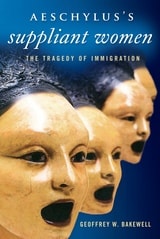
Aeschylus’s Suppliant Women
The Tragedy of ImmigrationGeoffrey W. Bakewell
University of Wisconsin Press, 2013
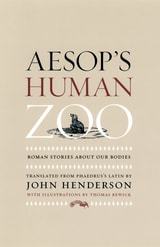
Aesop's Human Zoo
Roman Stories about Our BodiesPhaedrus
University of Chicago Press, 2004
Providing unusual insights into the heart of Roman culture, these clever poems open up odd avenues of ancient lore and life as they explore social types and physical aspects of the body, regularly mocking the limitations of human nature and offering vulgar or promiscuous interpretations of the stuff of social life.
Featuring folksy proverbs and satirical anecdotes, filled with saucy naughtiness and awful puns, Aesop's Human Zoo will amuse you with its eccentricities and hit home with its shrewdly candid and red raw messages. The entertainment offered in this volume of impeccably accurate translations is truly a novelty—a good-hearted and knowing laugh courtesy of classical poetry. Beginning to advanced classicists and Latin scholars will appreciate the original Latin text provided in this bilingual edition. The splash of classic Thomas Bewick wood engravings to accompany the fables renders the collection complete.
Aesopica
A Series of Texts Relating to Aesop or Ascribed to HimEdited by Ben Edwin Perry
University of Illinois Press, 1952
Ben Edwin Perry's Aesopica remains the definitive edition of all fables reputed to be by Aesop. The volume begins traditionally with a life of Aesop, but in two different and previously unedited Greek versions, with collations that record variations in the major recensions. It includes 179 proverbs attributed to Aesop and 725 carefully organized fables, for which Perry also provides their eldest known sources. To better evaluate the place of Aesop in literary history, Perry includes testimonies about Aesop made by Greek and Latin authors, from Herodotus to Maximus Planudes.
African American Writers and Classical Tradition
William W. Cook and James Tatum
University of Chicago Press, 2010
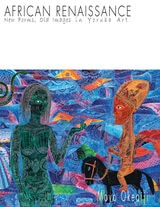
African Renaissance
New Forms, Old Images in Yoruba ArtM Okediji
University Press of Colorado, 2002
African Renaissance: New Forms, Old Images in Yoruba Art describes, analyzes, and interprets the historical and cultural contexts of an African art renaissance using the twentieth- and twenty-first-century transformation of ancient Yoruba artistic heritage. Juxtaposing ancient and contemporary Yoruba art, Moyo Okediji defines this art history through the lens of colonialism, an experience that served to both destroy ancient art traditions and revive Yoruba art in the twentieth century.
With vivid reproductions of paintings, prints, and drawings, Okediji describes how Yoruba art has replenished and redefined itself. Okediji groups the text into several broadly overlapping periods that intricately detail the journey of Yoruba art and artists: first through oppression by European colonialism, then the attainment of Nigeria’s independence and the new nation’s subsequent military coup, and ending with present-day native Yoruban artists fleeing their homeland.
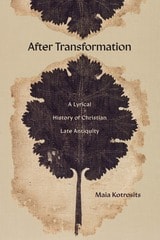
After Transformation
A Lyrical History of Christian Late AntiquityMaia Kotrosits
Duke University Press, 2025
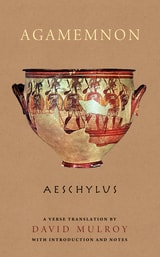
Agamemnon
Aeschylus, A verse translation by David Mulroy, with introduction and notes
University of Wisconsin Press, 2015
Aeschylus (525/4–456/5 B.C.E.) was the first of the three great tragic dramatists of ancient Greece, a forerunner of Sophocles and Euripides. His early tragedies were largely choral pageants with minimal plots. In Agamemnon, choral songs still predominate, but Aeschylus infuses them with such dramatic feeling that the spectator or reader is constantly spellbound.
Translator David Mulroy brings this ancient tragedy to life for modern readers and audiences. Using end rhyme and strict metrics, he combines the buoyant lyricism of the Greek text with a faithful rendering of its meaning in lucid English.
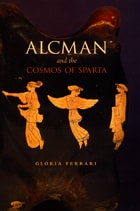
Alcman and the Cosmos of Sparta
Gloria Ferrari
University of Chicago Press, 2008
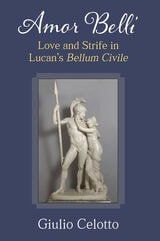
Amor Belli
Love and Strife in Lucan's Bellum CivileGiulio Celotto
University of Michigan Press, 2022
Compelled by the emperor Nero to commit suicide at age 25 after writing uncomplimentary poems, Latin poet Lucan nevertheless left behind a significant body of work, including the Bellum Civile (Civil War). Sometimes also called the Pharsalia, this epic describes the war between Julius Caesar and Pompey.Author Giulio Celotto provides an interpretation of this civil war based on the examination of an aspect completely neglected by previous scholarship: Lucan’s literary adaptation of the cosmological dialectic of Love and Strife.
According to a reading that has found favor over the last three decades, the poem is an unconventional epic that does not conform to Aristotelian norms: Lucan composes a poem characterized by fragmentation and disorder, lacking a conventional teleology, and whose narrative flow is constantly delayed. Celotto’s study challenges this interpretation by illustrating how Lucan invokes imagery of cosmic dissolution, but without altogether obliterating epic norms. The poem transforms them from within, condemning the establishment of the Principate and the Julio-Claudian dynasty.
Amorous Games
A Critical Edition of Les adevineaux amoureuxBy James Woodrow Hassell
University of Texas Press, 1974
Among the more interesting incunabula preserved in the Salle de la Réserve of the Bibliothèque National in Paris are the apparently unique copies of two editions, very similar in content, of a work entitled Les Adevineaux amoureux. In much more comprehensive form Les Adevineaux amoureux is preserved in a manuscript belonging to the Musée Conde at Chantilly. All three texts, in medieval French, appear to date from the 1470s. The present work, Amorous Games, is a critical edition of Les Adevineaux amoureux.
Amorous Games is a miscellany whose principal unifying force is the compiler's aim to provide a manual of conversation and entertainment for polite society. Included are series of questions and answers belonging to the well-established medieval tradition of the "Demandes amoureuses"; a very large number of riddles, mainly folk riddles; and "venditions en amours," little poems that apparently came into bing as part of a social game.
Students of medieval French literature, particularly those with a penchant for some of the minor genres, will find new material in the Amorous Games. Folklorists will discover what is probably the largest collection of riddles bequeathed to us by medieval France and also much that is of value to specialists in the proverb and folk tale.
For this critical edition of Les Adevineaux amoureux Professor Hassell has selected the Chantilly manuscript, because it is the most complete and also because it had not yet been published. The Appendix contains the text of the more complete of the two incunabula and the significant variants appearing in the other fifteenth-century printed edition. The manuscript text has been collated with that of the incunabula, and copious notes and an index to the riddles have been supplied. In his introduction Professor Hassell discusses in detail the major classes and subclasses of the riddle, drawing on the work of Petsch, Taylor, Abrahams, and other scholars of the genre.
Amphion
Lyre, Poetry, and Politics in ModernityLeah Middlebrook
University of Chicago Press, 2024
Amphion is the figure in Greek mythology who played so skillfully on a lyre that stones moved of their own accord to build walls for Thebes. While Amphion still presides over music and architecture, he was once fundamental to the concept of lyric poetry. Amphion figured the human power to inspire action, creating and undoing polities by means of language. In contrast to the individual inspiration we associate with the better-known Orpheus, Amphion represents the relentless, often violent, play of harmony and disorder in human social life.
In this wide-ranging study, Leah Middlebrook introduces readers to Amphion-inspired poetics and lyrics and traces the tradition of the Amphionic from the Renaissance through modernist and postmodern poetry and translation from the Hispanic, Anglophone, French, Italian, and ancient Roman worlds. Amphion makes a significant contribution to scholarship on the connection between poetry and politics and the history of the lyric, offering an account well-suited to our times.
An Introduction to Greek Epigraphy of the Hellenistic and Roman Periods from Alexander the Great down to the Reign of Constantine
B. H. McLean
University of Michigan Press, 2011
“In short, this is a reference work of the best kind. For the beginner, it is indispensable. And for those who already know something about its subject matter, the book is in many ways useful, informative, and interesting. We all owe a debt to [the author] for undertaking this significant project, and for completing it so well.”
—Michael Peachin, Classical World
“. . . provides invaluable road maps for non-epigraphers faced with passages of inscribed Greek.”
—Graham Shipley, Bryn Mawr Classical Review
Greek inscriptions form a valuable resource for the study of all aspects of the Greco-Roman world. They are primary witnesses to society's laws and institutions, religious habits, and language. This volume provides students with the tools to take advantage of the historical value of these treasures. It examines letter forms, ancient names, and ancient calendars, knowledge of which is essential in reading inscriptions of all kinds.
B. H. McLean discusses the classification of inscriptions into their various categories and analyzes particular types of inscriptions, including decrees, honorary inscriptions, dedications, funerary inscriptions, and manumissions. Finally, McLean includes special topics that bear upon the interpretation of specific features of inscriptions, such as Greek and Roman administrative titles and functions.
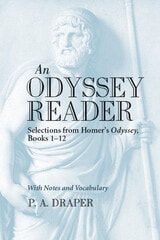
An Odyssey Reader
Selections from Homer's Odyssey, Books 1-12P. A. Draper
University of Michigan Press, 2012
Homer's Odyssey has captivated readers and influenced writers and artists for more than 2,000 years. Reading the poem in its original language provides an experience as challenging as it is rewarding. Most students encountering Homeric Greek for the first time need considerable help, especially with vocabulary and constructions that differ from the more familiar Attic forms. For anyone who has completed studies in elementary Greek, this edition provides the assistance necessary to read, understand, and appreciate the first book of the Odyssey in its original language.
Structured to maximize reading ease, P. A. Draper's volume stands out among introductions to the Greek Odyssey. Readers of this edition will appreciate the positioning of all notes facing the Greek text; the frequent vocabulary entries; the complete glossary; the appendix on basic Homeric forms and grammar; and the copious annotations on vocabulary, grammar, meter, historical and mythological allusions, and literary interpretation.
Primarily designed as a textbook, this volume will be an effective classroom tool and a useful acquisition for any library supporting a classics program. The book will find readers among high school and college Greek students, advanced students in Homer or epic poetry classes, graduate students working on reading-list requirements, and anyone interested in maintaining Greek reading skills.
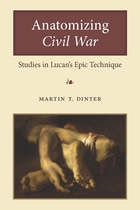
Anatomizing Civil War
Studies in Lucan's Epic TechniqueMartin T. Dinter
University of Michigan Press, 2013
Imperial Latin epic has seen a renaissance of scholarly interest. This book illuminates the work of the poet Lucan, a contemporary of the emperor Nero who as nephew of the imperial adviser Seneca moved in the upper echelons of Neronian society. This young and maverick poet, whom Nero commanded to commit suicide at the age of 26, left an epic poem on the civil war between Caesar and Pompey that epitomizes the exuberance and stylistic experimentation of Neronian culture. This study focuses on Lucan's epic technique and traces his influence through the Middle Ages and the Renaissance.
Martin T. Dinter's newest volume engages with Lucan's use of body imagery, sententiae, Fama (rumor), and open-endedness throughout his civil war epic. Although Lucan's Bellum Civile is frequently decried as a fragmented as well as fragmentary epic, this study demonstrates how Lucan uses devices other than teleology and cohesive narrative structure to bind together the many parts of his epic body.
Anatomizing Civil War places at center stage characteristics of Lucan's work that have so far been interpreted as excessive, or as symptoms of an overly rhetorical culture indicating a lack of substance. By demonstrating that they all contribute to Lucan's poetic technique, Martin T. Dinter shows how they play a fundamental role in shaping and connecting the many episodes of the Bellum Civile that constitute Lucan's epic body. This important volume will be of interest to students of classics and comparative literature as well as literary scholars. All Greek and Latin passages have been translated.
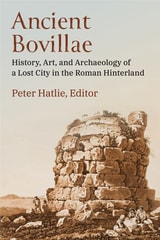
Ancient Bovillae
History, Art, and Archaeology of a Lost City in the Roman HinterlandEdited by Peter Hatlie
University of Michigan Press, 2025
Ancient Bovillae goes well beyond the work of any previous publication by gathering together all known evidence about the city from the ancient, medieval, and modern ages, with contributors analyzing the significance of Bovillae in art, architecture, religion, and history. Written by a distinguished team of scholars and featuring nearly one hundred images of artifacts, monuments, and technical drawings associated with Bovillae, this book boldly pieces together evidence about the history, art, and archaeology of Bovillae. It draws attention to Bovillae’s significance within the Roman world as well as its transformation and decline in the post-Roman era.
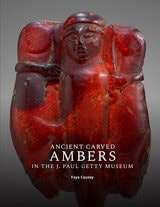
Ancient Carved Ambers in the J. Paul Getty Museum
Faya Causey
J. Paul Getty Trust, The, 0
The catalogue is preceded by a general introduction to ancient amber (which was also published in 2012 as a stand-alone print volume titled Amber and the Ancient World). Through exquisite visual examples and vivid classical texts, this book examines the myths and legends woven around amber—its employment in magic and medicine, its transport and carving, and its incorporation into jewelry, amulets, and other objects of prestige. This publication highlights a group of remarkable amber carvings at the J. Paul Getty Museum.
This catalogue was first published in 2012 at museumcatalogues.getty.edu/amber/. The present online edition of this open-access publication was migrated in 2019 to www.getty.edu/publications/ambers/; it features zoomable, high-resolution photography; free PDF, EPUB, and Kindle/MOBI downloads of the book; and JPG downloads of the catalogue images.
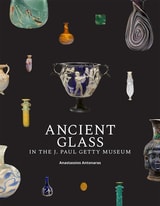
Ancient Glass in the J. Paul Getty Museum
Anastassios Antonaras
J. Paul Getty Trust, The, 2024
The J. Paul Getty Museum’s collection of ancient glass—astonishingly delicate, richly hued, and fancifully shaped—is among the most celebrated in the United States. Ranging from the Bronze Age to the medieval period (1500 BCE–1000 CE), the 584 objects included in this publication originated from a wide geographical area, including the Middle East, the Mediterranean, and central Europe.
This catalogue, written by acclaimed scholar Anastassios Antonaras, begins with a fascinating essay on the history of glassmaking—a highly technical art form that is still practiced similarly today—and continues with detailed and informative entries on the works. Each entry is accompanied by vivid photography. The book also includes a history of the collection, glossary of glassmaking terms, technical study, and full bibliography.
The free online edition of this open-access publication is available at getty.edu/publications/ancient-glass/ and includes 360-degree views and zoomable high-resolution photography. Also available are free PDF and EPUB downloads of the book, and JPG downloads of the main catalogue images.
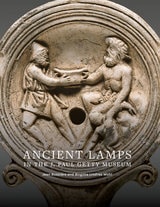
Ancient Lamps in the J. Paul Getty Museum
Jean Bussière
J. Paul Getty Trust, The, 2017
Reflecting the Getty's commitment to open content, Ancient Lamps in the J. Paul Getty Museum is available online at http://www.getty.edu/publications/ancientlamps and may be downloaded free of charge in multiple formats, including PDF, MOBI/Kindle, and EPUB, and features zoomable images and multiple views of every lamp, an interactive map drawn from the Ancient World Mapping Center, and bibliographic references.