Results by title
20 books match the query 'Ancient Greece'
A History of Trust in Ancient Greece
Steven Johnstone
University of Chicago Press, 2011
Acting Like Men
Gender, Drama, and Nostalgia in Ancient GreeceKaren Bassi
University of Michigan Press, 1999
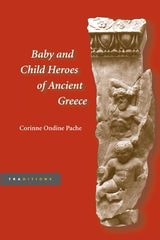
Baby and Child Heroes in Ancient Greece
Corinne Ondine Pache
University of Illinois Press, 2004
Examining literary, pictorial, and numismatic representations, Pache opens up a vast territory once occupied by children such as Charila, Opheltes, Melikertes, and the children of Herakles and Medea. She elegantly argues that the stories, songs, and sanctuaries honoring these heroes express parental fears and guilt about children's death. Pache further demonstrates that while the myths and rituals articulate basic human anxieties, their emphasis is ultimately on the beauty that transcends the gruesomeness of the narrative, turning their dread into poetry. By showing the continuity of child heroes in Greek religion, she is able to throw new light on iconographies that have previously defied explanation.
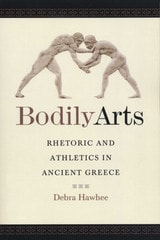
Bodily Arts
Rhetoric and Athletics in Ancient GreeceBy Debra Hawhee
University of Texas Press, 2005
The role of athletics in ancient Greece extended well beyond the realms of kinesiology, competition, and entertainment. In teaching and philosophy, athletic practices overlapped with rhetorical ones and formed a shared mode of knowledge production. Bodily Arts examines this intriguing intersection, offering an important context for understanding the attitudes of ancient Greeks toward themselves and their environment.
In classical society, rhetoric was an activity, one that was in essence "performed." Detailing how athletics came to be rhetoric's "twin art" in the bodily aspects of learning and performance, Bodily Arts draws on diverse orators and philosophers such as Isocrates, Demosthenes, and Plato, as well as medical treatises and a wealth of artifacts from the time, including statues and vases.
Debra Hawhee's insightful study spotlights the notion of a classical gymnasium as the location for a habitual "mingling" of athletic and rhetorical performances, and the use of ancient athletic instruction to create rhetorical training based on rhythm, repetition, and response. Presenting her data against the backdrop of a broad cultural perspective rather than a narrow disciplinary one, Hawhee presents a pioneering interpretation of Greek civilization from the sixth, fifth, and fourth centuries BCE by observing its citizens in action.
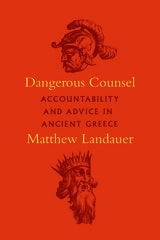
Dangerous Counsel
Accountability and Advice in Ancient GreeceMatthew Landauer
University of Chicago Press, 2019
With Dangerous Counsel, Matthew Landauer analyzes the sometimes ferocious and unpredictable politics of accountability in ancient Greece and offers novel readings of ancient history, philosophy, rhetoric, and drama. In comparing the demos to a tyrant, thinkers such as Herodotus, Plato, Isocrates, and Aristophanes were attempting to work out a theory of the badness of unaccountable power; to understand the basic logic of accountability and why it is difficult to get right; and to explore the ways in which political discourse is profoundly shaped by institutions and power relationships. In the process they created strikingly portable theories of counsel and accountability that traveled across political regime types and remain relevant to our contemporary political dilemmas.
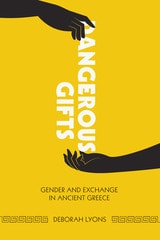
Dangerous Gifts
Gender and Exchange in Ancient GreeceBy Deborah Lyons
University of Texas Press, 2012
Deianeira sends her husband Herakles a poisoned robe. Eriphyle trades the life of her husband Amphiaraos for a golden necklace. Atreus’s wife Aerope gives away the token of his sovereignty, a lamb with a golden fleece, to his brother Thyestes, who has seduced her. Gifts and exchanges always involve a certain risk in any culture, but in the ancient Greek imagination, women and gifts appear to be a particularly deadly combination.
This book explores the role of gender in exchange as represented in ancient Greek culture, including Homeric epic and tragedy, non-literary texts, and iconographic and historical evidence of various kinds. Using extensive insights from anthropological work on marriage, kinship, and exchange, as well as ethnographic parallels from other traditional societies, Deborah Lyons probes the gendered division of labor among both gods and mortals, the role of marriage (and its failure) in transforming women from objects to agents of exchange, the equivocal nature of women as exchange-partners, and the importance of the sister-brother bond in understanding the economic and social place of women in ancient Greece. Her findings not only enlarge our understanding of social attitudes and practices in Greek antiquity but also demonstrate the applicability of ethnographic techniques and anthropological theory to the study of ancient societies.
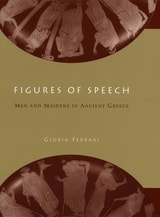
Figures of Speech
Men and Maidens in Ancient GreeceGloria Ferrari
University of Chicago Press, 2002
Ferrari begins by developing a theoretical perspective on visual representation, arguing that artistic images give us access to how their subjects were imagined rather than to the way they really were. For instance, Ferrari's examinations of the many representations of women working wool reveal that these images constitute powerful metaphors—metaphors, she argues, which both reflect and construct Greek conceptions of the ideal woman and her ideal behavior.
From this perspective, Ferrari studies a number of icons representing blameless femininity and ideal masculinity to reevaluate the rites of passage by which girls are made ready for marriage and boys become men. Representations of the nude male body in Archaic statues known as kouroi, for example, symbolize manhood itself and shed new light on the much-discussed institution of paiderastia. And, in Ferrari's hands, imagery equating maidens with arable land and buried treasure provides a fresh view of Greek ideas of matrimony.
Innovative, thought-provoking, and insightful throughout, Figures of Speech is a powerful demonstration of how the study of visual images as well as texts can reshape our understanding of ancient Greek culture.
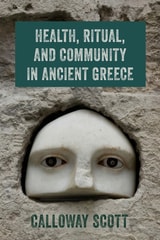
Health, Ritual, and Community in Ancient Greece
Calloway Scott
University of Wisconsin Press, 2027
At the heart of this book is a deceptively simple question: What does “health” mean? The answer, historian Calloway B. Scott shows, is culturally contingent, and in ancient Greece the concept went well beyond the proper functioning of an individual’s body. Rather, “health” (Greek hygieia) furnished a key discursive and ritual tool for civic cohesion, religious praxis, and even cultural identity. The all-important polis, central to ancient Greek social and political life, fundamentally depended on this conception of good health as a communal and religious phenomenon, and its ritualization informed relationships not just between individuals but also between communities of humans and between the human and divine realms.
Scott employs an impressive array of sources, from technical medical treatises to poetry to material remains and sanctuary sites, to explore the “body politic” of the ancient Greek world—and to query exactly what keeping that body healthy meant. Health, political identity, social relationships, and religious praxis were all deeply entwined; thus rites, rituals, and healing spaces were public, bringing people together in cohesive, coherent, and, ideally, healthy communities.
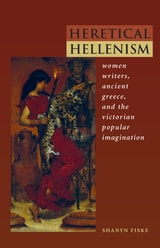
Heretical Hellenism
Women Writers, Ancient Greece, and the Victorian Popular ImaginationShanyn Fiske
Ohio University Press, 2008
The prevailing assumption regarding the Victorians’ relationship to ancient Greece is that Greek knowledge constituted an exclusive discourse within elite male domains. Heretical Hellenism: Women Writers, Ancient Greece, and the Victorian Popular Imagination challenges that theory and argues that while the information women received from popular sources was fragmentary and often fostered intellectual insecurities, it was precisely the ineffability of the Greek world refracted through popular sources and reconceived through new fields of study that appealed to women writers’ imaginations.
Examining underconsidered sources such as theater history and popular journals, Shanyn Fiske uncovers the many ways that women acquired knowledge of Greek literature, history, and philosophy without formal classical training. Through discussions of women writers such as Charlotte Brontë, George Eliot, and Jane Harrison, Heretical Hellenism demonstrates that women established the foundations of a heretical challenge to traditional humanist assumptions about the uniformity of classical knowledge and about women’s place in literary history.
Heretical Hellenism provides a historical rationale for a more expansive definition of classical knowledge and offers an interdisciplinary method for understanding the place of classics both in the nineteenth century and in our own time.
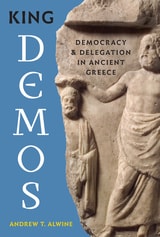
King Demos
Democracy and Delegation in Ancient GreeceAndrew T. Alwine
University of Texas Press, 2027
How ancient Greek democracies wrestled with the tension between egalitarianism and hierarchical structures necessary for organized government.
Democracy and egalitarianism are ever in tension. The ideal of direct democracy—equal participation in all aspects of governance—coexists with the reality that hierarchical structures are necessary to organize and stabilize the workings of the state. This tension consumed America’s founders. And two thousand years earlier, it had consumed the people of Athens.
King Demos shows how ancient Greek democracies wrestled with this problem, crafting what the Federalist Papers would later dream of: “a republican remedy for the diseases most incident to republican government.” As Athens grew and direct democracy became unwieldy, the Greeks developed a system of delegation, with the “people” (demos) conceived as a king with authority over a sprawling system of state officials whose day-to-day operation was handled by experts. Hierarchical structures became commonplace in the city, yet sovereign powers remained with the citizenry. Andrew Alwine argues that delegation was a stepping stone between direct and representative democracy and provided a crucial compromise, enabling the Greeks to benefit from the abilities of elite citizens while also keeping them under control.
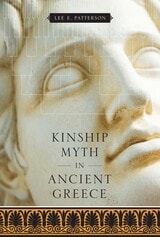
Kinship Myth in Ancient Greece
By Lee E. Patterson
University of Texas Press, 2010
In ancient Greece, interstate relations, such as in the formation of alliances, calls for assistance, exchanges of citizenship, and territorial conquest, were often grounded in mythical kinship. In these cases, the common ancestor was most often a legendary figure from whom both communities claimed descent.
In this detailed study, Lee E. Patterson elevates the current state of research on kinship myth to a consideration of the role it plays in the construction of political and cultural identity. He draws examples both from the literary and epigraphical records and shows the fundamental difference between the two. He also expands his study into the question of Greek credulity—how much of these founding myths did they actually believe, and how much was just a useful fiction for diplomatic relations? Of central importance is the authority the Greeks gave to myth, whether to elaborate narratives or to a simple acknowledgment of an ancestor. Most Greeks could readily accept ties of interstate kinship even when local origin narratives could not be reconciled smoothly or when myths used to explain the link between communities were only "discovered" upon the actual occasion of diplomacy, because such claims had been given authority in the collective memory of the Greeks.
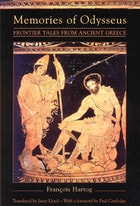
Memories of Odysseus
Frontier Tales From Ancient GreeceFrançois Hartog
University of Chicago Press, 2001
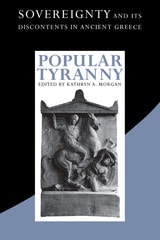
Popular Tyranny
Sovereignty and Its Discontents in Ancient GreeceEdited by Kathryn A. Morgan
University of Texas Press, 2003
The nature of authority and rulership was a central concern in ancient Greece, where the figure of the king or tyrant and the sovereignty associated with him remained a powerful focus of political and philosophical debate even as Classical Athens developed the world's first democracy. This collection of essays examines the extraordinary role that the concept of tyranny played in the cultural and political imagination of Archaic and Classical Greece through the interdisciplinary perspectives provided by internationally known archaeologists, literary critics, and historians.
The book ranges historically from the Bronze and early Iron Age to the political theorists and commentators of the middle of the fourth century B.C. and generically across tragedy, comedy, historiography, and philosophy. While offering individual and sometimes differing perspectives, the essays tackle several common themes: the construction of authority and of constitutional models, the importance of religion and ritual, the crucial role of wealth, and the autonomy of the individual. Moreover, the essays with an Athenian focus shed new light on the vexed question of whether it was possible for Athenians to think of themselves as tyrannical in any way. As a whole, the collection presents a nuanced survey of how competing ideologies and desires, operating through the complex associations of the image of tyranny, struggled for predominance in ancient cities and their citizens.
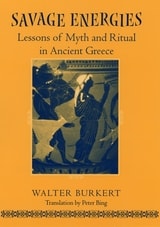
Savage Energies
Lessons of Myth and Ritual in Ancient GreeceWalter Burkert
University of Chicago Press, 2001
For example, in a much-cited essay on the Athenian religious festival of the Arrephoria, Burkert uncovers deep connections between this strange nocturnal ritual, in which two virgin girls carried sacred offerings into a cave and later returned with something given to them there, and tribal puberty initiations by linking the festival with the myth of the daughters of Kekrops. Other chapters explore the origins of tragedy in blood sacrifice; the role of myth in the ritual of the new fire on Lemnos; the ties between violence, the Athenian courts, and the annual purification of the divine image; and how failed political propaganda entered the realm of myth at the time of the Persian Wars.
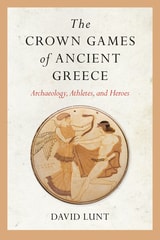
The Crown Games of Ancient Greece
Archaeology, Athletes, and HeroesDavid Lunt
University of Arkansas Press, 2022
The Crown Games were the apex of competition in ancient Greece. Along with prestigious athletic contests in honor of Zeus at Olympia, they comprised the Pythian Games for Apollo at Delphi, the Isthmian Games for Poseidon, and the Nemean Games, sacred to Zeus. For over nine hundred years, the Greeks celebrated these athletic and religious festivals, a rare point of cultural unity amid the fierce regional independence of the numerous Greek city-states and kingdoms.
The Crown Games of Ancient Greece examines these festivals in the context of the ancient Greek world, a vast and sprawling cultural region that stretched from modern Spain to the Black Sea and North Africa. Illuminating the unique history and features of the celebrations, David Lunt delves into the development of the contest sites as sanctuaries and the Panhellenic competitions that gave them their distinctive character. While literary sources have long been the mainstay for understanding the evolution of the Crown Games and ancient Greek athletics, archaeological excavations have significantly augmented contemporary understandings of the events. Drawing on this research, Lunt brings deeper context to these gatherings, which were not only athletics competitions but also occasions for musical contests, dramatic performances, religious ceremonies, and diplomatic summits—as well as raucous partying. Taken as a circuit, the Crown Games offer a more nuanced view of ancient Greek culture than do the well-known Olympian Games on their own. With this comprehensive examination of the Crown Games, Lunt provides a new perspective on how the ancient Greeks competed and collaborated both as individuals and as city-states.
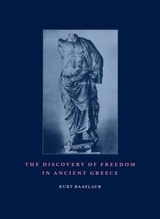
The Discovery of Freedom in Ancient Greece
Revised and Updated EditionKurt Raaflaub
University of Chicago Press, 2003
To find out, Raaflaub analyses ancient Greek texts from Homer to Thucydides in their social and political contexts. Archaic Greece, he concludes, had little use for the idea of political freedom; the concept arose instead during the great confrontation between Greeks and Persians in the early fifth century BCE. Raaflaub then examines the relationship of freedom with other concepts, such as equality, citizenship, and law, and pursues subsequent uses of the idea—often, paradoxically, as a tool of domination, propaganda, and ideology.
Raaflaub's book thus illuminates both the history of ancient Greek society and the evolution of one of humankind's most important values, and will be of great interest to anyone who wants to understand the conceptual fabric that still shapes our world views.
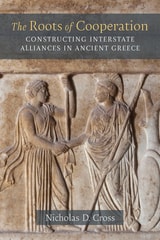
The Roots of Cooperation
Constructing Interstate Alliances in Ancient GreeceNicholas D. Cross
University of Michigan Press, 2026
Nicholas D. Cross’s The Roots of Cooperation reinterprets how the Greeks conceived, enacted, and displayed their alliances, offering a socially grounded understanding of interstate relations in antiquity. Following the international relations model of constructivism, Cross emphasizes the social features of Greek alliances including words used to articulate agreements, ceremonial acts they performed during the formation process, and the symbols they employed to illustrate how the alliances contributed to the creation of shared goals, ideas, and identities. The study covers the proposals for alliances, the articulation of alliance treaties, the ratification of alliances by means of religious ceremonies, the public display of the agreements in visual media, and the implications of terminated alliances. While alliances had political and military objectives, the Greeks represented them as collective and consensual achievements. Relying as much on epigraphic and numismatic evidence as on the literary record, this study recontextualizes interstate activity by analyzing how contemporaries imagined and depicted their formal interstate agreements. The Roots of Cooperation offers fresh insights that go beyond just alliances and can deepen our understanding of interstate relations, broadly speaking, in the ancient world.
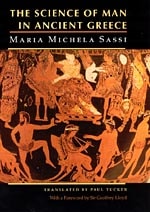
The Science of Man in Ancient Greece
Maria Michela Sassi
University of Chicago Press, 2000
Maria Michela Sassi reconstructs Greek attempts to answer such questions from Homer's day to late antiquity, ranging across physiognomy, ethnography, geography, medicine, and astrology. Sassi demonstrates that in the Greek science of man, empirical observations were inextricably bound up with a prejudiced view of the free Greek male as superior to all others. Thus, because women were assumed to have pale skin from staying indoors too much, Greek biology and medicine sought to explain this feature as an indication of the "cold" nature of women, as opposed to the "hot" constitution of men.
For this English translation, Sassi has rewritten the introduction and updated the text and references throughout, and Sir Geoffrey Lloyd has provided a new foreword.
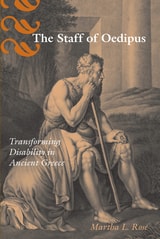
The Staff of Oedipus
Transforming Disability in Ancient GreeceMartha L. Rose
University of Michigan Press, 2013
Ancient Greek images of disability permeate the Western consciousness: Homer, Teiresias, and Oedipus immediately come to mind. But The Staff of Oedipus looks at disability in the ancient world through the lens of disability studies, and reveals that our interpretations of disability in the ancient world are often skewed. These false assumptions in turn lend weight to modern-day discriminatory attitudes toward disability.
Martha L. Rose considers a range of disabilities and the narratives surrounding them. She examines not only ancient literature, but also papyrus, skeletal material, inscriptions, sculpture, and painting, and draws upon modern work, including autobiographies of people with disabilities, medical research, and theoretical work in disability studies. Her study uncovers the realities of daily life for people with disabilities in ancient Greece and challenges the translation of the term adunatos (unable) as "disabled," with all its modern associations.
Theoretical Approaches to the Archaeology of Ancient Greece
Manipulating Material CultureLisa C. Nevett, Editor
University of Michigan Press, 2017
An introductory section exploring the emergence and growth of theoretical approaches is followed by examinations of the potential insights these approaches provide. The authors probe some of the meanings attached to ancient objects, townscapes, and cemeteries, for those who created, and used, or inhabited them.
The range of contexts stretches from the early Greek communities during the eighth and seventh centuries BCE, through Athens between the eighth and fifth centuries BCE, and on into present day Turkey and the Levant during the third and second centuries BCE. The authors examine a range of practices, from the creation of individual items such as ceramic vessels and figurines, through to the construction of civic buildings, monuments, and cemeteries. At the same time they interrogate a range of spheres, from craft production, through civic and religious practices, to funerary ritual.