Results by title
8 books match the query 'Ancient World'
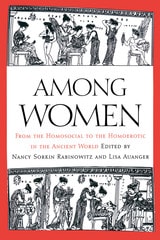
Among Women
From the Homosocial to the Homoerotic in the Ancient WorldEdited by Nancy Sorkin Rabinowitz and Lisa Auanger
University of Texas Press, 2002
Women's and men's worlds were largely separate in ancient Mediterranean societies, and, in consequence, many women's deepest personal relationships were with other women. Yet relatively little scholarly or popular attention has focused on women's relationships in antiquity, in contrast to recent interest in the relationships between men in ancient Greece and Rome. The essays in this book seek to close this gap by exploring a wide variety of textual and archaeological evidence for women's homosocial and homoerotic relationships from prehistoric Greece to fifth-century CE Egypt.
Drawing on developments in feminist theory, gay and lesbian studies, and queer theory, as well as traditional textual and art historical methods, the contributors to this volume examine representations of women's lives with other women, their friendships, and sexual subjectivity. They present new interpretations of the evidence offered by the literary works of Sappho, Ovid, and Lucian; Bronze Age frescoes and Greek vase painting, funerary reliefs, and other artistic representations; and Egyptian legal documents.
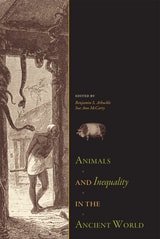
Animals and Inequality in the Ancient World
Benjamin S. Arbuckle
University Press of Colorado, 2014
The authors provide a global range of case studies from both New and Old World archaeology—a royal Aztec dog burial, the monumental horse tombs of Central Asia, and the ceremonial macaw cages of ancient Mexico among them. They explore the complex relationships between people and animals in social, economic, political, and ritual contexts, incorporating animal remains from archaeological sites with artifacts, texts, and iconography to develop their interpretations.
Animals and Inequality in the Ancient World presents new data and interpretations that reveal the role of animals, their products, and their symbolism in structuring social inequalities in the ancient world. The volume will be of interest to archaeologists, especially zooarchaeologists, and classical scholars of pre-modern civilizations and societies.
Archaeology of the Night
Life After Dark in the Ancient WorldNancy Gonlin
University Press of Colorado, 2020
How did ancient peoples experience, view, and portray the night? What was it like to live in the past when total nocturnal darkness was the norm? Archaeology of the Night explores the archaeology, anthropology, mythology, iconography, and epigraphy of nocturnal practices and questions the dominant models of daily ancient life. A diverse team of experienced scholars uses a variety of methods and resources to reconstruct how ancient peoples navigated the night and what their associated daily—and nightly—practices were.
This collection challenges modern ideas and misconceptions regarding the night and what darkness and night symbolized in the ancient world, and it highlights the inherent research bias in favor of “daytime” archaeology. Numerous case studies from around the world (including Oman, Mesoamerica, Scandinavia, Rome, Great Zimbabwe, Indus Valley, Peru, and Cahokia) illuminate subversive, social, ritual, domestic, and work activities, such as witchcraft, ceremonies, feasting, sleeping, nocturnal agriculture, and much more. Were there artifacts particularly associated with the night? Authors investigate individuals and groups (both real and mythological) who share a special connection to nighttime life.
Reconsidering the archaeological record, Archaeology of the Night views sites, artifacts, features, and cultures from a unique perspective. This book is relevant to anthropologists and archaeologists and also to scholars of human geography, history, astronomy, sensory studies, human biology, folklore, and mythology.
Contributors: Susan Alt, Anthony F. Aveni, Jane Eva Baxter, Shadreck Chirikure, Minette Church, Jeremy D. Coltman, Margaret Conkey, Tom Dillehay, Christine C. Dixon, Zenobie Garrett, Nancy Gonlin, Kathryn Kamp, Erin Halstad McGuire, Abigail Joy Moffett, Jerry D. Moore, Smiti Nathan, April Nowell, Scott C. Smith, Glenn R. Storey, Meghan Strong, Cynthia Van Gilder, Alexei Vranich, John C. Whittaker, Rita Wright

National Megalomania and Imagination of the Ancient World
Jie-Hyun Lim
Central European University Press, 2027
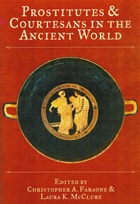
Prostitutes and Courtesans in the Ancient World
Edited by Christopher A. Faraone and Laura K. McClure
University of Wisconsin Press, 2006
Prostitutes and Courtesans in the Ancient World explores the implications of sex-for-pay across a broad span of time, from ancient Mesopotamia to the early Christian period. In ancient times, although they were socially marginal, prostitutes connected with almost every aspect of daily life. They sat in brothels and walked the streets; they paid taxes and set up dedications in religious sanctuaries; they appeared as characters—sometimes admirable, sometimes despicable—on the comic stage and in the law courts; they lived lavishly, consorting with famous poets and politicians; and they participated in otherwise all-male banquets and drinking parties, where they aroused jealousy among their anxious lovers.
The chapters in this volume examine a wide variety of genres and sources, from legal and religious tracts to the genres of lyric poetry, love elegy, and comic drama to the graffiti scrawled on the walls of ancient Pompeii. These essays reflect the variety and vitality of the debates engendered by the last three decades of research by confronting the ambiguous terms for prostitution in ancient languages, the difficulty of distinguishing the prostitute from the woman who is merely promiscuous or adulterous, the question of whether sacred or temple prostitution actually existed in the ancient Near East and Greece, and the political and social implications of literary representations of prostitutes and courtesans.
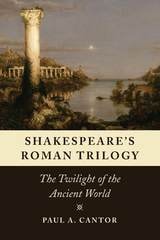
Shakespeare's Roman Trilogy
The Twilight of the Ancient WorldPaul A. Cantor
University of Chicago Press, 2017
Cantor analyzes the way Shakespeare chronicles the rise and fall of the Roman Republic and the emergence of the Roman Empire. The transformation of the ancient city into a cosmopolitan empire marks the end of the era of civic virtue in antiquity, but it also opens up new spiritual possibilities that Shakespeare correlates with the rise of Christianity and thus the first stirrings of the medieval and the modern worlds.
More broadly, Cantor places Shakespeare’s plays in a long tradition of philosophical speculation about Rome, with special emphasis on Machiavelli and Nietzsche, two thinkers who provide important clues on how to read Shakespeare’s works. In a pathbreaking chapter, he undertakes the first systematic comparison of Shakespeare and Nietzsche on Rome, exploring their central point of contention: Did Christianity corrupt the Roman Empire or was the corruption of the Empire the precondition of the rise of Christianity? Bringing Shakespeare into dialogue with other major thinkers about Rome, Shakespeare’s Roman Trilogy reveals the true profundity of the Roman Plays.
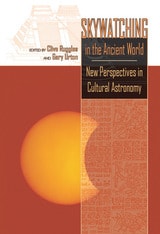
Skywatching in the Ancient World
New Perspectives in Cultural AstronomyClive Ruggles
University Press of Colorado, 2007
This collection's wide range of outstanding scholarship reveals that cultural astronomy has come into its own. The diverse topics addressed by the contributors include the correlation between Colonial Northern Zapotec and Gregorian calendars, the period of use of the Dresden Codex Venus table and the significance of the Lunar Almanacs that precede it, a new interpretation of an Inka tapestry mantle as a commemorative calendar, temple orientations in Hawai'i and church orientations in Medieval England, and the connection in cultural imagery between astronomers (science) and wizards (magic).
Contributors include: Harvey M. Bricker, Victoria R. Bricker, Edward E. Calnek, Clemency Coggins, John Justeson, Edwin C. Krupp, Stephen C. McCluskey, Susan Milbrath, Clive Ruggles, David Tavárez, Barbara Tedlock, Dennis Tedlock, Gary Urton, and R. Tom Zuidema. Mesoamerican Worlds Series
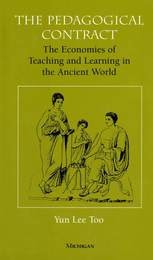
The Pedagogical Contract
The Economies of Teaching and Learning in the Ancient WorldYun Lee Too
University of Michigan Press, 2000