Results by title
6 books match the query 'Angles, Jeffrey'
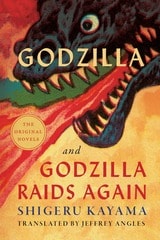
Godzilla and Godzilla Raids Again
Shigeru Kayama
University of Minnesota Press, 2023
The first English translations of the original novellas about the iconic kaijū Godzilla
Godzilla emerged from the sea to devastate Tokyo in the now-classic 1954 film, produced by Tōhō Studios and directed by Ishirō Honda, creating a global sensation and launching one of the world’s most successful movie and media franchises. Awakened and transformed by nuclear weapons testing, Godzilla serves as a terrifying metaphor for humanity’s shortsighted destructiveness: this was the intent of Shigeru Kayama, the science fiction writer who drafted the 1954 original film and its first sequel and, in 1955, published these novellas.
Although the Godzilla films have been analyzed in detail by cultural historians, film scholars, and generations of fans, Kayama’s two Godzilla novellas—both classics of Japanese young-adult science fiction—have never been available in English. This book finally provides English-speaking fans and critics the original texts with these first-ever English-language translations of Godzilla and Godzilla Raids Again. The novellas reveal valuable insights into Kayama’s vision for the Godzilla story, feature plots that differ from the films, and clearly display the author’s strong antinuclear, proenvironmental convictions.
Kayama’s fiction depicts Godzilla as engaging in guerrilla-style warfare against humanity, which has allowed the destruction of the natural world through its irresponsible, immoral perversion of science. As human activity continues to cause mass extinctions and rapid climatic change, Godzilla provides a fable for the Anthropocene, powerfully reminding us that nature will fight back against humanity’s onslaught in unpredictable and devastating ways.
Retail e-book files for this title are screen-reader friendly.
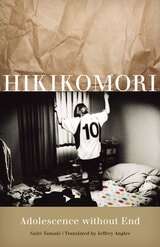
Hikikomori
Adolescence without EndSaito Tamaki
University of Minnesota Press, 2013
This is the first English translation of a controversial Japanese best seller that made the public aware of the social problem of hikikomori, or “withdrawal”—a phenomenon estimated by the author to involve as many as one million Japanese adolescents and young adults who have withdrawn from society, retreating to their rooms for months or years and severing almost all ties to the outside world. Saitō Tamaki’s work of popular psychology provoked a national debate about the causes and extent of the condition.
Since Hikikomori was published in Japan in 1998, the problem of social withdrawal has increasingly been recognized as an international one, and this translation promises to bring much-needed attention to the issue in the English-speaking world. According to the New York Times, “As a hikikomori ages, the odds that he’ll re-enter the world decline. Indeed, some experts predict that most hikikomori who are withdrawn for a year or more may never fully recover. That means that even if they emerge from their rooms, they either won’t get a full-time job or won’t be involved in a long-term relationship. And some will never leave home. In many cases, their parents are now approaching retirement, and once they die, the fate of the shut-ins—whose social and work skills, if they ever existed, will have atrophied—is an open question.”
Drawing on his own clinical experience with hikikomori patients, Saitō creates a working definition of social withdrawal and explains its development. He argues that hikikomori sufferers manifest a specific, interconnected series of symptoms that do not fit neatly with any single, easily identifiable mental condition, such as depression.
Rejecting the tendency to moralize or pathologize, Saitō sensitively describes how families and caregivers can support individuals in withdrawal and help them take steps toward recovery. At the same time, his perspective sparked contention over the contributions of cultural characteristics—including family structure, the education system, and gender relations—to the problem of social withdrawal in Japan and abroad.
The Book of the Dead
Orikuchi Shinobu
University of Minnesota Press, 2017
First published in 1939 and extensively revised in 1943, The Book of the Dead, loosely inspired by the tale of Isis and Osiris from ancient Egypt, is a sweeping historical romance that tells a gothic tale of love between a noblewoman and a ghost in eighth-century Japan. Its author, Orikuchi Shinobu, was a well-received novelist, distinguished poet, and an esteemed scholar. He is often considered one of the fathers of Japanese folklore studies, and The Book of the Dead is without a doubt the most important novel of Orikuchi’s career—and it is a book like no other.
Here, for the first time, is the complete English translation of Orikuchi’s masterwork, whose vast influence is evidenced by multiple critical studies dedicated to it and by its many adaptations, which include an animated film and a popular manga. This translation features an introduction by award-winning translator Jeffrey Angles discussing the historical background of the work as well as its major themes: the ancient origins of the Japanese nation, the development of religion in a modernizing society, and the devotion necessary to create a masterpiece. Also included are three chapters from The Mandala of Light by Japanese intellectual historian Andō Reiji, who places the novel and Orikuchi’s thought in the broader intellectual context of early twentieth-century Japan.
The Book of the Dead focuses on the power of faith and religious devotion, and can be read as a parable illustrating the suffering an artist must experience to create great art. Readers will soon discover that a great deal lies hidden beneath the surface of the story; the entire text is a modernist mystery waiting to be decoded.
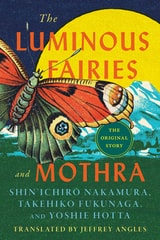
The Luminous Fairies and Mothra
Takehiko Fukunaga
University of Minnesota Press, 2026
The original story that hatched Mothra, one of the most beloved monsters in the “kaijuverse”—available in English for the first time
Mystical and benevolent, the colossal lepidopteran Mothra has been one of the most beloved kaiju since 1961, when The Luminous Fairies and Mothra was originally published in Japanese. Commissioned by Tōhō Studios from three of Japan’s most prominent postwar literary writers (Shin’ichirō Nakamura, Takehiko Fukunaga, and Yoshie Hotta), the novella formed the basis for the now-classic monster film Mothra, with a protagonist second only to Godzilla in number of film appearances by a kaiju. Finally available in its first official English translation, The Luminous Fairies and Mothra will captivate ardent, longtime fans of the films as well as newcomers.
Written just months after the largest political demonstrations Japan had ever seen, The Luminous Fairies and Mothra reflects the rebellious spirit of the time. In this original story, explorers visit a South Pacific island and capture a group of fairies, inciting the fury of the goddess Mothra, who sets out for Japan on a mission of rescue and revenge. Expressing a powerful social stance about Japan’s need to chart its own foreign policy during the Cold War, the novella’s political message was ultimately toned down in the Tōhō Studios film. Through this translation, Anglophone audiences will discover Mothra as a figure of protest fiction intricately reflecting the complex geopolitical situation in early 1960s Japan.
The Luminous Fairies and Mothra is translated into lively prose by Jeffrey Angles, who also wrote an extensive afterword about the novella’s cultural context, the unusual story of its composition, and the development of the 1961 film. Following Angles’s best-selling translation of the original Godzilla novellas, this new work will once again delight kaiju fans everywhere.
Retail e-book files for this title are screen-reader friendly with images accompanied by short alt text and/or extended descriptions.

Twelve Views from the Distance
Mutsuo Takahashi
University of Minnesota Press, 2012
From one of the foremost poets in contemporary Japan comes this entrancing memoir that traces a boy’s childhood and its intersection with the rise of the Japanese empire and World War II. Originally published in 1970, this translation is the first available in English.
In twelve chapters that visit and revisit critical points in his boyhood, Twelve Views from the Distance presents a vanished time and place through the eyes of an accomplished poet. Recounting memories from his youth, Mutsuo Takahashi captures the full range of his internal life as a boy, shifting between his experiences and descriptions of childhood friendships, games, songs, and school. With great candor, he also discusses the budding awareness of his sexual preference for men, providing a rich exploration of one man’s early queer life in a place where modern, Western-influenced models of gay identity were still unknown.
Growing up poor in rural southwestern Japan, far from the urban life that many of his contemporaries have written about, Takahashi experienced a reality rarely portrayed in literature. In addition to his personal remembrances, the book paints a vivid portrait of rural Japan, full of oral tradition, superstition, and remnants of customs that have quickly disappeared in postwar Japan. With profuse local color and detail, he re-creates the lost world that was the setting for his beginnings as a gay man and poet.

Writing the Love of Boys
Origins of Bishonen Culture in Modernist Japanese LiteratureJeffrey Angles
University of Minnesota Press, 2010
Jeffrey Angles focuses on key writers, examining how they experimented with new language, genres, and ideas to find fresh ways to represent love and desire between men. He traces the personal and literary relationships between contemporaries such as the poet Murayama Kaita, the mystery writers Edogawa Ranpo and Hamao Shiro, the anthropologist Iwata Jun’ichi, and the avant-garde innovator Inagaki Taruho.
Writing the Love of Boys shows how these authors interjected the subject of male–male desire into discussions of modern art, aesthetics, and perversity. It also explores the impact of their efforts on contemporary Japanese culture, including the development of the tropes of male homoeroticism that recur so often in Japanese girls’ manga about bishonen love.