Results by title
13 books match the query 'Angola'
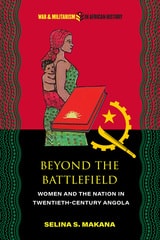
Beyond the Battlefield
Women and the Nation in Twentieth-Century AngolaSelina S. Makana
Ohio University Press, 0
Beyond the Battlefield offers a critical reappraisal of Angola’s nationalist history by centering the experiences and political agency of women during the country’s transition from Portuguese colonial rule to independence. Challenging dominant masculinist narratives that equate anticolonial resistance with armed combat, this study introduces maternalist nationalism as a theoretical framework to illuminate how women engaged in nation building through often-overlooked forms of labor and activism.
While men were largely visible on the battlefield, women fought a parallel struggle on the home front—mobilizing care work, reproductive labor, and political engagement in ways that were essential to the liberation movement and the postindependence state. Drawing on archival sources and women’s testimonies, Makana explores how patriotic motherhood—a concept defined as the fusion of nationalist politics with gendered expectations of women’s roles—enabled women to see themselves as vital contributors to the nation’s future.
This study contributes to scholarship in African history, gender studies, and postcolonial theory by offering a nuanced account of the intersections among militarism, nationalism, and gender. It invites readers to reconsider the frameworks through which political subjectivity and historical memory are constructed. Beyond the Battlefield is an essential resource for scholars and students interested in the gendered dimensions of colonialism, war, and state formation in modern Africa.
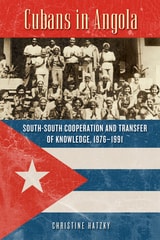
Cubans in Angola
South-South Cooperation and Transfer of Knowledge, 1976–1991Christine Hatzky
University of Wisconsin Press, 2015
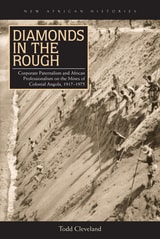
Diamonds in the Rough
Corporate Paternalism and African Professionalism on the Mines of Colonial Angola, 1917–1975Todd Cleveland
Ohio University Press, 2015
Diamonds in the Rough explores the lives of African laborers on Angola’s diamond mines from the commencement of operations in 1917 to the colony’s independence from Portugal in 1975. The mines were owned and operated by the Diamond Company of Angola, or Diamang, which enjoyed exclusive mining and labor concessions granted by the colonial government. Through these monopolies, the company became the most profitable enterprise in Portugal’s African empire. After a tumultuous initial period, the company’s mines and mining encampments experienced a remarkable degree of stability, in striking contrast to the labor unrest and ethnic conflicts that flared in other regions. Even during the Angolan war for independence (1961–75), Diamang’s zone of influence remained comparatively untroubled.
Todd Cleveland explains that this unparalleled level of quietude was a product of three factors: African workers’ high levels of social and occupational commitment, or “professionalism”; the extreme isolation of the mining installations; and efforts by Diamang to attract and retain scarce laborers through a calculated paternalism. The company’s offer of decent accommodations and recreational activities, as well as the presence of women and children, induced reciprocal behavior on the part of the miners, a professionalism that pervaded both the social and the workplace environments. This disparity between the harshness of the colonial labor regime elsewhere and the relatively agreeable conditions and attendant professionalism of employees at Diamang opens up new ways of thinking about how Africans in colonial contexts engaged with forced labor, mining capital, and ultimately, each other.
Empire in Africa
Angola and Its NeighborsDavid Birmingham
Ohio University Press, 2006
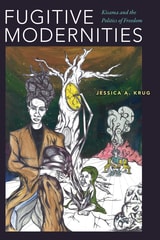
Fugitive Modernities
Kisama and the Politics of FreedomJessica A. Krug
Duke University Press, 2018
Implementing Inequality
The Invisible Labor of International DevelopmentRebecca Warne Peters
Rutgers University Press, 2020
In the Skin of the City
Spatial Transformation in LuandaAntónio Tomás
Duke University Press, 2022
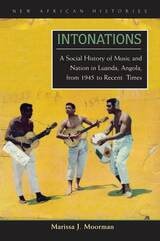
Intonations
A Social History of Music and Nation in Luanda, Angola, from 1945 to Recent TimesMarissa J. Moorman
Ohio University Press, 2008
Intonations tells the story of how Angola’s urban residents in the late colonial period (roughly 1945–74) used music to talk back to their colonial oppressors and, more importantly, to define what it meant to be Angolan and what they hoped to gain from independence. A compilation of Angolan music is included in CD format.
Marissa J. Moorman presents a social and cultural history of the relationship between Angolan culture and politics. She argues that it was in and through popular urban music, produced mainly in the musseques (urban shantytowns) of the capital city, Luanda, that Angolans forged the nation and developed expectations about nationalism. Through careful archival work and extensive interviews with musicians and those who attended performances in bars, community centers, and cinemas, Moorman explores the ways in which the urban poor imagined the nation.
The spread of radio technology and the establishment of a recording industry in the early 1970s reterritorialized an urban-produced sound and cultural ethos by transporting music throughout the country. When the formerly exiled independent movements returned to Angola in 1975, they found a population receptive to their nationalist message but with different expectations about the promises of independence. In producing and consuming music, Angolans formed a new image of independence and nationalist politics.
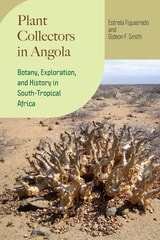
Plant Collectors in Angola
Botany, Exploration, and History in South-Tropical AfricaEstrela Figueiredo and Gideon F. Smith
University of Chicago Press, 2024
For any region, cataloging, interpreting, and understanding the history of botanical exploration and plant collecting, and the preserved specimens that were amassed as a result, are critically important for research and conservation. In this book, published in cooperation with the International Association for Plant Taxonomy, Estrela Figueiredo and Gideon F. Smith, both botanists with expertise in the taxonomy of African plants, provide the first comprehensive, contextualized account of plant collecting in Angola, a large country in south-tropical Africa. An essential book for anyone concerned with the biodiversity and history of Africa, this authoritative work offers insights into the lives, times, and endeavors of 358 collectors. In addition, the authors present analyses of the records that accompanied the collectors’ preserved specimens. Illustrated in color throughout, the book fills a large gap in the current knowledge of the botanical and exploration history of Africa.

Powerful Frequencies
Radio, State Power, and the Cold War in Angola, 1931–2002Marissa J. Moorman
Ohio University Press, 2019
Powerful Frequencies details the central role that radio technology and broadcasting played in the formation of colonial Portuguese Southern Africa and the postcolonial nation-state, Angola. In Intonations, Marissa J. Moorman examined the crucial relationship between music and Angolan independence during the 1960s and ’70s. Now, Moorman turns to the history of Angolan radio as an instrument for Portuguese settlers, the colonial state, African nationalists, and the postcolonial state. They all used radio to project power, while the latter employed it to challenge empire.
From the 1930s introduction of radio by settlers, to the clandestine broadcasts of guerrilla groups, to radio’s use in the Portuguese counterinsurgency strategy during the Cold War era and in developing the independent state’s national and regional voice, Powerful Frequencies narrates a history of canny listeners, committed professionals, and dissenting political movements. All of these employed radio’s peculiarities—invisibility, ephemerality, and its material effects—to transgress social, political, “physical,” and intellectual borders. Powerful Frequencies follows radio’s traces in film, literature, and music to illustrate how the technology’s sonic power—even when it made some listeners anxious and frightened—created and transformed the late colonial and independent Angolan soundscape.
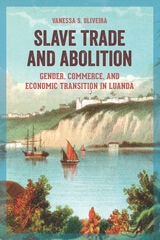
Slave Trade and Abolition
Gender, Commerce, and Economic Transition in LuandaVanessa S. Oliveira
University of Wisconsin Press, 2022
Vanessa S. Oliveira traces how existing commercial networks adapted to changes in the Atlantic slave trade during the first half of the nineteenth century. Slave Trade and Abolition reveals how women known as donas (a term adapted from the title granted to noble and royal women in the Iberian Peninsula) were often important cultural brokers. Acting as intermediaries between foreign and local people, they held high socioeconomic status and even competed with the male merchants who controlled the trade. Oliveira provides rich evidence to explore the many ways this Luso-African community influenced its society. In doing so, she reveals an unexpectedly nuanced economy with regard to the dynamics of gender and authority.
The Normality of Civil War
Armed Groups and Everyday Life in AngolaTeresa Koloma Beck
Campus Verlag, 2012
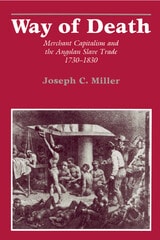
Way of Death
Merchant Capitalism and the Angolan Slave Trade, 1730–1830Joseph Calder Miller
University of Wisconsin Press, 1996
This acclaimed history of Portuguese and Brazilian slaving in the southern Atlantic is now available in paperback.
With extraordinary skill, Joseph C. Miller explores the complex relationships among the separate economies of Africa, Europe, and the South Atlantic that collectively supported the slave trade. He places the grim history of the trade itself within the context of the rise of merchant capitalism in the eighteenth century. Throughout, Miller illuminates the experiences of the slaves themselves, reconstructing what can be known of their sufferings at the hands of their buyers and sellers.