Results by title
7 books match the query 'Animal communication'
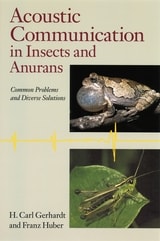
Acoustic Communication in Insects and Anurans
Common Problems and Diverse SolutionsH. Carl Gerhardt and Franz Huber
University of Chicago Press, 2002
H. Carl Gerhardt and Franz Huber address these questions among many others, drawing on research from bioacoustics, behavior, neurobiology, and evolutionary biology to present the first integrated approach to the study of acoustic communication in insects and anurans. They highlight both the common solutions that these very different groups have evolved to shared challenges, such as small size, ectothermy (cold-bloodedness), and noisy environments, as well as the divergences that reflect the many differences in evolutionary history between the groups. Throughout the book Gerhardt and Huber also provide helpful suggestions for future research.
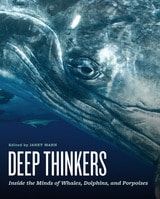
Deep Thinkers
Inside the Minds of Whales, Dolphins, and PorpoisesEdited by Janet Mann
University of Chicago Press, 2017
Diving into our current understanding of and dynamic research on dolphin and whale cognition, communication, and culture, Deep Thinkers reveals how incredibly sophisticated these mammals are—and how much we can learn about other animal minds by studying cetacean behavior. Through a combination of fascinating text and more than 150 beautiful and informative illustrations, chapters compare the intelligence markers of cetaceans with those of birds, bats, and primates, asking how we might properly define intelligence in nonhumans. As all-encompassing and profound as the seas in which these deep cetacean cultures have evolved, Deep Thinkers is an awesome and inspiring journey into the fathoms—a reminder of what we gain through their close study, and of what we lose when the great minds of the sea disappear.
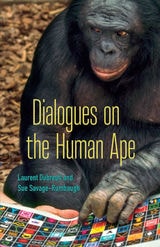
Dialogues on the Human Ape
Laurent Dubreuil
University of Minnesota Press, 2018
A primatologist and a humanist together explore the meaning of being a “human animal”
Humanness is typically defined by our capacity for language and abstract thinking. Yet decades of research led by the primatologist Sue Savage-Rumbaugh has shown that chimpanzees and bonobos can acquire human language through signing and technology.
Drawing on this research, Dialogues of the Human Ape brings Savage-Rumbaugh into conversation with the philosopher Laurent Dubreuil to explore the theoretical and practical dimensions of what being a “human animal” means. In their use of dialogue as the primary mode of philosophical and scientific inquiry, the authors transcend the rigidity of scientific and humanist discourses, offering a powerful model for the dissemination of speculative hypotheses and open-ended debates grounded in scientific research.
Arguing that being human is an epigenetically driven process rather than a fixed characteristic rooted in genetics or culture, this book suggests that while humanness may not be possible in every species, it can emerge in certain supposedly nonhuman species. Moving beyond irrational critiques of ape consciousness that are motivated by arrogant, anthropocentric views, Dialogues on the Human Ape instead takes seriously the continuities between the ape mind and the human mind, addressing why language matters to consciousness, free will, and the formation of the “human animal” self.
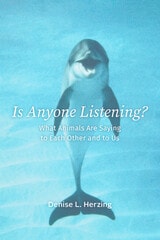
Is Anyone Listening?
What Animals Are Saying to Each Other and to UsDenise L. Herzing
University of Chicago Press, 2024
If you could pose one question to a dolphin, what would it be? And what might a dolphin ask you? For forty years, researcher and author Denise L. Herzing has investigated these and related questions of marine mammal communication. With the assistance of a friendly community of Atlantic spotted dolphins in the Bahamas, Herzing studies two-way communication between different dolphin species and between humans and dolphins using a variety of cutting-edge experiments. But the dolphins are not the only ones talking, and in this wide-ranging and accessible book, Herzing explores the astonishing realities of interspecies communication, a skill that humans currently lack.
Is Anyone Listening? connects research on dolphin communication to findings from Jane Goodall on chimpanzees, Dian Fossey on mountain gorillas, Cynthia Moss on African elephants, and others driving today’s exploration of possible animal languages. Although humans have long attempted to crack animal communication codes, only now do we have the advanced machine-learning tools to help. As Herzing reveals, researchers are finding fascinating hints of language in nonhuman species, including linguistic structures, vowel equivalents, and complex repeated sequences. By looking at the many ways animals use and manipulate signals, we see that we’ve only just begun to appreciate the diversity of animal intelligence and the complicated and subtle aspects of animal communication.
Considering dolphins and other nonhuman animals as colleagues instead of research subjects, Herzing asks us to meet animals as both speakers and listeners, as mutually curious beings, and to listen to what they are saying.
Listening to Beauty
Rhetorics of Science in Sea and SoundMegan Poole
University of Chicago Press, 2025
Our attempts to understand the world are always more than simply rational. Our bodies learn through lived experience, our natural environments challenge what we think we know, and we take lessons from our nonhuman kin. Even scientists, often considered paragons of rationality, frequently describe their findings in the language of beauty. For rhetorician Megan Poole, beauty is integral to how scientific research works.
Drawing on interviews with leading biologists, Poole explores what happens when scientists set aside objectivity and listen for beauty around them. The wonder we feel at the plumage of birds, the melodies of whales, or the caretaking of elephants may not help us (on its own) to isolate a given fact, but such encounters may teach us to open ourselves to a different way of knowing entirely. Through stories about researchers’ encounters with wonder, Listening to Beauty reveals how scientific discovery happens sometimes unsystematically, sometimes incoherently, often beautifully.
The Cultural Lives of Whales and Dolphins
Hal Whitehead and Luke Rendell
University of Chicago Press, 2014
Unequivocally: yes. In The Cultural Lives of Whales and Dolphins, cetacean biologists Hal Whitehead, who has spent much of his life on the ocean trying to understand whales, and Luke Rendell, whose research focuses on the evolution of social learning, open an astounding porthole onto the fascinating culture beneath the waves. As Whitehead and Rendell show, cetacean culture and its transmission are shaped by a blend of adaptations, innate sociality, and the unique environment in which whales and dolphins live: a watery world in which a hundred-and-fifty-ton blue whale can move with utter grace, and where the vertical expanse is as vital, and almost as vast, as the horizontal.
Drawing on their own research as well as a scientific literature as immense as the sea—including evolutionary biology, animal behavior, ecology, anthropology, psychology, and neuroscience—Whitehead and Rendell dive into realms both humbling and enlightening as they seek to define what cetacean culture is, why it exists, and what it means for the future of whales and dolphins. And, ultimately, what it means for our future, as well.
The Simian Tongue
The Long Debate about Animal LanguageGregory Radick
University of Chicago Press, 2007